

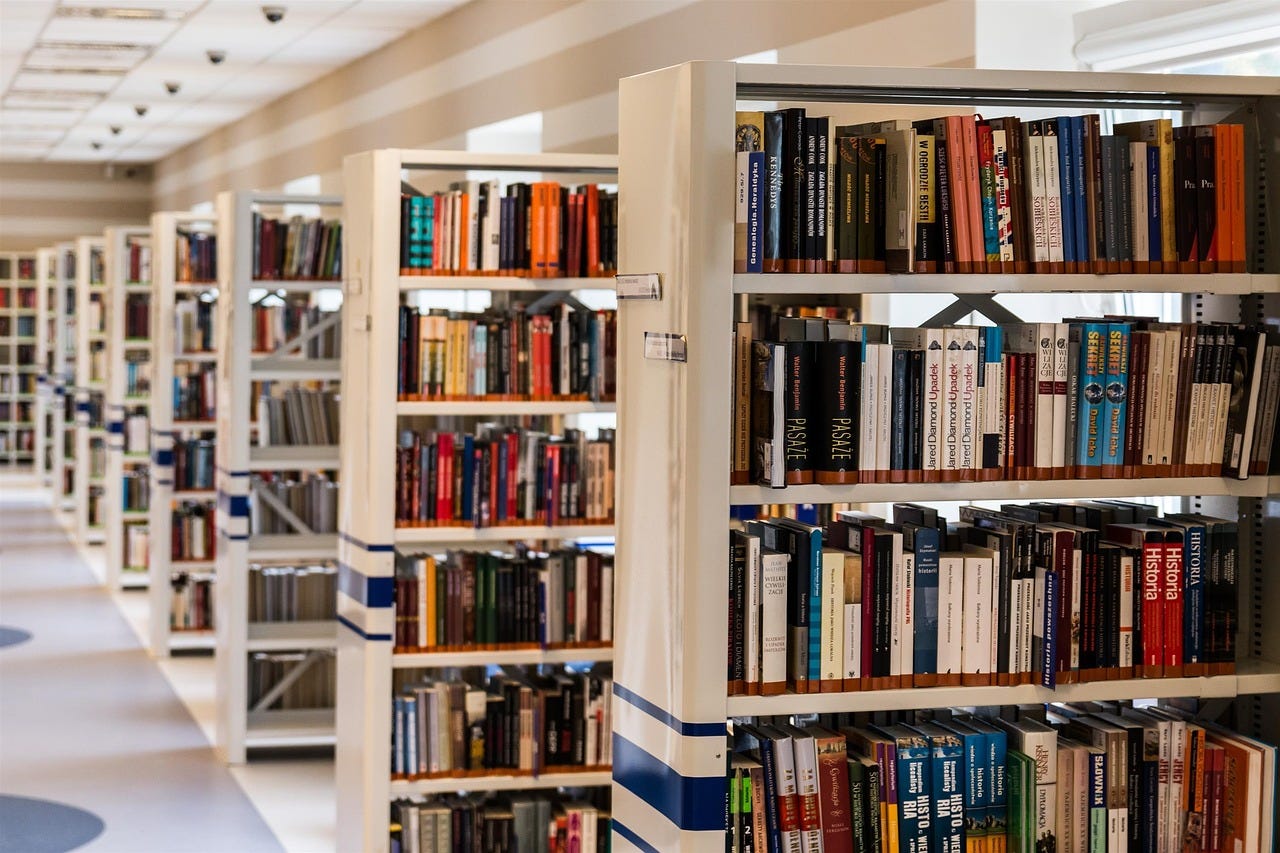
If you, like me, are a resident of the United States and visit your local library frequently, you will have noticed that every year your library will do some sort of observance of the American Library Association’s “Banned Books Week”. Likely there will be a display of “banned books” in the library and on its social media. Obviously, the books are not actually banned, since they are on display at your local library. So the point of the exercise seems to be to convey the following message:
What a lucky person, you, our patron, are! You live in a place where everyone, librarians especially, are dedicated warriors in the great ongoing battle against the vile spectre of censorship. Hurray for us (librarians and all other good people) and hurray for you!
Sadly, none of this is true.
When I was a child, it never occurred to me that political biases might determine a library’s purchasing choices. Even as an adult I did not worry much about this, since I assumed that even if there was some bias, it probably would not restrict my reading choices. Having served several years as a library trustee in Massachusetts during the great derangements of the COVID shutdown and ensuing years, I have realized that I was wrong to be complacent. There is so much to be concerned about.
I began writing about this problem more than two years ago, on Substack and for my local online newspaper. One of my articles demonstrated bias in public library collections. I’ve examined library-related legislation in Massachusetts and reported on an incident where library staff were bullied into cancelling a proposed talk at a Massachusetts library. In a previous article for FAIR I examined the dilatory response of public libraries to the suddenly increased demand for Charlie Kirk’s then most recently published book in the weeks after his murder.
And that’s just me! Many others have tried to address the censorship problems, by many means. In contrast to the ALA (American Library Association), the ALP (Association of Library Professionals) takes a clear and unambiguous stance on library neutrality. Others have contributed by examining and challenging the beliefs that undergird this problem of library censorship. An organization in Salado, TX has posted an excellent article about the bias in the entire book selection process of public libraries. A Canadian librarian has examined the extreme bias that public libraries display in their collections in support of gender identity ideology. There are many more examples.
I have also taken action beyond simply examining, documenting, challenging, and reporting: I launched the “Make Every Week Freedom to Read Week” project in October 2024. This project’s goal is to identify books that are not in public library collections but would be if libraries better represented their communities, and to change that situation by purchase requests, repeated as necessary. Last year, I documented the successes and failures of that effort in another Substack article. The project is turning two years old this month. I think every community could use a “Make Every Week Freedom to Read Week” project.
This year, FAIR in Libraries is ready to help make that vision a reality by collecting instances where a library excluded a book from its collection via its Incident Reporting page. We ask that you report instances where a public library has resisted clearly expressed community demand in its purchase decisions.
FAIR in Libraries welcomes incident reports from anywhere in North America. Different regions run their library systems in different ways, so library bias can be made evident in a number of different ways. The digital collections that a library may offer vary; I am familiar with Hoopla Digital and Overdrive/Libby. Here are the mechanisms that I have observed in Massachusetts:
A library may simply refuse to purchase a physical item even when a library patron has requested it, or may simply ignore a patron’s request. (Some libraries do not have purchase request forms on their websites, in that case, an email to the director is the way to make the purchase request.)
With Overdrive/Libby the situation is much the same as with physical books in terms of how purchasing is done. Libraries buy (or rent) a specific book from the Overdrive/Libby collection. You can request specifically an Overdrive/Libby copy. In this modern age, some people prefer to read books or listen to audio via a digital service rather than make use of a physical copy, so it is probably correct to view a digital copy as having equal stature with a physical copy. The responsibility for having made the purchase of a particular book is more diffuse with a digital service like Overdrive/Libby and so, where the book is controversial, a library may prefer an Overdrive/Libby purchase. Further, if an item is purchased for its Overdrive/Libby collection by any public library in any of several Massachusetts library consortia, that item becomes available to any patron in any of those consortia, via a sharing arrangement among the consortia. To request an item via Overdrive/Libby you should do the same as with a physical item, and, of course, your request may be ignored or refused. However, the Libby App offers a Notify Me service via its smart tagging system, so, if an item you requested is purchased, you will be notified immediately via the Libby app if you use that.
With Hoopla Digital, the situation is different again. Hoopla offers its whole catalog to every library that uses its service. The catalogs are not shared among libraries. In recent years, Hoopla has given individual libraries the ability to exclude items in the Hoopla catalog. The default search via the Hoopla app shows only what the library allows you to check out. In the app, you can change the selection from “All Titles in Catalog” to “All hoopla Titles” and you will generally see more items. If you see an item only when you select “All hoopla Titles” then your library has excluded that item according to some rubric of its own. To request an item via Hoopla Digital you should do the same as for a physical item. Hoopla has a “Requests” feature, but there is no reason to believe that libraries monitor your Hoopla Requests. Of course, the library may refuse to unblock the item or ignore your request.
When reporting an incident where a library has refused to purchase, or in the case of Hoopla Digital, unblock an item, it is important to document everything as fully as possible. Most book request facilities are a simple web form; you may not receive any record of your request to keep for your records. So it is important when requesting an item to make a visual record of your request. Modern web browsers generally have good facilities for taking screenshots of your browser window and mobile devices have good facilities for taking screenshots of your whole screen. Save that image in an easy to find place, like a separate, clearly named folder, so you can use it to follow up with your library and if you report an incident to FAIR.
When you are ready to report an incident, use FAIR’s incident reporting portal, making sure to select “Public Library” for the “Type of Institution”. Your “Relationship to Institution” is most likely “patron”. Upload all supporting documents that you have available, including the shot of your original request, with dates. Make sure to include a screenshot demonstrating that for you, a patron, the book is unavailable and does not show up in your search results. This is absolutely essential evidence for requests for digital items, as it is usually impossible for anyone who has not logged in as a patron to see what selection a library is presenting to its patrons.
FAIR in Libraries looks forward to your submissions and thanks you for your contribution to making our public libraries fair for all.
We welcome you to share your thoughts on this piece in the comments below. Click here to view our comment section moderation policy.
The opinions expressed here do not necessarily reflect those of Fair For All or its employees.
In keeping with our mission to promote a common culture of fairness, understanding, and humanity, we are committed to including a diverse range of voices and to encouraging compassionate, good-faith discourse.
We are actively seeking perspectives on this topic and others. If you’d like to join the conversation, please send completed drafts to submissions@fairforall.org.

There are some great recent interviews on Informed Dissent about librairies, with an interest in gender medicine, which discusses many aspects of this, also!
https://informeddissentpodcast.substack.com/p/overdue-libraries-and-the-gender
https://informeddissentpodcast.substack.com/p/overdue-libraries-and-the-gender-88a
https://informeddissentpodcast.substack.com/p/overdue-finding-library-neutrality