

A new Politico report on what Americans think of our lives and country was released this week, and the results are bleak. Forty-six percent of respondents agreed with the statement that “The American dream no longer exists,” compared with just 26 percent who disagreed. Forty-nine percent agreed with the sentiment that our best times as a country are behind us, compared to just 41 percent who said they are yet to come. Fifty-two percent of respondents are so unhappy with the state of our nation that they agree with the statement, “To make life better in America we need radical change.”
And it’s not Democrats who feel disaffected under the current administration. Forty-six percent of Trump supporters agreed that our country needs radical change.
In short, most of us are pessimistic and unhappy about our country’s prospects.
Why do we feel this way? One cause that’s often discussed, and that the report goes into (to be fair, the report also goes into other possible causes) is economic. Politico quotes political scientist Jennifer McCoy, who says:
“[Y]oung people especially ... are feeling that, feeling that they can’t buy a house, they can’t afford to have children, they still have student debt, all of these things.”
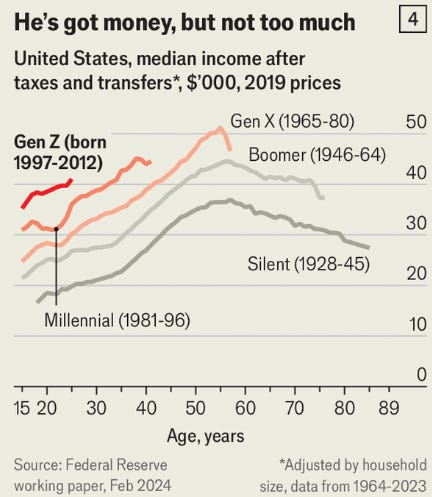
This explanation sounds superficially appealing, but I’m not convinced that economic concerns are driving our societal pessimism. For one thing, hard numbers show that Generation Z (who the survey found to be most pessimistic about the state of our country) are the wealthiest generation in human history. A report by The Economist shows that, even adjusting for inflation, Gen Z out-earns members of every previous generation.
For another, social science shows that money isn’t what makes us happy. A study published in The Journal of Socio-Economics analyzed 10,000 people over 18 years to determine which factors contributed the most to human happiness. The authors’ answer? Not money. The authors note that: “Income only plays a small part in influencing our well-being.” In fact, you would need to earn an extra $150,000 per year in order to receive as much additional happiness as you would from having just one additional close friend.
As a freelance writer, I’ve had my share of financially difficult years, and I’m not discounting the impact of poverty on folks’ well-being. But all the same, if we see happiness as a pie, then money seems to account for only a small slice.
So if a struggling economy isn’t behind our malaise as a country, then what is? I think the answer is that our society is broken in more foundational ways. One of these ways which isn’t discussed enough is that our society is structured such that most of us struggle to experience beauty in our day-to-day lives.
Philosophers throughout history have recognized the importance of beauty when it comes to living the good life. Ancient philosophers described the good life (kalokagathia) as a fusion of what was good (agathon) and what was beautiful (kalon).
One benefit of introducing more beauty into our lives, as philosopher Claus Dierksmeier points out, is that beauty gets us out of our own heads. Dierksmeier notes that the act of trying to create something beautiful frees us from our “self-centered perspective” in pursuit of an ideal. I would argue that the same is true of experiencing beauty: when we’re on top of a mountain or listening to a transcendent piece of music, our petty fears and anxieties can fade away for a moment. We become less self-obsessed, which is to say less focused on our own pain, and when we shift our perspective outwards we find that our pain becomes less dominant.
Another benefit of introducing more beauty into our lives is that there’s something about beauty that helps us to live higher and more esteemed lives. Beauty gets us closer to the sacred, however we define that. Dierksmeier notes that modern philosophers consider beauty to be “a conduit to the deeper meaning and destination of life” and a key way “to realize one’s true human potential.” He writes that:
“The coincidence of opposites that the beautiful accomplishes—the harmonious fusion of disparate elements such as order and irregularity in the beautiful object, the merger of toil and pleasure in the producer, the combination of concentration and relaxation in the beholder, and so on—are still seen as betokening something special (a grace, a faculty for bestowing life, starting afresh, creating something novel, combined with a spirit of elevation/generosity/superabundance or supererogatory giving) that enables human life to transcend itself and its animal nature.”
The final benefit of beauty is that it can help us to cope with modern life.
Whatever good may be said of modern life, most people agree that it’s exhausting. Our to-do lists are a mile long. Technology makes it easy to tackle each individual task (for instance, I can schedule an oil change for my car with a few clicks of a mouse), but there are also an inordinate number of tasks. Burnout and fatigue are some of the hallmarks of modern society: most of us feel exhausted, and at the same time we feel—like Sishyphus—that there’s still an infinite amount that needs doing.
Some of the most common phrases in modern life are “I need to do XYZ” and “I should really do XYZ,” both of which suggest that the speaker has far more on their plate than they seem able to actually accomplish.
Faced with that, experiencing beauty can provide a balm. As Dierksmeier notes, experiencing beauty is “reinvigorating” and even “soul-saving.” When we spend a day in a beautiful forest, it can replenish our energy levels and provide rest to our weary souls. When we make experiencing beauty a daily part of our lives, we can find that it offers a sort of spiritual rest: we don’t feel as burned out and fatigued as we once did.
The problem is that modern society often leaves us parched for beauty.
For one thing, while wonderful art is still being made, AI slop is starting to drown out the type of human-created beauty that can restore our souls. A recent analysis found that half of all English-language articles are written by AI, and another analysis found that half of long-form LinkedIn posts are AI-generated. AI slop is getting turned into books, too; Amazon has had to limit people to posting a maximum of three books per day in part to limit the spread of slop.
The spread of slop can seem inevitable when AI tools can generate 100,000 words with the click of a button: Mike Todasco reveals that his AI alter ego has published 17 books “of mostly unreadable slop” on Amazon in the past three years (including a new one appropriately titled This Is Slop!), all in less time than it takes some of the great authors to produce a single novel. It can feel hard to escape the spread of AI slop for another reason too: social media algorithms actually boost AI-generated content, ensuring that we see more of it.
Even a lot of human-generated content is hardly artistic. We’re in the age of the influencer, and a lot of the most popular videos on Instagram and TikTok are simply next-gen reality TV: influencers mining their conflict and intimate moments in order to offer us brief amusement. As Gen Z author Freya India writes of her generation: “We are now turning our lives into mindless entertainment.”
It can also feel like we have fewer media for experiencing truly transcendent art, too. 2025 has seen the release of some incredible movies, but the theaters that let us truly experience these films are dying. During the pandemic, box office sales cratered, and they never quite recovered even after the pandemic ended: Variety reports that “Ticket sales in 2024 fell to $8.7 billion, a 23.5% drop from pre-pandemic levels.” When I go to the theater these days, I consider it a big showing if I see more than four or five other people in the seats.
Of course, there’s nothing wrong with watching movies at home. But the best films are masterpieces of art and sound; watching Guillermo del Toro’s new visually stunning Frankenstein, or hearing the haunting warbling of Bruce Springsteen in Springsteen: Deliver Me From Nowhere, is simply a more transcendent experience when we’re engaging with these films on the silver screen than when we’re squinting at the same films on our phones. The decline of theaters and the rise of streaming may have all sorts of upsides, but it’s hard not to also see this trend as the decline of a traditional way to experience beauty.
Throughout history, one of the most reliable ways to experience beauty was by immersing ourselves in nature. There’s something about a pristine forest glade or a raging river that speaks deeply to our souls. But as more and more of us choose to live in cities, experiencing nature can feel harder and harder. We’ve traded craggy mountains for concrete jungles, ancient forests for the perfectly manicured front lawns of suburbia, and I’m not sure the trade has been worth it. For many of us living in the heart of the city, even getting to nature can require an all-day excursion.
It’s probably not a coincidence that the deepest sense of malaise in Politico’s report is experienced among young people. Sixty-four percent of respondents aged 18 to 24 said that “To make life better in America we need radical change,” and those numbers go down for each successive age group. Generation Z is known as the terminally online generation. It’s not just that these young men and women spend less time outside than members of previous generations, which means they’re less likely to experience the transcendent beauty of nature. They’re also much more distracted than previous generations (19 percent say they’re on YouTube “almost constantly”), and it’s hard to experience beauty on anything deeper than the surface level when we’re constantly distracted.
So if experiencing beauty is an essential part of living the good life, and if our society is set up to discourage us from experiencing beauty, what can we do about the problem?
The good news is that we don’t have to transform society. Instead, our experience of the world is in our hands. Modern society may make it harder, but we can absolutely still fill our lives with the kinds of transcendent beauty that rejuvenates our souls and that buffers us against the aches and pains of modern life.
For one thing: no matter how bad the ratio of slop to beauty gets, true art will still keep being made, and that means that we can seek it out. All that’s required is for us to be conscious about the media that we consume. We should avoid watching slop or soulless content just as background noise or to fill the empty space. Instead, we should think deliberately about what we put into our souls. If we watch a film or a TV show, it should be because we find what we’re watching enriching and rejuvenating on a soul-deep level. If we listen to a song, it should be with an ear towards deeply appreciating what we’re hearing. Art should be an experience that we cherish, not simply background static.
Another solution is for us to spend more time in nature. Carve out a Saturday to go hiking through an old forest. Get up half an hour early so that you can sit outside and watch the sun rise. Spend less time online, and cultivate more outdoor hobbies; spend less time looking at pictures of the world on your phone, and more time planning excursions to see those same sights in breathtaking person.
Finally, we can spend more time consciously unplugged. A lot of us live lives of endless distraction: keeping one eye on our phones when we’re eating or working or even hanging out with friends. But these distractions stop us from experiencing the sheer magnificence of the world. When we are fully present, we can find in almost any moment something radiant and wonderful. The soft interplay of light coming in through our windows. The crunch of gravel underfoot. The crisp bite of an apple, and feeling the juices and the sweetness explode in our mouths. The world is a beautiful place, if we’re willing to let go of our electronic distractions long enough to see it.
To be clear, seeking to experience more beauty in our lives is unlikely to be the silver bullet that will fix our society. Our social problems are deep and complex, and there is no single solution. But we were made to live lives in which we bask in the transcendent beauty of the world, and consciously choosing to do more of that might do more to cure our malaise than we expect.
Text FAIRFORALL to 707070 to donate to FAIR’s 250 for 250 Campaign.
We welcome you to share your thoughts on this piece in the comments below. Click here to view our comment section moderation policy.
The opinions expressed here do not necessarily reflect those of the Fair For All or its employees.
In keeping with our mission to promote a common culture of fairness, understanding, and humanity, we are committed to including a diversity of voices and encouraging compassionate and good-faith discourse.
We are actively seeking other perspectives on this topic and others. If you’d like to join the conversation, please send drafts to submissions@fairforall.org.

"Sophisticated" people declared that beauty was kitsch 100 years ago. They praised Picasso and atonal symphonies instead. For a defense of beauty, read The Romatic Manifesto by Ayn Rand.
The good. The true. The beautiful. We seem more interested in their opposites.