


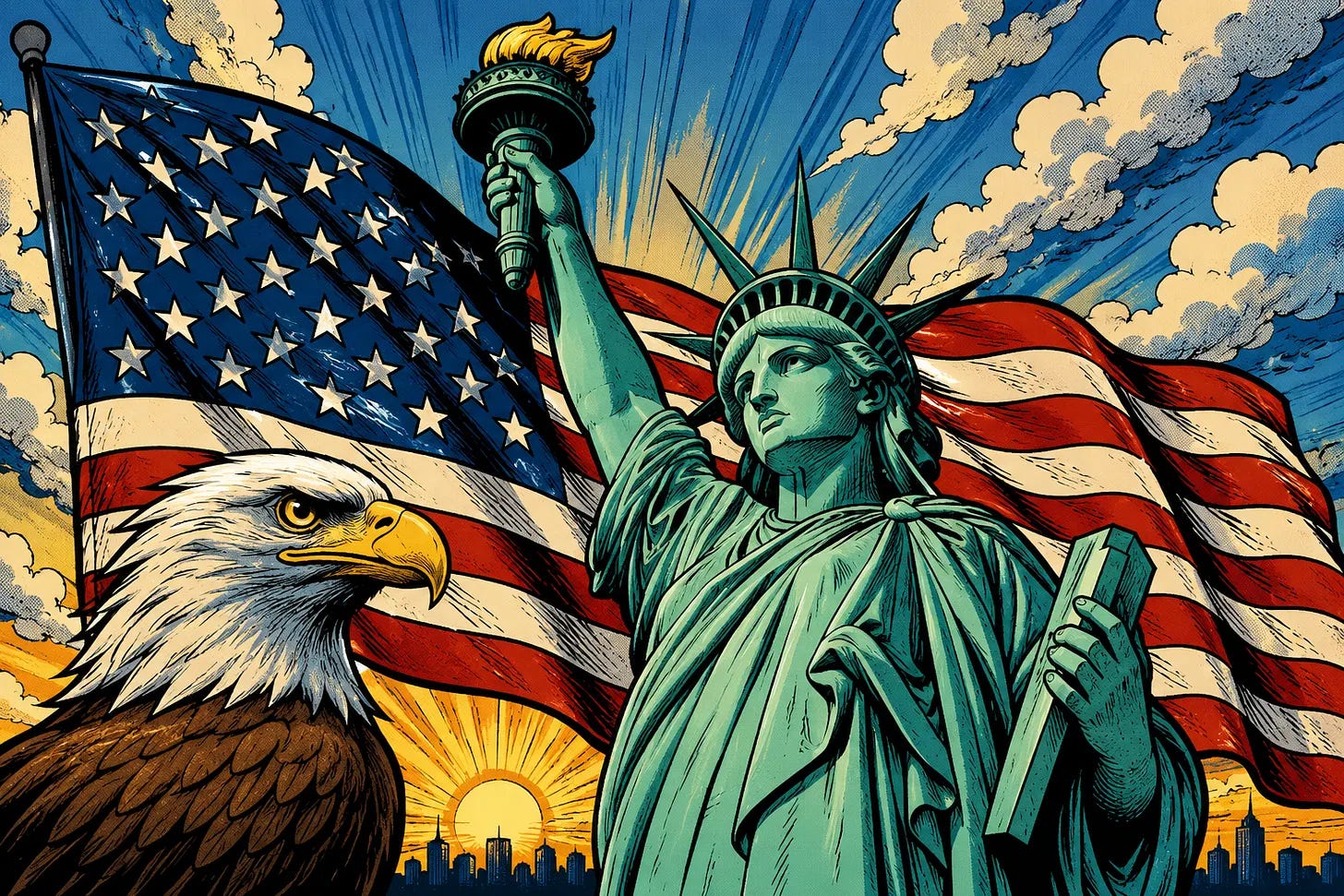
On this 250th Anniversary of American Independence, Try Gratitude Instead of Grievance.
This week, we reflected on America’s 250th anniversary with an essay by David King that argues for gratitude over grievance. Drawing on his experiences living abroad, the author suggests that a global perspective can help place America’s challenges in context while highlighting the freedoms, stability, and opportunities that are often taken for granted.
Rather than ignoring the nation’s shortcomings, the essay contends that acknowledging them should not come at the expense of appreciating what America has accomplished. King notes that we should all cultivate gratitude as a foundation for constructive civic engagement, arguing that a healthier national conversation begins with recognizing what parts of our nation are still works in progress alongside our many national successes.
“So on this anniversary of independence, if you feel compelled to say that we are inappropriately celebrating 250 years of oppression, imperialism, exploitation, racism, slavery, brutality, and warmongering, spare us the complaints. Take that energy and go make something better instead.
We here in the USA are so damn lucky. Yes, even you. And while things may feel dystopian at this particular juncture in our history, only by choosing to be grateful for what we have can we stave off those threatening to take it away from us.”

How do public libraries select the wrong books for kids?
This week, we explored how children’s books make their way onto public library shelves and the often-overlooked process behind library collection development. Rather than focusing solely on individual librarians, the essay examines the broader publishing ecosystem—including publishers, reviewers, wholesalers, and acquisition practices—and argues that these institutions collectively influence the range of viewpoints available to young readers.
The author contends that ideological incentives throughout this pipeline can shape children’s collections in ways that narrow viewpoint diversity, particularly on topics such as gender and sexuality. The essay explores how libraries can better uphold intellectual freedom through more independent collection development, broader representation of perspectives, and greater community engagement in the selection process.
“Even if these elements are not always aligned, the process still results in library collections being stacked with books for kids on gender and sexuality that skew heavily toward a one-sided viewpoint. These views [are], presented as fact to an audience not yet capable of critical analysis…”

Commencement 2026: Jonathan Haidt Address

Cradle Americans
Eli Steele’s essay reflects on America’s 250th anniversary by exploring what it means to inherit freedom rather than fight for it. Drawing on his family’s history—from segregation and the Civil Rights Movement to the Holocaust—Steele argues that many Americans have become “cradle Americans,” born into freedoms they have never had to defend and, as a result, may not fully appreciate.
Using personal history alongside philosophical reflection, Steele contends that freedom is not merely a legal or political condition but an individual responsibility that must be actively exercised. Rather than dwelling on America’s failures or idealizing its past, he encourages readers to honor the sacrifices of previous generations by embracing personal courage, accountability, and the freedoms they have inherited.
“I am the first male on my father’s side to be born free of any government-sanctioned racial oppression, and who knows how far back the line of unfree men runs behind me in America. That is the inheritance my converts left me. I did not earn it. I was the cradle American they made possible. I grew up in freedom but do I and the millions of others like me know what I was given? Or do I only practice it out of habit? What is the value of a freedom that has not been suffered for?”
How Jack Became Black
This week, we announced the opening of FAIR's Summer Film Series with a screening of Eli Steele's documentary How Jack Became Black. Inspired by his experience enrolling his multiracial son in public school, Steele examines the role racial classification continues to play in American institutions and asks what it means to see people as individuals rather than members of racial groups.
Blending personal experience with broader cultural reflection, Steele questions the purpose and consequences of race-based categorization in education and public life. The film invites viewers to consider how concepts of identity, equality, and individual dignity shape the way we think about race today, followed by a live discussion exploring these questions in greater depth.
“This film is the record of one father trying to keep one boy out of a category, and finding a whole country built on the practice. FAIR has framed the night around the right questions. Will we ever see people as individuals rather than members of groups? Who belongs? How should we think about race?”

Why Democracy Requires Renewal
Michael Dimock, Ph.D., “president of Pew Research Center, a leading source of nonpartisan, non-advocacy data”, reflects on America’s 250th anniversary and the future of the nation’s democratic experience. Drawing on public opinion research, he explores the growing challenges of political polarization, civic disengagement, and declining trust in institutions while arguing that these trends need not define America’s future.
Rather than dwelling solely on the nation’s divisions, the address calls on Americans to reclaim a sense of civic responsibility by engaging with one another, embracing democratic participation, and remaining open to institutional reform. It ultimately argues that the founders left behind not a finished system, but an ongoing project—one that each generation has both the opportunity and the responsibility to strengthen.
“In a way, what binds us is this very idea that this nation can be, hopes to be an inspiration to future generations and a beacon to the world. What we sometimes forget though is that this system was never meant to be static. The founders didn’t hand us a finished product. They handed us an ongoing project that requires engagement and creativity from one generation to the next. Right? So our responsibility is to carry that democratic imagination forward to make sure that this democratic republic doesn’t become static, right, or stuck or rigid or even cynical.”

The American College of Surgeons Remains Committed to Ideology
Dr. Richard T. Bosshardt examines what he sees as the American College of Surgeons’ continued commitment to DEI initiatives, arguing that recent leadership decisions reflect an ongoing preference for ideological priorities over viewpoint diversity and merit-based principles.
Focusing on the organization’s decision to invite Supreme Court Justice Ketanji Brown Jackson to deliver a keynote lecture at its 2026 Clinical Congress, Bosshardt contends that the invitation signals an enduring institutional alignment with DEI despite growing legal, scientific, and public debate surrounding these issues. His essay raises broader questions about ideological conformity within professional medical organizations, the role of open debate in scientific institutions, and how organizations can foster excellence while remaining open to differing perspectives.
“My suggestion to my fellow surgeons: boycott the Clinical Congress in September and make it the least attended in ACS history. Perhaps then, the leadership will get the message that we are not racists, that surgery is not racist, and that surgeons treat patients with the same care and competence, regardless of race or other immutable characteristics.”