

Text FAIRFORALL to 707070 to donate to FAIR’s 250 for 250 Campaign.


The Middle Way Through America’s Political Wilderness
For FAIR’s Substack, Greg Thomas writes about why reviving democratic discourse requires a bold recommitment to moderation.
In our current environment of extreme polarization, fed by media bifurcation and algorithmic manipulation, speaking for the exhausted majority in the middle has become a radical act. It requires courage to stand against the thought-policing that characterizes both extremes, where expressing openness to opposing views brings backlash from one’s own cohort. But this is precisely what democratic citizenship demands: the willingness to think independently, speak truthfully, and listen generously.


A Sad Collapse in Student Preparation at UC San Diego Was Inevitable
For the American Enterprise Institute, FAIR Advisor Robert Pondiscio writes about the consequences of magical thinking in education policy and practice.
But the deeper crisis is moral. We have persuaded ourselves that to pursue excellence is to perpetuate inequity, that holding students to high standards is unfair, that success can be achieved by adjusting expectations rather than meeting them. The UCSD report exposes the folly of that thinking. “Equity” without preparation is cruelty disguised as compassion. It delivers opportunity in name only, while denying students the knowledge and skills they need to thrive.

Snap out of your crisis of confidence, America — your country depends on it
For the New York Post, FAIR Advisor Shadi Hamid writes about America’s confidence crisis and why it matters.
This raises the perennial question of whether “exceptionalism” is a useful prism for understanding America’s strengths, if not necessarily its flaws. I, for one, think it’s useful. And I would go one step further. America needs to believe in its own exceptionalism. A country that doesn’t believe in itself is one that is vulnerable to challengers and competitors.
The case for “exceptionalism” of any kind is getting more difficult to make. In my writing, I have asked myself many times whether I really wanted to use words like “dominance” or “exceptionalism,” which I know can be off-putting to a significant number of readers. But I am increasingly convinced this instinctive discomfort is itself part of the problem. Why does the idea of America being better elicit such negative reactions in the first place?

The Left’s New Moralism Will Backfire
For The Atlantic, Thomas Chatterton Williams argues that the rhetoric of “moral clarity” coming from the left isn’t helping their cause.
Of course, “no Nazi tattoos” and “don’t advocate political violence” are not particularly lofty ethical bars to clear; no one should be dismissed as a snowflake for finding such transgressions disqualifying. But the fact that many on the left seem willing to extend Platner the opportunity to redeem his mistakes is a promising sign. It is grounded in the recognition that Democrats’ long-term moral interests are moot if they can’t win elections.
The alternative—rigid sanctimoniousness that cannot allow the possibility of forgiveness or negotiation—is not clarity. It’s dogmatism.
Voting is tied to more tolerance in men — but less in women
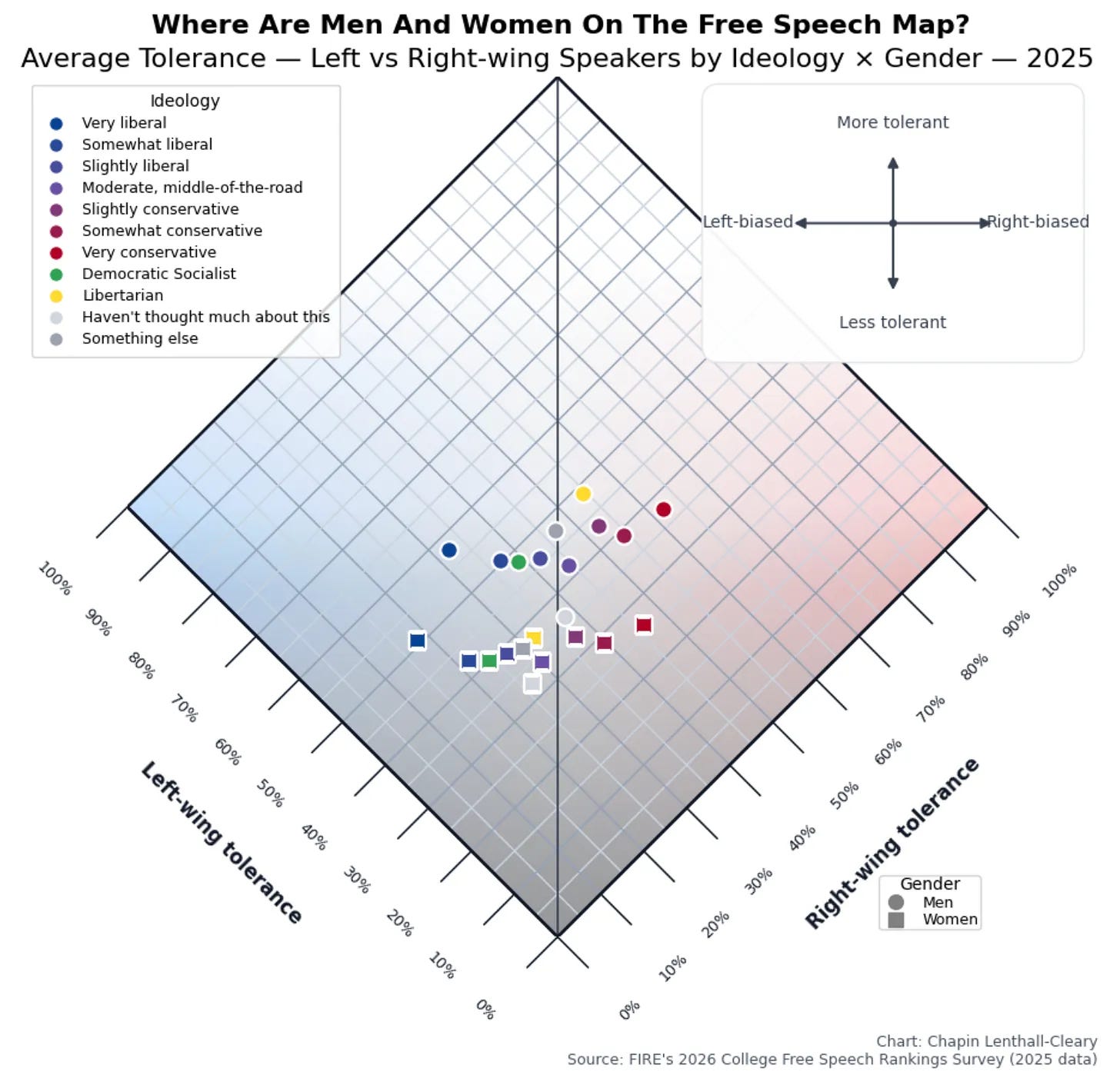
For Expression, Chapin Lenthall-Cleary writes about the data that shows how being registered to vote correlates with political tolerance.
For men, the boost in tolerance mostly comes from one place: Registered men are a lot more likely to be “perfectly tolerant” — the folks who say they’d allow every speaker, full stop. Political participation seems to make men more likely to believe in the principle of free speech for all. That effect doesn’t exist for women, at all. Instead, being registered to vote makes women more likely to be totally intolerant of the right specifically. In other words, registering to vote increases the odds of landing women in the stereotype of being woke. Men see a bump in that zone too, but it’s much smaller — and still overshadowed by the much larger increase in men becoming fully tolerant across the board.
Put together, this means that being registered to vote pulls men towards the free speech ideal and pulls women towards the woke stereotype.

FAIR News Podcast
For audio versions of our FAIR News and FAIR Weekly Roundup newsletters, subscribe and listen to FAIR News Weekly on Apple Podcasts, Spotify, Google Podcasts, or via RSS feed.
Join the FAIR Community
Join us, and become a member of FAIR.
Become a FAIR volunteer, or join a FAIR chapter.
Sign-up for a Welcome to FAIR Zoom information session to learn more about our mission.
Share your reviews and incident reports on our FAIR Transparency website.
Please don’t reference articles to read if they are under a paywall. Was looking forward to reading the article from The Atlantic and it is unavailable.