

Text FAIRFORALL to 707070 to donate to FAIR’s 250 for 250 Campaign.


How a False Accusation Destroyed My Career and My Life
For FAIR’s Substack, Ed Roos writes about how his life unraveled overnight in the grip of cancel—or as he calls it, revenge—culture.
Now, as I approach my 60th birthday, instead of preparing for retirement, I’m starting over. After countless rejections from both the private and public sectors, I found solace in volunteering at a local nonprofit. That volunteer work became a part-time job, earning a fifth of my previous salary, but it restored a glimmer of meaning to my life. I help people in need every day. It gives me purpose, but it’s not enough to support my family. And I still ache for the profession that once defined me. Education wasn’t just a career—it was my calling.
Even after being completely exonerated, Seattle Schools has refused my repeated requests to be rehired.
My story is not unique—but it’s proof of what happens when truth is sacrificed to ideology, and when vengeance replaces justice. No one should ever have to endure what I did for simply doing their job.

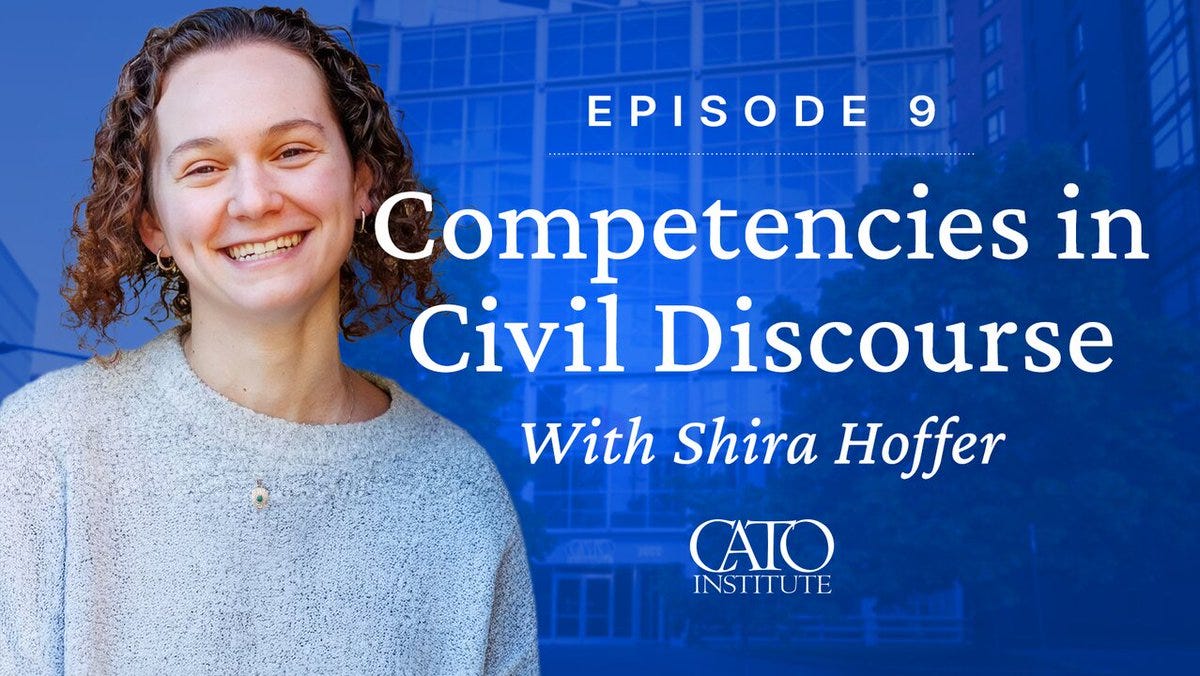
Competencies in Civil Discourse: Episode 9
FAIR Advisor Erec Smith speaks with Shira Hoffer, the founding Executive Director of The Viewpoints Project, about what would happen if we stopped assuming we know why people have their beliefs and asked WHY they have their beliefs.

Why I choose to root for U.S. dominance
For The Washington Post, FAIR Advisor Shadi Hamid shares an excerpt from his new book, The Case For American Power.
Progressives have always had a utopian bent, believing that life — not just for Americans but for millions abroad — can be made better through human initiative and solidarity (rather than, say, simply hoping that the markets will self-correct). The problem is that the better, more just world that so many of them hope for does not appear on its own; it must be willed into existence. Our values are not freestanding; they must be guaranteed, and in global politics nothing can be guaranteed without the credible threat of force. To move beyond the temptations of the passive voice, who exactly provides this guarantee? In most cases, for better or worse, there is only one obvious candidate: the United States. Morality, or in this case a more just global order, is impossible without power. And as it turns out, it’s not only impossible without power. It’s impossible without American power.

From laws to literacy: The science of reading needs more than statutes to succeed
For the Fordham Institute, FAIR Advisor Robert Pondiscio and Kristen McQuillan write about how good reading instruction is a practice, not a policy.
Legislators are understandably impatient; parents even more so. But reform timelines and political timelines rarely align. The risk is that the science of reading becomes another compliance exercise—same teachers, same lessons, new labels. Avoiding this trap is a particularly sticky challenge for public policy since getting right it implies monitoring not just student outcomes but pedagogy and curriculum: Are student experiences really aligned to the science of reading? Are children getting the chance to read and make meaning of content-rich, worthwhile texts? Are they talking and writing about them? It’s one thing—and essential—to track student proficiency, but it’s a much stronger tool for improvement to track how their instructional experiences are evolving over time.


Speaking at the site of a murder
For The Eternally Radical Idea, Greg Lukianoff writes about his speech at Utah Valley University, the place where Charlie Kirk was murdered in front of students.
The murder at UVU was a terrible rupture. But the way back isn’t complicated. It’s hard, but not complicated. We rebuild the old peace treaty by keeping the line between words and blows bright. We recommit to persuasion over punishment — especially when we’re sure we’re right. We teach students that argument is not an act of violence; it’s the alternative to it.
I didn’t give the polished, sweeping lecture I wrote and rewrote. And I’d be lying if I said that every stumble I had in the speech didn’t irk me when I listened to it later. But I think that’s how you know this was really from my heart, at an emotional moment in a space that had become historic for all the wrong reasons. I stood where a man died and made a simple case. America is not inevitable. It’s a choice. Let’s not become like everybody else. Let’s keep the wager. Let’s use words.
Watch the Speech:

FAIR News Podcast
For audio versions of our FAIR News and FAIR Weekly Roundup newsletters, subscribe and listen to FAIR News Weekly on Apple Podcasts, Spotify, Google Podcasts, or via RSS feed.
Join the FAIR Community
Join us, and become a member of FAIR.
Become a FAIR volunteer, or join a FAIR chapter.
Sign-up for a Welcome to FAIR Zoom information session to learn more about our mission.
Share your reviews and incident reports on our FAIR Transparency website.