

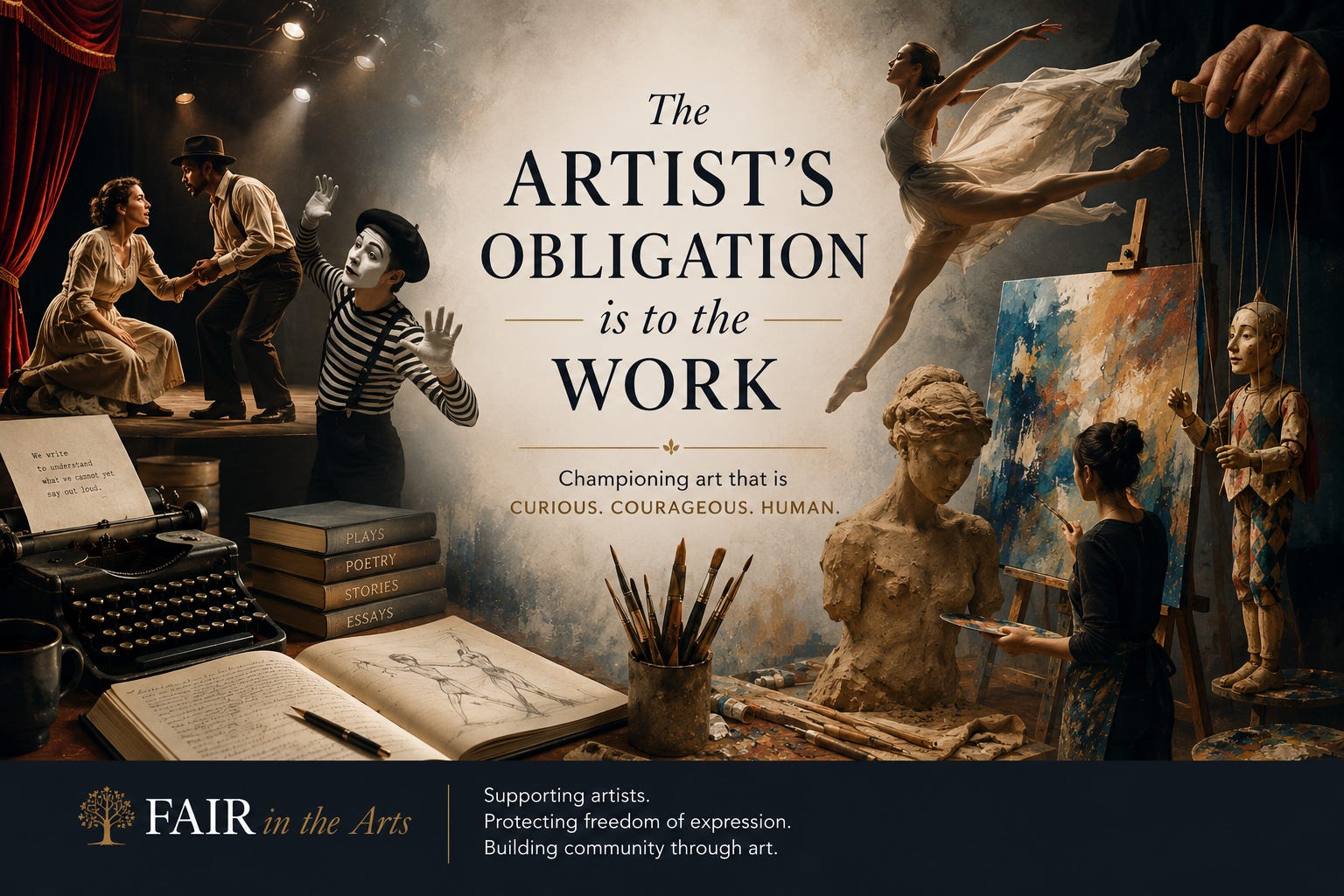
I first discovered FAIR four years ago when I witnessed the effects of identity politics, bullying, and cancellations across different spaces in education, medicine, and the arts. While volunteering on several initiatives in Los Angeles that aligned with FAIR’s work, I had the privilege of joining projects whose members were thoughtful, intellectually grounded, and genuinely wonderful people, committed to human dignity, freedom of expression, and civil liberties. Again and again, I found that the people who support and contribute to FAIR’s many endeavors represent a pinnacle in generosity and professionalism, and a willingness to stand for pro-human principles.
As I began to focus more on FAIR’s role in both education and the arts, I took on active roles reviewing FAIR’s extraordinary “Many Stories, One Nation” curriculum, co-hosting Fair in Conversation, facilitating FAIR’s Playwright’s Think Tank, its Novel and Poetry Writers Group, and leading one of their many chapters. Throughout, I came to appreciate something increasingly rare: a genuine diversity of thought. For me, especially as an artist, FAIR is a tribe that isn’t tribal. If you were to join one of FAIR’s monthly In-Conversation Zooms or listen to one of the writers’ gatherings, you’d hear disagreement, questioning, arguments, and also appreciation, compassion, and laughter.
In the artist groups, we understand that supporting the art is more important than agreeing on politics, and we are openly able to share our artistic achievements, struggles, disappointments, and convictions. What holds us together is not agreement on every issue, but a commitment to art for arts’ sake, and especially for the principles of civility and mutual respect that allow people who disagree to continue speaking and listening to one another.
This commitment is where FAIR in Arts comes into play and where the organization’s work occupies a particularly important place. The arts are often among the first subjects cut from schools and among the last endeavors supported by public and private institutions. Yet, the arts remain among the most powerful ways a civilization reflects on itself.
After more than thirty years working in theater and publishing, as well as teaching philosophy, writing and literature, I have come to believe that while politics may be downstream from culture, culture is itself downstream from the arts. Depending, of course, on the art.
I’m not talking about the art that imitates whatever ideas happen to be fashionable. Not art created to secure political affirmation or demonstrate conformity. And not art whose expression has been decided before the artist begins the work. I mean art that is deeply human. Art that is introspective, curious, unsettling, original. Art that finds itself in places its creator did not expect to go. Art that asks questions without knowing in advance the acceptable answers.
Today, as throughout history, that kind of art can be discouraged. It can be defunded, censored, ridiculed, and temporarily driven underground.
FAIR in the Arts is where I found the support that I needed to rebuild my own courage to be that kind of artist. It is where I found a community that encouraged me to do what the work itself required without constantly looking over my shoulder for censorship, cancellation, or ideological judgment. And it is also where I discovered that the artists and audiences I hoped were still out there–really are. I have come to think of FAIR in the Arts as a kind of home that is increasingly difficult for an artist to find, which is why I’m committed to supporting it as a space that gives artists the security to think openly and widely, and to make art without first having to demonstrate political usefulness.
There is enormous pressure today for artists to become activists and for works of art to affirm particular social or political perspectives. But activism is not the artist’s obligation.
The artist’s obligation is to the work. To follow an idea wherever it leads. To tell the truth as the artist sees it. To illuminate contradictions rather than conceal them. To explore the complexity of human beings rather than reduce them to categories. I believe that is the kind of art that needs to be protected and supported.
Your contribution, whether monetary or in-kind, helps FAIR create opportunities for artists who still believe in art that reaches us where identity and politics are subordinate to our shared humanity. I hope you will consider supporting FAIR in the Arts to help us preserve a place for artists willing to take the risks that real art has always required. And I hope you’ll subscribe to the FAIR in the Arts newsletter and join us in what comes next.
Warmly,
Karen Howes
Interim Director, Fair in the Arts
We welcome you to share your thoughts on this piece in the comments below. Click here to view our comment section moderation policy.
The opinions expressed here do not necessarily reflect those of Fair For All or its employees.
In keeping with our mission to promote a common culture of fairness, understanding, and humanity, we are committed to including a diverse range of voices and to encouraging compassionate, good-faith discourse.
We are actively seeking perspectives on this topic and others. If you’d like to join the conversation, please send completed drafts to submissions@fairforall.org.

I'm grateful for FAIR and appreciate this article, Karen. 'Activism is not the artist’s obligation.' Couldn't agree more!
It makes me so sad that the art community in 2026 is the most fearful and the most conformist. Maybe because they depend so much on the largesse of the wealthy?