

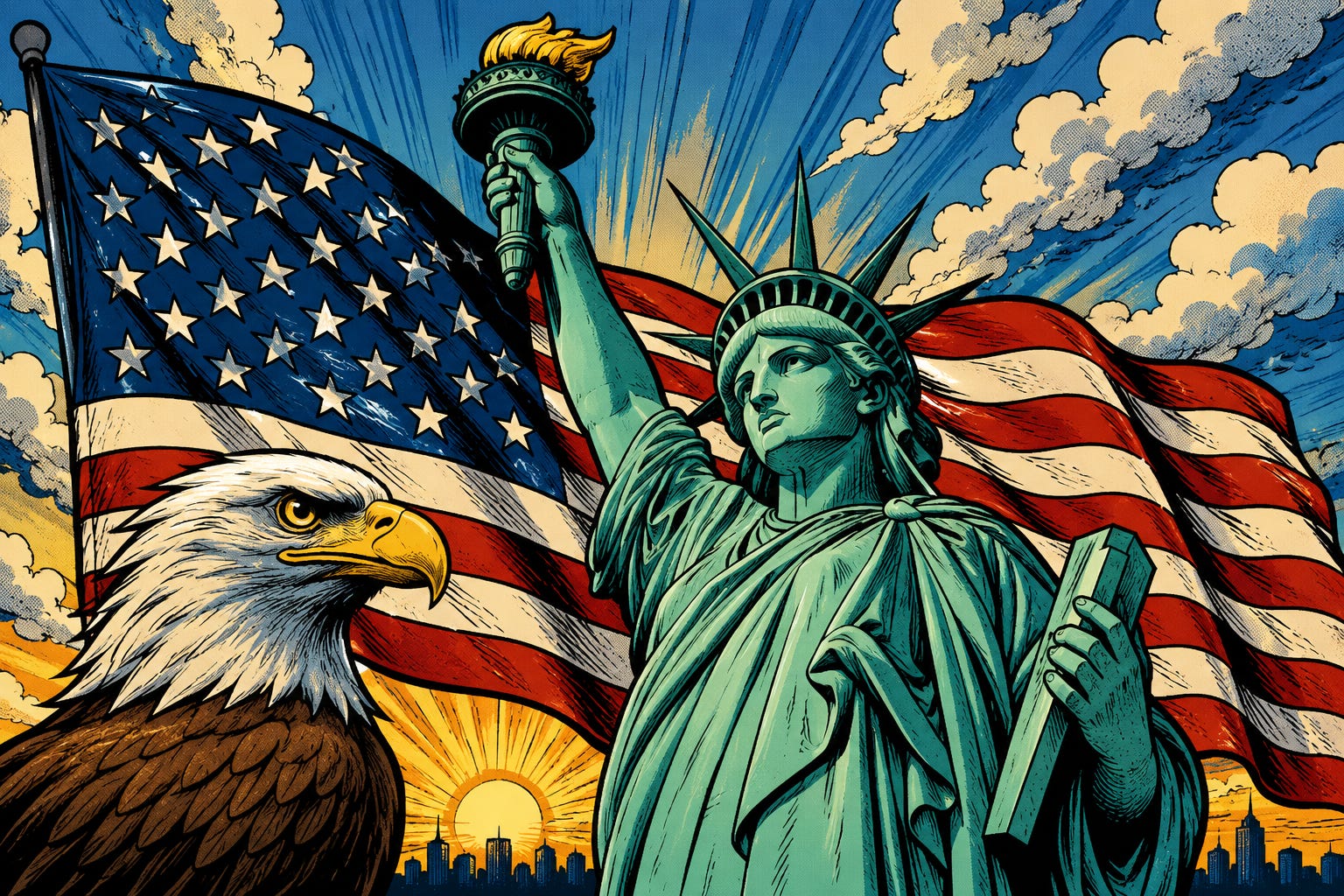
This morning, I did not need to boil my water to drink it. My power has been on uninterrupted for many months. When I go out later, the vast majority of other drivers will be predictable and follow traffic laws. I will inevitably, at some point, criticize people in power in a very direct and public way, and I will not fear retribution from the government or other powerful people for doing so. When I go to the store, prices will be higher than I like, but they will probably be exactly what’s listed on the shelf, and the products I buy I can almost certainly expect to work properly. If I go for a walk in the park, strangers will greet me with a smile and a “hello.” I will drive past a farmstand that consists only of a shelter, products, and a box to put money in, unmonitored, and there will be both cash and products there. I recognize this isn’t universally true. Prices are unaffordable for some families and a walk in some neighborhoods carries real risk. These are real exceptions, and they matter. But my point is that these are exceptions, not the rule.
I type this from a nation about to turn 250 years old, having spent a great deal of my life in places where all of the above have not been true.
No, I have not described a utopia, but I have described a place we have all taken for granted — or even worse, needlessly denigrated, at one point or another.
Although I do not use social media, I know well that if I took a look at any social media platform I would be bombarded by nonstop cynical rhetoric about how America is a great evil in the world, a failed state, a terrible place to live, a place some long to escape from — a pox on the earth that would be best undone and abandoned.
I think we can reasonably expect that rhetoric to escalate quite a bit at the least appropriate time, as we celebrate 250 years of independence. But I believe a bit of thanks for that independence feels more in order.
Gratitude work has become widely regarded as a huge boost to mental health. The concept is simple: spending time intentionally focusing on what we are happy about in our lives can give us (according to an article from Harvard Women’s Health Watch) “… greater emotional and social well-being, better sleep quality, lower depression risks, and favorable markers of cardiovascular health.”
So, gratitude is good for us. Knowing this makes many anti-America remarks and the deep and unrelenting cynicism on social media look as bad as a pack-a-day cigarette habit.
Some will criticize the US as being “no better than a third-world country”, losing sight of the incredible comfort that we (yes, even many poor people) experience here compared to the vast majority of other countries. Others will talk about how the founders guaranteed only the rights of “rich white men”, willfully disregarding the slow but undeniable progression to guaranteeing those rights for everyone and how absolutely novel that is in history. Others will claim that America “has no culture,” an odd statement to make about the greatest cultural exporter in modern history — a culture that would not be nearly as rich without the contributions of those people they see as “systemically oppressed”.
They’ll make these criticisms from their safe, comfortable, air-conditioned homes. They’ll make them with zero fear of retribution or consequence. They’ll make these criticisms to an audience of similarly cynical, resentful, and ungrateful people who will reinforce their vitriol.
To me, this is like the teenager in the McMansion who screams at his parents, storms out, and speeds off in the BMW they bought him. Where are you going, kid? You’ll be back in your nice bedroom with your childhood toys tonight, and your parents probably won’t even ask you to apologize for your behavior.
That said, there is absolutely plenty to be unhappy about. I believe that on almost all fronts, American society is declining and losing much of what makes us special. I fear that my ability to live on my own terms here is under threat more and more as time progresses. But I also believe that a big part of the reason these problems exist is because so many in our “intellectual” classes are demoralized by this relentless strain of perspective-free self-hate.
A part of how we got here is social media: cynicism, self-righteousness, and snarky jabs at those who are perceived as “powerful.” Hot takes generally play better there, as they drive engagement. That seems to reinforce the shibboleth-like nature of American self-hate as a means of accessing the purported “intelligentsia”. As Benedict Beckeld, author of Oikophobia: Why Successful Societies Turn Against Themselves, says:
“Like Diogenes’ sneers and sarcasms about his fellow Greeks, or Voltaire’s snarkiness about French tradition and religion, little virtue-signaling asides about American faults are de rigeur for those Americans wishing to communicate how cosmopolitan and superior they are.”
It should not be news to anyone that spending all of one’s time incessantly criticizing others is not a strong indicator of moral superiority, but rather a substitute for it. Confidence and competence are quiet because security does not require belittlement.
Having spent half my adult life living in the People’s Republic of China and a great deal of time traveling the rest of the world, I can tell you this: having a global perspective puts the contrast between American society and most others in the world in stark light.
My anecdotal experience aside, simply looking at net migration numbers tells you an undeniable story: In 2025, enough people chose the United States over their home country that, standing in a line holding hands, they would stretch from New York City to Miami.
Being grateful does not mean willfully ignoring real problems or being revisionist about history. But willful ignorance and revisionism cut both ways: as much as they can be used to “whitewash” true evils, they can also be used to reinforce needless negativity. You know what’s wrong with America today. You’re probably bombarded with these problems in your social media feeds, so I’m not going to spend time discussing them here. I, too, am feeling the embarrassment of our broken political system and the existential dread brought about by the state of our economy.
Yet despite the challenges we face today and the many ghastly moments of our history, what we choose to focus on is key to the solution. Allow me to anthropomorphize our nation for a moment. Have you ever loved someone whose bad choices brought them to a bad place? If you truly wanted them to get better, would you spend your time constantly berating them for their flaws and proclaiming how bad they are to everyone you both know? Once you’ve acknowledged their reality, what is the purpose of staying critical? To feel better about yourself? Because some part of you fears you’re just like them? Be honest.
So on this anniversary of independence, if you feel compelled to say that we are inappropriately celebrating 250 years of oppression, imperialism, exploitation, racism, slavery, brutality, and warmongering, spare us the complaints. Take that energy and go make something better instead.
We here in the USA are so damn lucky. Yes, even you. And while things may feel dystopian at this particular juncture in our history, only by choosing to be grateful for what we have can we stave off those threatening to take it away from us.
As we celebrate America’s 250th birthday, join FAIR in cultivating a common culture of gratitude. The more of us who do, the less we’ll have to criticize.
We welcome you to share your thoughts on this piece in the comments below. Click here to view our comment section moderation policy.
The opinions expressed here do not necessarily reflect those of Fair For All or its employees.
In keeping with our mission to promote a common culture of fairness, understanding, and humanity, we are committed to including a diverse range of voices and to encouraging compassionate, good-faith discourse.
We are actively seeking perspectives on this topic and others. If you’d like to join the conversation, please send completed drafts to submissions@fairforall.org.

Absolutely inspiring and much needed right now.
Beautiful! Want to help the country? Want to help yourself? Be grateful.