

In a famous 2018 essay, Andrew Sullivan observed that “we all live on campus now,” arguing that rampant identitarianism and the culture of mobbing and cancellation then being seen in higher education would inevitably affect society. These tendencies in higher education have been instrumental in stoking public expressions of moral outrage and exacerbating political polarization.
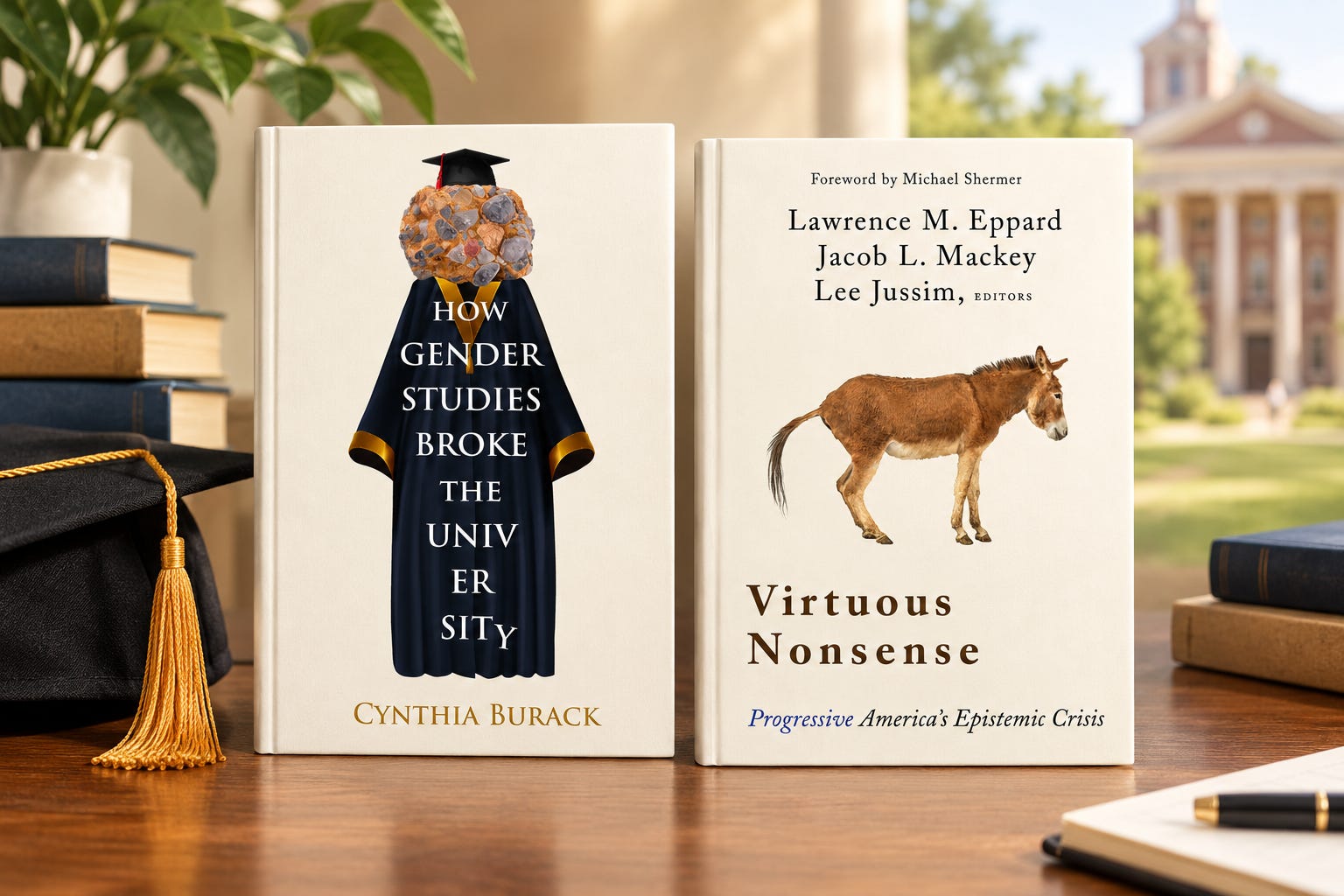
The impacts of an increasingly illiberal academia are articulated with particular brilliance in two important new books, both from Virginia-based publisher Pitchstone: Cynthia Burack’s How Gender Studies Broke the University, and the anthology Virtuous Nonsense: Progressive America’s Epistemic Crisis, edited by Lawrence Eppard, Jacob Mackey, and Lee Jussim. While Burack’s book is a frankly personal yet biting indictment of the illiberal state of the academy, Virtuous Nonsense gathers together diverse perspectives on institutional progressivism drawn from previously published articles.
That both were released by Pitchstone reflects the publisher’s belief that “the best way to arrive at reality-based conclusions…is through the application of evidence-based reason and the pursuit of good-faith debate.”
The recognition of this drift away from “reality-based” scholarship and debate drives the narrative of Burack’s book, as the author recounts how she went from a full participant in gender studies to questioning it—at some personal and professional cost. Burack retired from Ohio State University in 2025, having taught in the Department of Women’s and Gender Studies for 26 years. The author of five books and numerous scholarly articles, she has made a particular study of the impact of Christian fundamentalism on LGBTQ rights, most recently in 2022’s How Trump and the Christian Right Saved LGBTI Human Rights: A Religious Freedom Mystery.
While the title of her latest book isn’t quite literal–she does address the ideological capture of other fields as well–Burack stresses that “gender studies had a key role in creating an alarmingly effective habitat for anti-intellectualism, political dogmatism, and…authoritarianism” (Burack 14). Her focus is what she refers to as “academic progressive illiberalism,” noting ironically that “the very scholars who have labored most to condemn totalizing theories and binary accounts of every issue are some of the most binary, totalizing and moralizing thinkers I’ve ever encountered” (46).
The book’s first chapter is entitled “Mea Culpa,” and relates not only her own journey through academia but the trajectory of women’s studies itself, which went from an interdisciplinary perspective in the 1970s to its growing institutional isolation and illiberalism in the 1990s and beyond. Because gender studies would come to frame disagreement as “betrayal,” what had started as an admirable and necessary corrective that excavated the many formerly hidden accomplishments of women throughout history became instead a project championing and valorizing “sacralized victim groups” (69).
Because the conclusions of gender studies scholars are “not up for debate” (82), the findings in the field are also frequently presented as unprecedented—not because scholars didn’t conduct a proper database search but because they deliberately cull any published scholarship that doesn’t “share their values and commitments.” This includes any “scholarship that can be dismissed as patriarchal, cisheteronormative, or insufficiently antiracist” (Burack 83). In ignoring or rejecting findings for non-epistemic reasons, this tendency not only undermines the scholarly enterprise, but serves to enforce ideological conformity.
Burack explains that faculty are expected to account for the hierarchy of various identity groups through what is known as “progressive stacking”: giving speaking priority in the classroom to representatives of the most “oppressed” groups first (134-5). Burack would run afoul of this rule, resulting in complaints from students as part of a nearly two-year investigation into her “nefarious pedagogical activities” (11) which included engaging her students in a “non-consensual thought experiment” (173) (a complaint which, if broadly applied, would certainly eliminate virtually all pedagogy in philosophy!).
While the policing of language and institutionalization of “bias reporting systems” comprise an infrastructure that has enabled the academy (faculty and administrators both) to function as if they’re “primarily in the business of enforcing morality” (Burack 202), it is the silencing of opposing viewpoints that Burack finds to be immoral. Her own painful experience enduring an investigation into her teaching underscores much of the book, in particular Chapter 4, “Enemies of the People,” in which she details how universities punish dissent and create the “illusion of consensus” by creating a culture of conformity borne of fear of official punishment and ostracism by colleagues. “Something,” she concludes, “has gone terribly wrong” (Burack 263).
The contributors and editors of Virtuous Nonsense would wholeheartedly agree with Burack’s assessment, but see the problem as a broader “epistemic crisis” that is not confined to universities, but has infected almost all of America’s institutions.
The editors of Virtuous Nonsense are well-recognized: Lawrence Eppard is Director of the Connors Institute for Nonpartisan Research and Civic Engagement at Shippensburg University, and a regular contributor to the work of the Heterodox Academy; while Jacob Mackey is an Associate Professor of Comparative Studies in Literature and Culture at Occidental College in Los Angeles and co-founder of Free Black Thought; and Lee Jussim is a distinguished professor of social psychology at Rutgers University who has written and spoken extensively on DEI, anti-racism trainings and stereotyping. Most recently, Jussim co-authored a Health and Human Services paper linking support for gender identity ideology to support for authoritarianism and political violence. All three editors previously collaborated on co-editing the book The Poisoning of the American Mind, which addresses how Americans across the political spectrum “are retreating into their own information bubbles, seceding from a common reality.”
Part one focuses exclusively on the epistemic crisis in the academy, starting with Jonathan Haidt’s now-famous 2016 HxA essay, “The University Must Choose One Telos” in which Haidt argues that academics can either use their research to pursue social justice or the truth—but not both. Musa Al-Gharbi (author of 2024’s We Have Never Been Woke) follows with a plea for ideological diversity in the academy, pointing out that the dramatic underrepresentation of conservative academics tends to narrow the range of questions asked in the social sciences and humanities, but leaves out the perspectives of rural and working-class individuals: “Conservative” he reminds readers “is not a synonym for “[w]hite” (Eppard et al 82).
Part two delves into the seemingly contradictory debates over the role of gender identity ideology—which denies the existence and salience of biological sex—and those over gender equity between men and women, for which sex is central. Like Cynthia Burack, biologists Jerry Coyne and Luana Maroja argue that their field has been disastrously malformed by gender ideology, which has resulted in the needless cordoning off of entire avenues of inquiry. Similarly, Kay Hymowitz argues that “gender identity, with its vision of autonomous children in touch with their innermost authentic desires, negates all we know about adolescence [from child psychology], just as it does early childhood” (Eppard et al 208). Meanwhile, to help explain the appearance of a gender pay gap, Eppard and Katie Bonomo urge social scientists not to dismiss the possibility that “occupational segregation may stem from differences in the characteristics of men and women themselves” and the types of work they tend (on average) to choose (176).
On matters of race, contributors question the conventional research on “microaggressions” (Jussim) and “implicit bias” studies (Carol Tavris), while Michael Huemer and Robert VerBruggen give closer scrutiny to both the eyewitness accounts and data on police shootings of black suspects, with the latter arguing that, based on data alone, “bias [on the part of police] is extremely difficult to detect and prove. It appears and disappears as researchers consult different data and use different methods” (Eppard et al 255). This is not to argue that racial bias on the part of some police does not exist, but rather that it resists straightforward empirical metrics.
In the concluding essays Mackey cites his 2023 coining of the term “virtuous lie” as “misleading information that carries a positive moral valence” in service of what the speaker believes is a good cause (Eppard et al 397). This type of assertion, says Mackey, is “a catastrophizing misrepresentation of the oppression to which some ‘marginalized’ group is subjected by ‘oppressor’ groups” (399). Finally, Michael Huemer warns that these “virtuous lies” lead to misguided public policy interventions that will inevitably fail, thereby harming the very constituencies they were intended to help. Ultimately, Huemer argues, the critical social justice imperatives bound up in race, sex, and gender identity—and the repetition of calumnies against one’s nation or demographic—can only serve to fuel conflict and reduce social trust.
While very different in purpose and tone, these two books draw the same conclusion: That the academy has been transformed from an institution of knowledge, discovery, and transmission into an enforcer of a new moral order, with real-world consequences.
Burack’s anger is, accordingly, palpable as she writes in her book that,
[w]e should be outraged that academics and universities came to treat so many of their colleagues as enemies, forcing them into silence, conformity, apologies, preemptive obedience, and sometimes punishment…It’s hard to imagine a greater violation of the ethics of scholarly institutions than to insist that all ideas outside the ambit of progressivism cause harm and, therefore, must be silenced (Burack 202-203).
These books offer a compelling window into the ways in which so many Americans are trapped in their own epistemic bubbles, which are often amplified by their preferred media. What is of concern here is that these epistemic political bubbles are occurring inside what should be neutral institutions. Both How Gender Studies Broke the University and Virtuous Nonsense are essential reading for anyone concerned with the future of the academy and—more troublingly—that of the world it has helped to shape in its image.
We welcome you to share your thoughts on this piece in the comments below. Click here to view our comment section moderation policy.
The opinions expressed here do not necessarily reflect those of Fair For All or its employees.
In keeping with our mission to promote a common culture of fairness, understanding, and humanity, we are committed to including a diverse range of voices and to encouraging compassionate, good-faith discourse.
We are actively seeking perspectives on this topic and others. If you’d like to join the conversation, please send completed drafts to submissions@fairforall.org.

Great article. Very informative. But I must ask- what took so long for these authors to come to these conclusions and finally write about it? The university has been in free fall for decades exacerbated by covid and George Floyd.