


Last month, Charlie Kirk, founder of Turning Point USA, was shot and killed during a Turning Point event at Utah Valley University.
Not long afterward, I found myself wondering:
Had Charlie Kirk written any books?
Were his books available through my local library system?
And were libraries responding appropriately by purchasing additional copies to meet the sudden surge in demand?
It turns out the answers are:
Yes, Charlie Kirk has written several books. His most recent, Right Wing Revolution: How to Beat the Woke and Save the West, was published in 2024.
Yes, every Charlie Kirk book in my state’s library system appears to be on hold.
To answer the third question—how libraries are responding to what we might call the “Charlie Kirk Book Challenge”—it helps to examine “holds ratios.” This metric compares the number of patrons’ holds on a book to the number of copies available within a library consortium. When a sudden spike in interest occurs, libraries are expected to purchase additional copies to meet that demand. Comparing the holds ratio for available copies versus available plus “on order” copies shows whether libraries are responding effectively. If they are, the second ratio should be significantly lower.
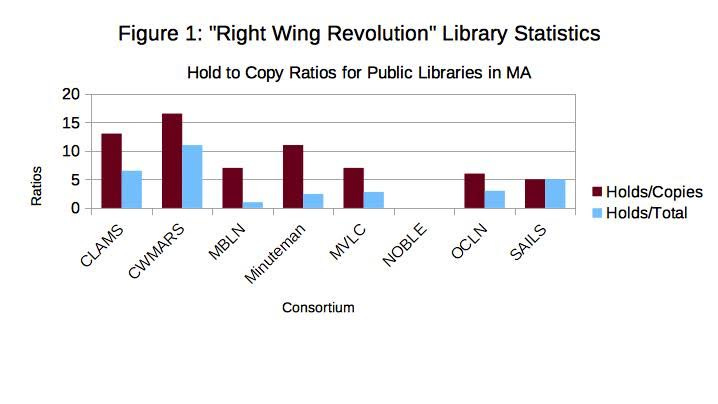
Figure 1 illustrates this for Right Wing Revolution, Kirk’s most recent title. I looked at Massachusetts library consortia with a large proportion of public libraries—academic libraries are not a good fit for a book like this. A high holds ratio indicates that demand greatly exceeds supply; a ratio of around 1:1 is ideal, meaning one patron waiting per copy.
Most, but not all, Massachusetts consortia are responding adequately. Either the existing holds ratios are reasonable, or libraries are ordering more copies to meet demand. Unfortunately, the NOBLE (North of Boston Library Exchange) system has zero copies of Right Wing Revolution and, as of now, no plans to purchase any—disregarding the clear interests of some of their patrons.
Elsewhere, the situation is worse. The Allegheny County, Pennsylvania library system, with roughly 75 libraries, has only one copy of Right Wing Revolution—and 53 holds. One more copy is on order, which will still leave a ratio of 26:1. At that rate, the last person in line could wait six months to a year. Montgomery County, Pennsylvania has no copies at all, and a retired librarian in Oregon told me that there is just one public library copy in the entire state.
This year, the American Library Association (ALA) has designated October 5–11 as “Banned Books Week.” During this annual event, libraries across the country celebrate their supposed courage in resisting “book bans” and “censorship.” Many claim that left-wing censorship doesn’t exist—though most of us know better. In blue states, librarians often deride other states for their supposed intolerance, while promoting “banned book” lists that, in reality, consist of titles readily available everywhere. These lists function more as marketing tools than statements of principle.
So, will libraries include Charlie Kirk’s books in their “Banned Books Week” displays this year, praising their own bravery for defending the “freedom to read”? I doubt it. Instead, they’ll proudly display titles like Randi Weingarten’s Why Fascists Fear Teachers—for which the Allegheny County system has 15 copies to satisfy just 11 holds. For many librarians, personal sympathies clearly align with Weingarten’s views, not Kirk’s.
What will compel libraries—such as NOBLE in Massachusetts or Allegheny County in Pennsylvania—to treat all patrons fairly, regardless of ideology?
I propose total transparency, enforced by legislation. Each year, libraries should be required to publish detailed reports showing the number of items purchased, weeded, lost, and checked out. If purchasing decisions reveal ideological favoritism rather than responsiveness to patron demand, that would be evident in the data.
The issue is urgent. Many libraries are actively “weeding” books that conflict with prevailing ideologies. Once removed, these books are unlikely to return. The time to demand accountability—and to legislate transparency—is now.
We welcome you to share your thoughts on this piece in the comments below. Click here to view our comment section moderation policy.
The opinions expressed here do not necessarily reflect those of the Fair For All or its employees.
In keeping with our mission to promote a common culture of fairness, understanding, and humanity, we are committed to including a diversity of voices and encouraging compassionate and good-faith discourse.
We are actively seeking other perspectives on this topic and others. If you’d like to join the conversation, please send drafts to submissions@fairforall.org.

I ran a banned book library book test a few years back against Jordan Peterson's books.
I found an ALA list of books that a school district had banned. First, small segue on the meaning of "banned" --
-- "banned" for this list meant libraries were told to remove the books for review. That review would be done by the district school board. If reviewed well, then the books would return for circulation.
Now, I totally get that a review process is more government red tape. The irony here being: libertarian sounding conservatives leveraging the government to impose itself more in the lives of citizens. And I sympathize with committees of nonexperts making decisions that circumvent professionals. In this case, a school board committee trumping librarians trained to maintain circulation for local patrons.
The test case for my example was hyperlocal and democratic. It's partisan to criticize government red tape when the situation was hyperlocal. This test case was a school board that is directly elected by local citizens. And it's myopic to not emphasize that there was a democratic process. A school whose funds are by far raised from local citizens, despite much smaller subsidies from State and federal funding that typically get talked about.
So this was small government representing a small electorate acting on behalf of locals. This needs to be re-stated because the book-banning gets national attention, and digs up very old debates about federal power and protection, State homerule or sovereignty, versus local, direct democracy. These are deflections, but if the debate goes national then the implications reach further than pundits realize.
In this example of books, I found that the bulk of the books had been reviewed and returned to circulation. So a big news story that grew into a What-If nothingburger.
Another test case were banned books championed by the ALA. I compared the ALA book ban list to my local, regional public library. My local, public library had a copy of almost every book available on the shelf or for digital check-out. I compared this to Jordan Peterson's books. Every print copy of Peterson was checked out, and the digital copies were waitlisted. So the local demand to read Peterson's books was huge, while the demand to read the banned books was tiny or negligible.
I came to a conclusion that the ALA is fabricating a national narrative about banned books. This narrative shines a spotlight on a valid group of patrons who want to read a niche type of book, and demand this be funded. While at the same time, shifting the spotlight creates a shadow on the very large demand by other patrons, and synthesizes a constrained supply for books that ALA leadership finds ideologically abhorrent.
My examples are just local searches and research. I really wish a librarian or curator would research circulation demands of these various collections. Is my conclusion accurate? Are the collections of books labelled "right-wing" artificially constrained?
It's a relief to see you do this kind of research for Massachusetts. I didn't know librarians or curators could measure this, like the "high holds ratio".
Wondering what the stats are for Abigail Shrier’s “Irreversible Damage.”