

The first time I approached the story of Saartjie Baartman, I built a cage around the audience. It was a sound cage — an attempt to make the audience feel, even for a moment, what it might mean to be placed on display. My movements triggered a sound loop that repeated through the room as the choreography continued. Beat after beat, the structure relied on repetition until sensation overtook comfort. In her time, Baartman was displayed throughout Europe objectified and exhibited as a curiosity for audiences eager to consume difference. I wanted to trouble the act of looking itself. I set out to haunt the conscience of the room. Instead, I found myself haunted.
Beneath the concept of exploring objectification and discomfort was something more personal. A tell-tale heart — a sound that grows louder the more you try to contain it. I believed that if I engineered the structure precisely enough, the meaning would land — that scale would intensify truth. Instead, the performance structure exposed me. During one performance, the loop cut out. The repetition vanished — and with it the cool effect that made the work seem innovative. The floor went silent. I stood there, aware that the audience was no longer watching the concept. They were watching me. In frustration, I broke the fourth wal l— not as strategy, but as ego. I cussed out the audience — not at them, but because I had just ruined my own piece.
From the ruins of the piece, I had a realization. It is easier to accuse spectatorship than to examine one’s own role in it. I was trying to make something architecturally airtight and intellectually impressive. If I am honest, I was also trying to sound smart. The work did not falter because it lacked ambition. It faltered because I had not yet aligned myself with what I was asking the work to hold.
Saartjie Baartman’s name carries historical weight. A South African woman, she was exhibited in 19th-century Europe under dehumanizing conditions. Ultimately, her body became a spectacle and taxonomy. For artists, that symbolism is potent and opens urgent conversations about race, power, and objectification. As I continued researching her experience, something unsettled me. My lived experience as a contemporary Black American woman did not mirror Baartman’s historical conditions. I could study her life. I could feel proximity to her story. But proximity is not equivalence.
Around that same time, I was volunteering with young people who had survived sexual exploitation. Listening to them shifted something fundamental. In their stories, I heard echoes of lives that felt closer to Baartman’s historical reality than to my own. The recognition was sobering. One question kept returning: Was I constructing work around inherited suffering that was not fully mine to perform? Instead of abandoning the project, I complicated it.
I met a visual artist willing to imagine Baartman differently. Together we began rewriting her —not as a specimen or tragic emblem, but as a superhero in a mini zine titled Wildcard. Saartjie, or Lady Sarah, was self-possessed, wry, powerful, and refused containment.
In a deck of cards, a wildcard does not belong to a single suit. It can shift value. It can alter the direction of the game without overturning the table. The name felt right. Baartman’s historical image had been fixed — categorized, labeled, contained. A wildcard refuses fixed placement. It introduces movement into systems that prefer certainty.
And still, I wrestled with form.
At one stage, I borrowed the beat from L’il Mama’s Lip Gloss and looped it until the room leaned forward. I understood what that rhythm carries — shine, visibility, consumability, and I let the complexity sit there. I bopped to it, and so did the audience. A rhythm can celebrate presence. It can also shrink Black women into surface. That tension lived inside the work.
I stitched body parts into the choreography as fragments layered onto fragments, intending to critique the dissection and display imposed on Black bodies. Yet in doing so, I confronted how easily critique can mirror the structure it seeks to expose. The piece had become a creature assembled from theory, history, sound, and ego. The gloss shimmered, but the question of alignment did not disappear.
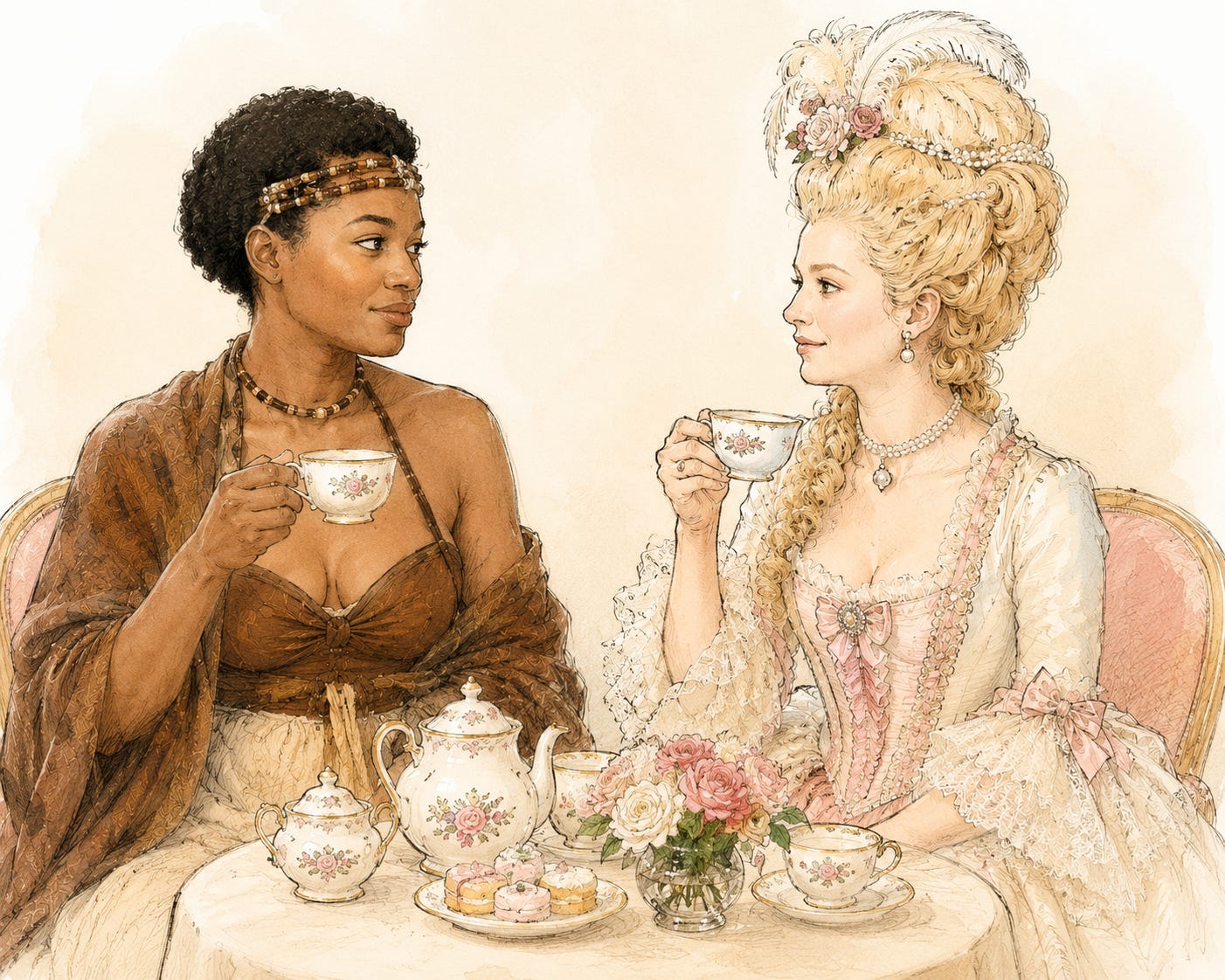
In later iterations, the work shifted tone. I presented Wildcard in academic and community spaces where satire replaced immersion. The setting became Club Afterlife: a liminal space where history loosens its grip long enough to be examined differently. Here women of history who have faced undue objectification could imagine a new end to their stories.
Marie Antoinette and Saartjie Baartman were not adversaries. They were unlikely companions — two women shaped by spectacle in different centuries, comparing notes — yet history had flattened them into symbols. In this imagined afterlife, they could speak.
The metaphor was simple: Can you perform a whole-bodied act in parts? Can you separate intellect from flesh, head from torso, history from body — and still succeed? Marie strategizes. She intellectualizes. At one point, she even removes her head, determined to prove that thought alone can win. She still loses. Saartjie stays intact. The body refuses fragmentation.
At one conference, I invited the audience to test the theory. We found ourselves — academics in sensible shoes included — bending backward beneath an imaginary bar in a hotel ballroom. It was slightly absurd. But it was also clarifying. We were all trying very hard to understand embodiment. Then we had to embody it. Embodiment cannot be footnoted. Integration cannot be compartmentalized.
In the years following the pandemic, conversations around identity and representation intensified across artistic spaces. Statements often came before movement. Language grew sharper. Expectations became more explicit. I felt the subtle pressure to position myself before I moved — to define my place in the conversation before making the work. Instead, I found myself asking a quieter question: Was I aligned with the work I was making? Not politically aligned. Not rhetorically aligned. Ethically aligned. Nearly nine years of sobriety have taught me the difference between intensity and clarity. I know what heat feels like. I also know what quiet feels like. If Wildcard was going to survive, it needed alignment — not proximity to trauma, not institutional approval.
Before literary ghosts entered the room, the name Faulkner already lived in my family. My great-grandmother was Marie Faulkner. The story began at a kitchen table long before it entered theory. Choosing the pen name M. Octavia Faulkner was not an attempt to borrow weight. The “M.” holds two lineages — my great-grandmother Marie, and Mary Shelley, whose stitched creature once echoed in my studio experiments. Blood and imagination. Inheritance and invention.
Wildcard is evolving into a larger work — part satire, part embodied inquiry- and what I call a “satirical séance.” Unlike the private haunting of misalignment, this séance is communal. It invites participants to call history into the room not to reenact spectacle, but to examine it together. The workshops that accompany the piece are designed as spaces of reconnection rather than division. Through movement, dialogue, and humor, participants explore what it means to remain whole — to resist fragmentation in their own thinking and bodies. The aim is not accusation, but integration. Wholeness is not achieved in isolation; it is practiced in relationship.
The FAIR Artist Grant supports this developmental stage: rehearsal time, collaboration, embodied testing. Applying did not feel like chasing validation. Receiving the grant did not feel like triumph. It felt like seeking and making room. Room to draft. Room to test. Room to build without constructing another cage. Saartjie — Lady Sarah — is no longer displayed. No longer compartmentalized. No longer engineered.
FAIR’s support allows Wildcard to move from concept into embodied experimentation, where these questions live not just on the page, but also in the body and in the community. The tell-tale heart I once tried to engineer into the floor was never Baartman’s alone. It was my own misalignment, beating louder each time I tried to bury it beneath structure, theory, or spectacle. I mistook intensity for truth. I mistook volume for clarity. Alignment does not silence the heart. It steadies it. Fully whole, she wins, we all win — and in her wholeness we are reminded that none of us stand intact alone. The script is still in progress. The stage is waiting.
We welcome you to share your thoughts on this piece in the comments below. Click here to view our comment section moderation policy.
The opinions expressed here do not necessarily reflect those of Fair For All or its employees.
In keeping with our mission to promote a common culture of fairness, understanding, and humanity, we are committed to including a diverse range of voices and to encouraging compassionate, good-faith discourse.
We are actively seeking perspectives on this topic and others. If you’d like to join the conversation, please send completed drafts to submissions@fairforall.org.
