

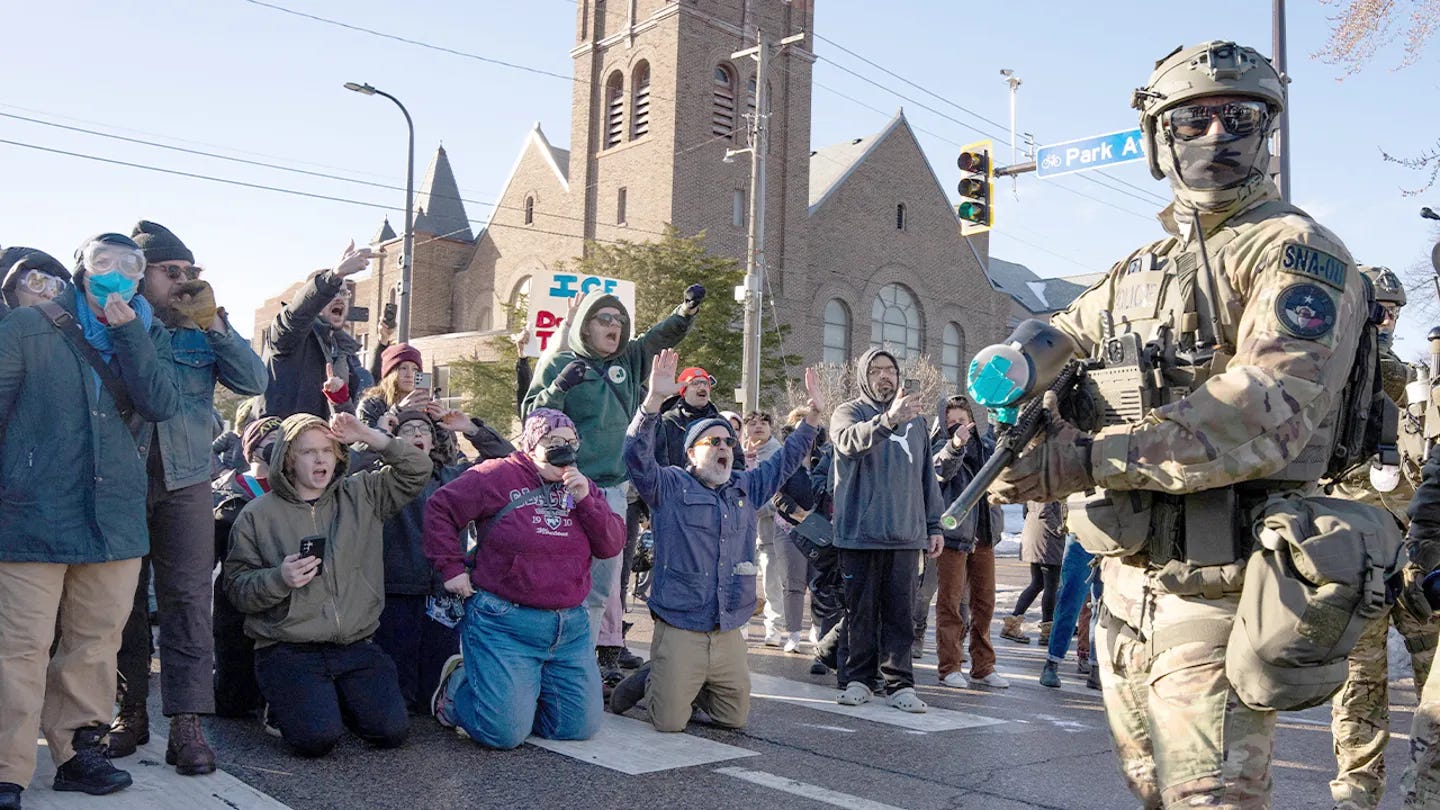
On January 18, 2026, protesters disrupted a church service to demand “justice” for Renee Good and an end to immigration enforcement, violating a social norm that most people still regard as basic. Scenes like this have become less unusual in recent years. As protests against ICE continue, sometimes escalating in troubling ways, I find myself, along with many others, caught in an uncomfortable position. I agree that ICE has overreached, violated long-standing norms, and in some cases may even have crossed legal boundaries. And yet, despite sharing many of the protesters’ substantive concerns, I often find myself unable to support the way those concerns are being expressed.
This feeling isn’t new. I’ve experienced it with left-wing protest movements since at least 2020. There is something about them that feels misguided and unserious, even when the cause itself is serious. I notice it in my own reaction: a sense of discomfort when I see peaceful anti-ICE demonstrations, raised fists, and familiar slogans, even though I broadly agree with their message. At the same time, that same reaction doesn’t surface when I think about the events of January 6, 2021, which struck me as tragic and dangerous rather than performative. Nor did I feel it watching the Hong Kong protests of 2019—a movement that still fills me with admiration for the protesters’ courage and sadness over their defeat. Why does one form of protest inspire respect, while another—closer to home—elicits unease? Is this simply bias, or something more structural?
I think it is more than bias, and that understanding the difference matters. If we want to draw attention to injustice, and to real risks of authoritarian drift in the United States, we need protest movements that persuade rather than alienate.
By “left-wing” protest movements here, I mean familiar examples: anti-ICE demonstrations, Black Lives Matter protests and the unrest associated with them, and recent anti-Israel protests. What unites many of these movements is not their goals, but the way those goals are pursued. Too often, moral seriousness is replaced by moral performance. Emotional expression, symbolic disruption, and a sense of assumed righteousness are elevated over discipline, proportionality, and concrete, achievable change.
Many protesters clearly see themselves as heirs to the civil rights movement. But the comparison often falters. When we look back at Birmingham in the 1960s, we see protesters who faced violence and humiliation with restraint and dignity, exposing injustice without reveling in it. Today’s protests frequently project a tone of sarcasm, contempt, and theatrical outrage. Rather than appealing to the conscience of broader society, they often signal belonging to an in-group that already agrees.
There is also a difference in risk that matters. The protesters in Hong Kong faced a genuine authoritarian state, one willing to permanently destroy their futures. In contrast, American protesters—while sometimes unfairly arrested or mistreated, which should never be minimized—generally operate in a system where most will return home safely at the end of the day. Scale matters. Recognizing this does not diminish legitimate grievances; it grounds them in reality. When demands are framed in sweeping, absolute terms—“Abolish ICE,” for example—without clear legal pathways or specific reforms, the movement can appear less focused on solutions than on the act of protest itself. The result is a cycle where symbolic expression becomes the goal, and concrete outcomes remain secondary.
This tendency is reinforced by the use of extreme language. Allegations that ICE has violated due process rights are serious and alarming on their own. They do not need amplification through comparisons to the Holocaust or other historical atrocities. Hyperbole weakens credibility and signals that the primary purpose of the protest may be emotional release rather than persuasion or reform.
So where does that leave us, when political expression so often becomes a contest of outrage rather than a search for solutions? This problem is not unique to the left, but it is particularly visible there right now. A first step may be to disengage from social media environments that reward emotional escalation and flatten complex moral issues into slogans. We should also reaffirm basic civic norms. Sacred spaces exist, and they deserve respect. If the concern is government overreach, that concern should be expressed in ways that uphold, rather than corrode, shared public life.
Societies weaken when protest becomes primarily an outlet for rage, and when spectacle replaces persuasion. Protest is most powerful when it appeals to our shared humanity—when it treats even opponents as people capable of being convinced, rather than obstacles to be shamed.
If we can return to forms of protest that are disciplined, humane, and oriented toward real change, then exercising the right to dissent might once again feel like a serious moral act rather than an empty performance.
We welcome you to share your thoughts on this piece in the comments below. Click here to view our comment section moderation policy.
The opinions expressed here do not necessarily reflect those of the Fair For All or its employees.
In keeping with our mission to promote a common culture of fairness, understanding, and humanity, we are committed to including a diversity of voices and encouraging compassionate and good-faith discourse.
We are actively seeking other perspectives on this topic and others. If you’d like to join the conversation, please send drafts to submissions@fairforall.org.

You might also suggest spending more time thinking and examining your position. Is it really an injustice you are protesting? What is unjust in capturing people who have committed crimes? What is unjust about holding people accountable?
What is justice? If what is occurring is legal, how, specifically is it unjust?
Secondly, for whom are you actually protesting? Be honest. Is what you are doing helping someone else or really making you feel better?
I posit that most of Left-wing protesting is more about people shouting and belittling others to makes themselves feel better than addressing an actual injustice.
You wrote, "Societies weaken when protest becomes primarily an outlet for rage, and when spectacle replaces persuasion."
What you're missing is that the weakening of society is the real goal of the protests.
The particular causes which you ostensibly "support" are not what these protests are actually about. As Saul Alinsky wrote in Rules for Radicals (1971), "The issue is never the issue. The issue is always the revolution.”