

For most people, “where are you from?” takes three seconds to answer, but I need a moment.
As a kid, I never really knew what my mother tongue was. The first language I spoke was Russian. But we moved to Israel when I was six, and ever since, I think and dream in Hebrew. So which culture is the more accurate answer?
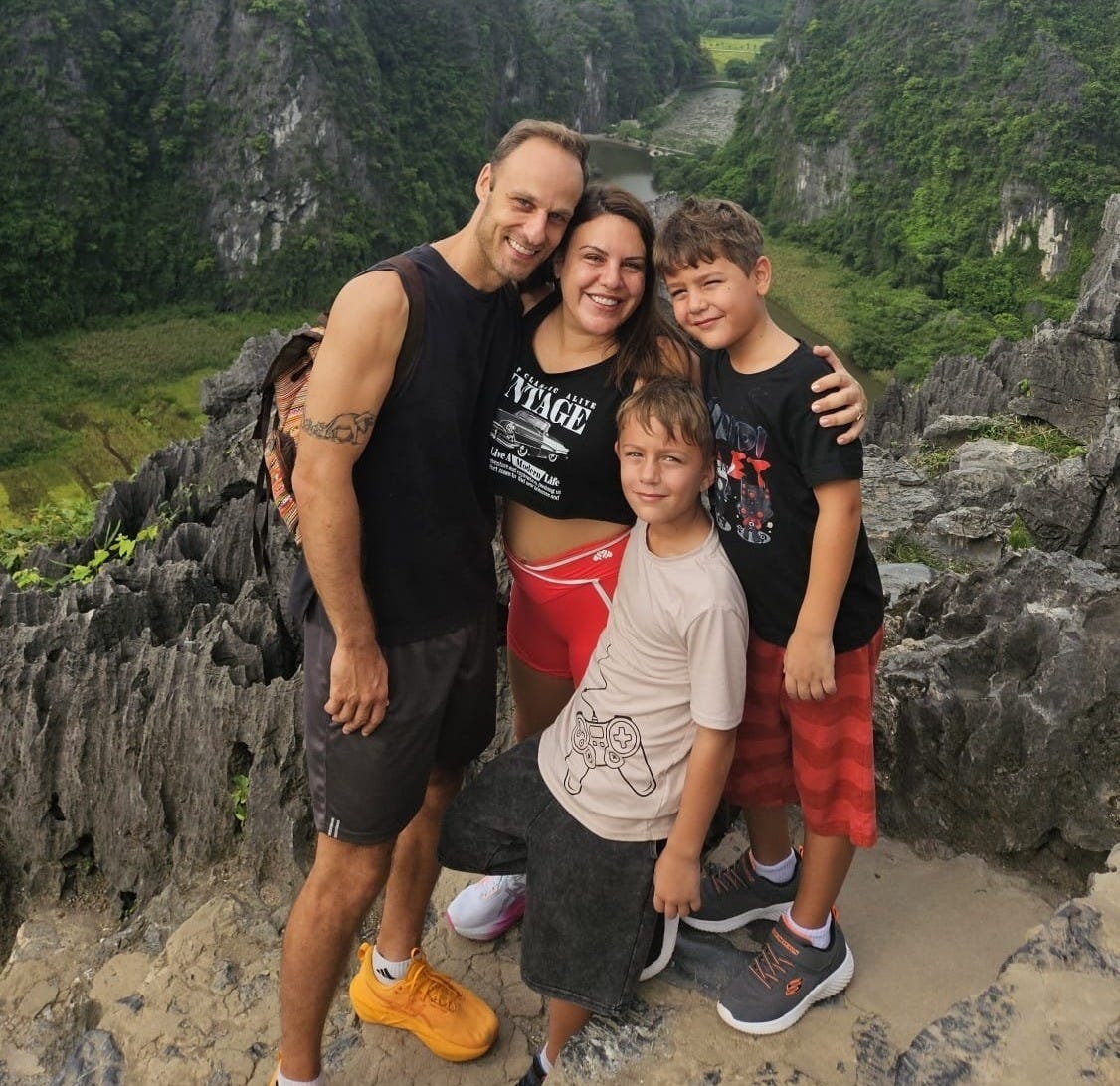
At 42, the question only got harder. I was born in Ukraine. I grew up in Israel. Now my wife Lital and I are raising our kids on an island in Thailand. If there’s a single clear answer, I still haven’t found it.
My parents left Ukraine for Israel with a box of vodka bottles, which they traded for bananas somewhere in Hungary along the way. They were running from a hard life toward a country that promised them safety and belonging–a tribe.
Thirty years later, their kid walked away from the stability they’d worked so hard to build.
I built my life on the foundations they provided, and I don’t blame them for the stability they worked so hard to create. But eventually, that stability started to feel less like a foundation and more like a ceiling. Everything was predictable, safe, and finished–and honestly, I was suffocating under all that certainty. I realized I needed a little friction just to feel alive. As it turns out, I’m not an outlier. I keep meeting other children of immigrants who are doing the exact same thing: walking away from the safety our parents fought for, not because we reject their struggle, but because it’s not the life we want to live.
For years in Israel, I could predict almost exactly what my life would look like ten years out. Not a bad life, just a predictable one. Same morning traffic, same supermarket, same news, same playgrounds, and the clarity, strangely, started to suffocate me. Apparently, I need some uncertainty to feel alive.
My wife Lital didn’t. She loved what we had. I understood that dragging her and the kids into an adventure she didn’t want wouldn’t end well, so I let the dream go.
And then a war started in our home, Israel. We flew to Thailand for two weeks, to spare the kids the worst of it.
The ability to simply leave, to seek refuge in a tropical paradise while the world we knew was consumed by conflict, is a privilege I know most don’t have. While others were huddled in shelters or facing the front lines, we were able to trade the sound of sirens for the sound of the ocean; a reality that carries a weight of its own.
Two weeks became two months. Two months became almost three years. Without ever intending to, we’d left our whole life behind.
A few months in, we had to fly to Cambodia for a visa run. I thought I was starting to understand Asia. Cambodia didn’t fit any pattern I had previously encountered.
Cambodia didn’t feel like another country, it felt like another planet. Even the airport was a ceremony: lines, entry fees, a police officer offering to move us up the queue with the kids for a little extra. I still don’t know if that was a bribe or an express lane. Even the money felt made up. Tens of thousands of the local currency for a coffee.
That sense of total disorientation–feeling like I’d landed on an alien world– forced me to see how much of my “clarity” was really just lazy pattern recognition. When everything from the money to the social codes becomes unreadable, your brain starts desperately scanning for any familiar anchor just to simplify things again. This is not to suggest one culture is superior to the other. As a multilingual, multicultural traveler, I have experienced the best and worst of many nations. Rather, in a world that often sends us out from our homes, away from our tribes and into places we can’t speak our mother language, familiarity becomes the ultimate comfort.
That was the hard part, actually: I couldn’t read the people around me. I came from a place where people mostly say what they think. Here, “yes” didn’t always mean yes, and a smile didn’t always mean agreement–sometimes it was just a way to keep the peace. Once I pressed my palms together and bowed to thank a taxi driver, the way I do in Thailand. He smiled, then shook my hand. I hadn’t broken a rule, I had just used the wrong cultural gesture. Living between so many shifting worlds meant I was constantly recalibrating, forever switching gears just to avoid stumbling over a cultural line I couldn’t quite see.
One night we had a Friday dinner with a group of Israeli travelers, and everything clicked at once. My people. Same humor, same codes, the same inside language you can’t fake. I felt safe before anyone had said a single real thing.
We all do this. We land somewhere strange and scan the room for someone who looks like us. Drop me into a world of aliens, and suddenly every human feels like family.
But the identity boxes aren’t fixed. That’s the part I didn’t expect.
Lital was sure no place but Israel could ever feel like home. Today she sings in Thai in the island bars, goes out dancing with Thai friends, trains Muay Thai, and has a Thai flag tattooed on her arm. She’s smashed every box that used to define her and built a life she couldn’t have imagined.
What does “where are you from” tell you about her?
It tells you perhaps where she was born or what her passport says, but it tells you nothing about her, who she is, or what cultures she truly belongs to.
And then there are the kids.
We recently got stuck in Vietnam for three weeks–another visa run. Almost every day we’d take the boys somewhere to burn off energy: a play zone, a roller rink, a park.
It never stopped amazing me. Every time I came to collect them, they were in the middle of a pack of Vietnamese kids, proudly introducing them to me: “Dad, I made two new friends.”
No shared language. No shared country. No passports checked. Just two new friends, in a city we were only passing through.
I went to Cambodia looking for my own tribe, just to feel safe. Lital learned you can belong to more than one. The kids don’t look for tribes at all, they just look for someone to play with.
Maybe that’s the real difference. Some of us have to understand a person before we’ll connect. Others connect first, and understand later.
When was the last time you met someone before it mattered where they were from?
About the Author:
Vic Levitin built four startups, then stepped off the default path to rebuild life from the ground up on a Thai island with his family. Writing about the experiment at viclevitin.com
We welcome you to share your thoughts on this piece in the comments below. Click here to view our comment section moderation policy.
The opinions expressed here do not necessarily reflect those of Fair For All or its employees.
In keeping with our mission to promote a common culture of fairness, understanding, and humanity, we are committed to including a diverse range of voices and to encouraging compassionate, good-faith discourse.
We are actively seeking perspectives on this topic and others. If you’d like to join the conversation, please send completed drafts to submissions@fairforall.org.

I like people who ask where I'm from. I ask people where they're from. It's interesting. Lital must have some great stories in her answer.