

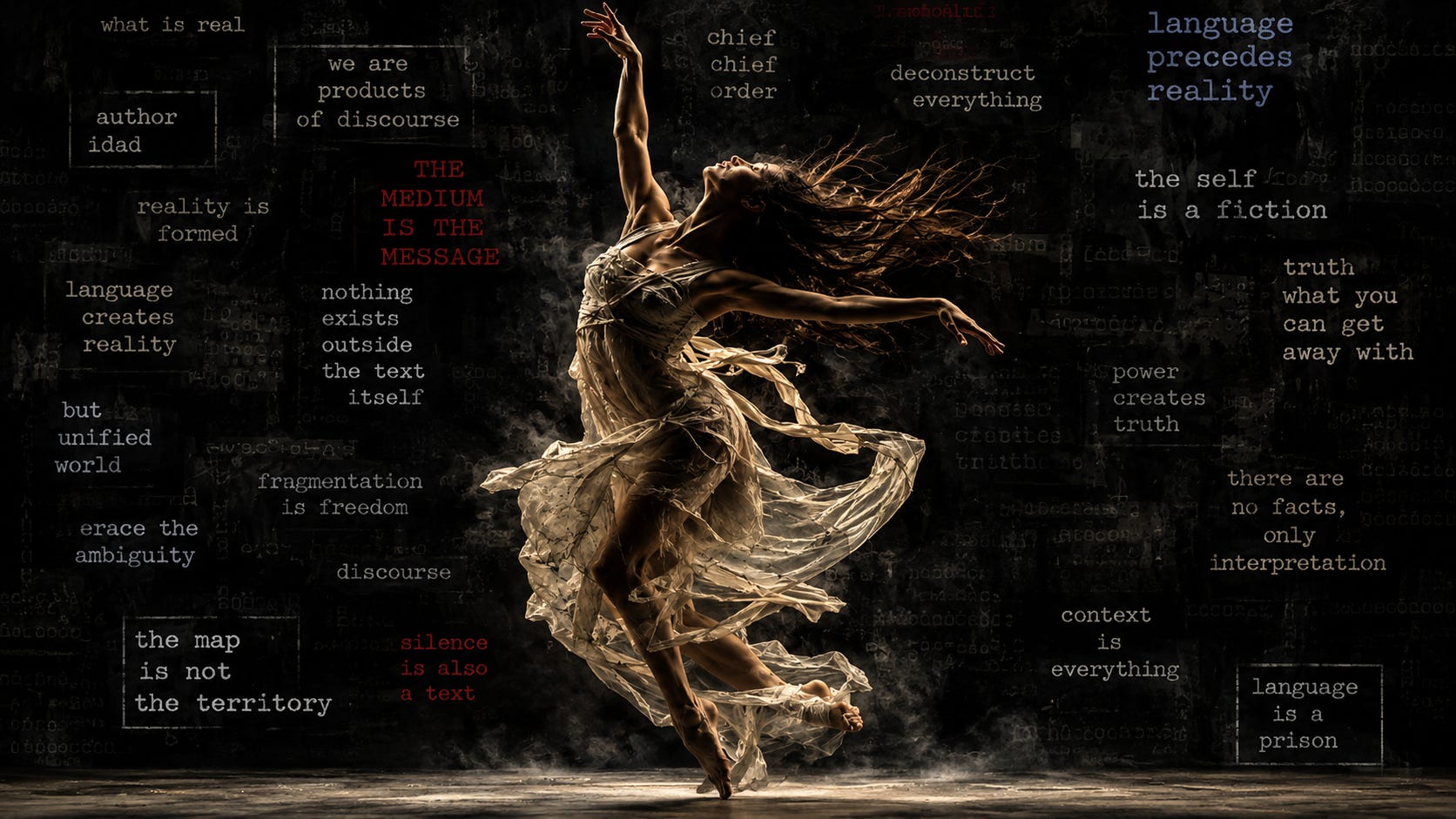
On September 15th, a federal judge temporarily blocked the University of California from enforcing portions of its harassment policy against members of Defending Education, an advocacy organization who supports the use of sex-aligned pronouns. According to the University of California’s Sexual Violence and Sexual Harassment Policy, referring to a person as “he” if the person identifies as “she” could be considered a violation. The dispute was ostensibly about free speech, but underneath lurked a stranger problem: two people can now use the same familiar words -- he, she, man, woman -- while understanding them to signify different realities. The federal court wasn’t called upon to define the words, but merely to referee what people may say.
I’ve come to accept that the state of the world and the many incongruous perceptions taking space within it cannot be successfully delineated, clarified, or even commented upon using words. Language is no longer a reliable means of communication in our convoluted, emotional world. Instead, it has become a tool for fomenting confusion.
So be it.
I’m turning instead to methods of expression that worked when I was a teenager, a time when life felt too vast and complicated for words, but also a time when I stood in awe of its mysteries and wanted to share my discoveries with others.
What did I do? I danced. I wrote poetry. I painted. I played music.
I Don’t Blame Wittgenstein
Ludwig Wittgenstein spent much of his philosophical life puzzling over the relationship between language and reality. His early work explored how language might picture the world; his later work emphasized that words acquire meaning through their use within shared forms of life. Hence his famous observation: “The meaning of a word is its use in the language.”
There was something hopeful in that. Language provided the common ground upon which human beings could construct and share meaning. Little did Wittgenstein know that language, as the structure upon which individuals and societies build a shared world, could also be used to dismantle that world.
This is what the Postmodernists figured out. But for all their intellectual ingenuity, Derrida and Foucault could not have constructed their sociopathic theories of post-structuralism without standing on the shoulders of earlier philosophers -- none of whom intended their work to justify the notion that changing the definition of a woman could change biological reality.
But here we are: chasing our tails and scratching our heads while words that once described the world are repurposed to reconstruct it. And we’re letting them do it, so putz on us.
To be fair to Wittgenstein, his argument was not that language magically manufactures reality. Nor did he claim that changing the meaning of a word changes the material world to which it refers. It was later that thinkers took Wittgenstein’s idea much further. Somehow, they didn’t realize that it was one thing to argue that the meaning of a word depends upon how we use it, and quite another to argue that language itself determines what we accept as truth.
It was in that journey, however, that an important distinction became blurred: the difference between changing how we describe reality and changing reality itself.
Enter an Inverted Babel
In the biblical story of Babel, people could no longer understand one another because they suddenly spoke different languages. Our predicament is the inverse: we speak the same language and use the same words, yet disagree about what those words mean. It raises the question: Is language necessary for us to think and make sense of our experiences? Does the mind need the structure of language to form ideas? And what happens when language is manipulated to the point that we can no longer use it to describe what we understand to be true and real?
We needn’t build a tower to find out. The University of California’s harassment case offers a curious example: two people can speak the same language, use the same words, and nevertheless inhabit different systems of meaning. Thus, does altering language reveal a truer truth? Or can truth instead be covered over by using language as a weapon against it?
All this is a long way of explaining why I’ve had difficulty writing about the state of the world and my experiences within it. The tool upon which I depend to communicate–language itself–has been poisoned.
Just as a traveler with a corrupted compass cannot trust the direction it gives, I can no longer trust that the words I choose to write or speak will carry my thoughts to another mind intact.
I find myself rewinding to my teenage years, when words also seemed inadequate. I turn again to dance, painting, poetry and music and to the nuanced forms of expression that can sometimes communicate what language cannot.
I do not believe changing language can change reality. Truth is not downstream of language. And I believe there remain ways of expressing ourselves that allow us to inhabit and share the same world.
Advice to the poets, painters, dancers and musicians: emerge from the ideological rubble while you still can. Tell your policy makers, your school boards, your galleries, theaters, and legislators that there’s no such thing as “chest-feeding.” It’s called “breastfeeding.” Make it known that boys’ bathrooms do not need a supply of tampons. Do this before someone decides that Madonna and Child must be renamed Person Who Gave Birth and Child.
This is the vision behind FAIR in the Arts: to bring together artists who believe creative work flourishes in an atmosphere of freedom, intellectual curiosity and the representation of truth. Through groups for writers, playwrights, poets, visual artists, filmmakers, performers and other creative disciplines, we’re building a professional community committed not to a common ideology, but to the freedom necessary to create. We want artists to find one another, support one another and bring ambitious work into the world. When we’re ready to try our minds at language again, we can bring back the philosophers.
Until then, we shall dance.
And write poems.
Ascending
Out of the chaos of the cosmos,
Beyond earth and sky,
Beyond the outstretched plains, where the
tumbleweeds blow over dusty roads,
it is time for us to move on
and make for ourselves
a home
that is comfortable and
remembers what we have almost
forgotten.
We welcome you to share your thoughts on this piece in the comments below. Click here to view our comment section moderation policy.
The opinions expressed here do not necessarily reflect those of Fair For All or its employees.
In keeping with our mission to promote a common culture of fairness, understanding, and humanity, we are committed to including a diverse range of voices and to encouraging compassionate, good-faith discourse.
We are actively seeking perspectives on this topic and others. If you’d like to join the conversation, please send completed drafts to submissions@fairforall.org.

"...I’ve had difficulty writing about the state of the world." I disagree. This is a wonderfully written and insightful post. The most important part is the call to action at the end: we must speak what is true. Recently, I was particularly offended when I heard my state assembly rep refer to abortion as 'reproductive justice'. Whatever one's position may be, let's not sugar coat it.