

Dear Friends of FAIR,
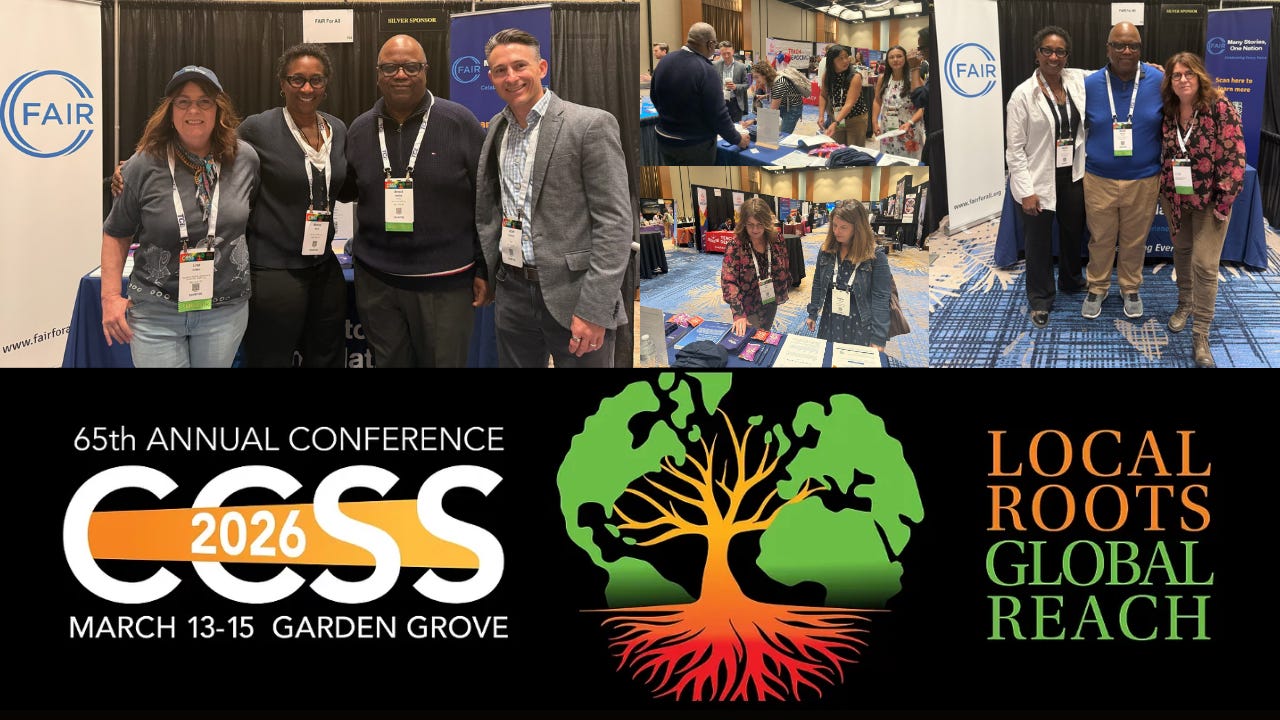
Last month, FAIR attended the California Council for the Social Studies (CCSS) conference in Garden Grove, and what we encountered there reinforced our belief that we have created a solution educators genuinely need.
Dr. Adam Seagrave’s presentation, How to Teach the Declaration of Independence and Ethnic Studies Together, drew a standing-room-only crowd. Educators were invited to explore the Declaration’s meaning across diverse American historical experiences and its global resonances, while engaging directly with primary sources, lesson plans, and other materials from Many Stories, One Nation. The interest was visible in real time. While Dr. Seagrave was still speaking, I watched several attendees visit FAIR’s website to examine the curriculum for themselves.
The energy carried over to our exhibitor booth the next day. Teachers stopped by specifically to say they had attended the session, found it compelling and thought-provoking, and wanted to learn more. Many signed up to receive information about bringing Many Stories, One Nation to their schools.
But what struck us more than the number of teachers who stopped by was what they told us. Teachers expressed the kind of urgency that comes when people feel a need acutely and are relieved to discover that a solution exists.
Again and again, educators told us they were drawn to Many Stories, One Nation for reasons that go to the heart of how FAIR’s curriculum was designed. Rather than treating the experiences of ethnic groups in isolation, our approach is chronological and integrated. Students encounter different communities in historical context as participants in a shared American experience, grappling together with the forces that have shaped the nation across time. Teachers told us this felt both more honest and more teachable than curricula that silo groups into separate, disconnected units. One educator described it as the difference between a mosaic and a collage: the pieces in Many Stories, One Nation actually connect.
The civil discourse component generated its own wave of enthusiasm. Teachers described classrooms that have become genuinely difficult to navigate, where students arrive with strong, often opposing convictions about history, identity, and belonging, and where a single discussion can fracture rather than build community. Several told us they had been looking for structured tools to help students engage across those differences with both rigor and respect. The civil discourse exercises woven throughout Many Stories, One Nation gave them exactly what they had been searching for: a pedagogically grounded way to model disagreement without division.
Perhaps the most surprising conversations were with teachers whose schools have already adopted Ethnic Studies curricula. Several educators approached us specifically because they were looking for a balanced alternative that met California’s Ethnic Studies standards while offering a more unifying frame. They were frank about the limitations they have encountered with existing materials and genuinely curious about whether Many Stories, One Nation could serve as a complement or a replacement. That these conversations happened at all is a measure of how much space exists in the market for what Fair For All has built.
The FAIR team left CCSS with something we did not entirely expect: momentum in a state that has led the national push for Ethnic Studies mandates. We are actively following up with the educators we met and are more confident than ever that we will reach our goal of introducing Many Stories, One Nation in five schools this fall. Our conversations in Garden Grove, and the enthusiasm we encountered at the Minnesota Council for the Social Studies conference in February, tell the same story: educators are ready, and the demand is real. To meet it, we need your help.
If you are a California or Minnesota educator interested in learning more, we would love to hear from you: info@manystoriesonenation.com. If you are a supporter who wants to put this curriculum in front of more teachers, here is what we are working to fund right now:
On-the-ground professional development. A curriculum is only as strong as the teachers who deliver it. We are committed to providing in-person training and ongoing support to every school that adopts our curriculum, and we need resources to make that possible.
Expanding the curriculum from one semester to a full year. A full-year course would deepen student engagement and broaden adoption possibilities in schools planning their fall schedules.
Aligning the curriculum with Minnesota’s Ethnic Studies standards. The enthusiasm we encountered in Minnesota was real, and we intend to honor it. Alignment will require an additional review by the Johns Hopkins School of Education, and we are ready to move forward the moment funding is in place.
Fall is closer than it seems. Schools are making curriculum decisions now, and every week matters. If you believe, as we do, that American students deserve an ethnic studies education that unifies rather than divides, please consider making a gift today.
Every gift helps us grow this curriculum, reach new states, and train more educators to teach an American story that includes all of us.
With gratitude,
Monica Harris
Executive Director, FAIR

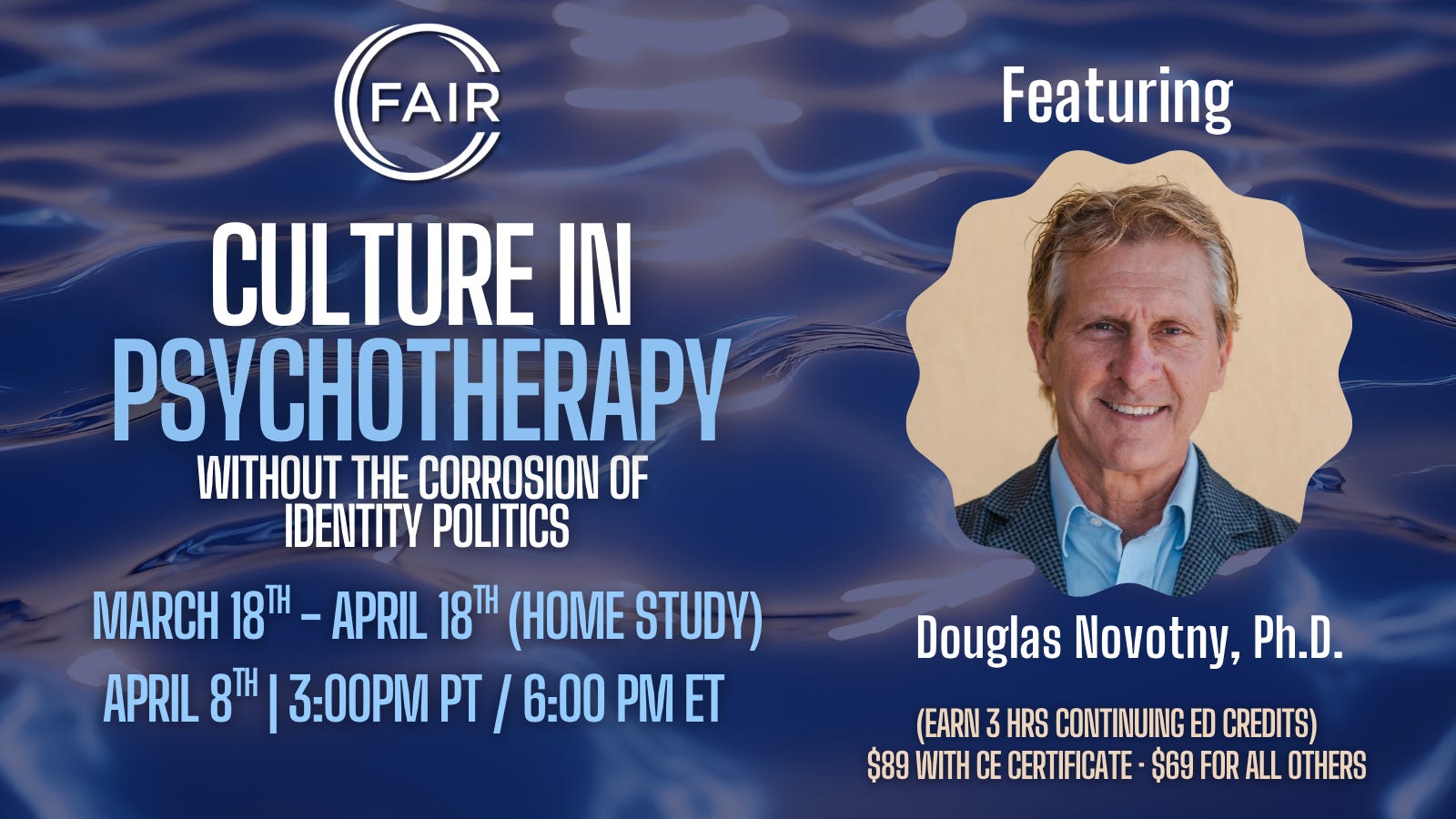
Culture in Psychotherapy — Without the Corrosion of Identity Politics
Join FAIR in partnership with Dr. Douglas Novotny for this upcoming course: Amid today’s culture wars, Identity Politics has corroded the teaching and practice of psychotherapy. Many people on both sides feel distrustful, alienated, and/or demoralized. This course gives a structural model for clinical work that re-enlivens moral depth — without moralism. The goal of this course is to clarify concepts and conflicts that impact both daily life and clinical settings.
Research indicates that ideological diversity — seeing topics from different points of view — improves psychology. This course builds on FAIR Advisor Jon Haidt‘s Moral Foundations Theory, a cultural lens to grasp differences across cultures, within cultures, and the experiences of clients and students encountered by therapists. Specific clinical applications will be explored, and critiques and competing moral models will be considered. This structural model helps to explain interpersonal divisions (and intra-psychic ones) and offers ways to bridge them through deep cultural understanding and relational attunement.
This course is available now March 18th - April 18th (self-paced Home Study) and April 8th. Course fee: $69 (+ $20 if requesting Continuing Ed. Certificate)
P.S. Read Dr. Doug Novotny this week on our Substack:
Invasion of the Body Snatchers: Identity Politics and the Soul of Psychotherapy

In Invasion of the Body Snatchers, alien pods overtake people one by one. Each person looks the same but something essential is missing: warmth, individuality, and the emotional presence that makes human connection possible.

The Lost Art of Listening: Building Empathy Across Differences
Join FAIR Advisors John Wood, Jr. and Ilana Redstone for this upcoming webinar, moderated by FAIR Executive Director Monica Harris. We will discuss the need to develop emotional intelligence and perspective-enhancing skills and how deep listening strengthens democratic participation and community bonds. This theme also supports FAIR's commitment to respectful civil discourse, which is a foundational element of our Many Stories, One Nation curriculum.

The Open Therapy Institute (OTI) is at the forefront of a burgeoning area of mental health care, developing innovative, evidence-based tools to help people, support professionals, and address social issues. Whether you’re a mental health professional, a patient, the leader of an organization, or just a citizen looking for openness and dialogue, OTI is developing solutions to help make things better.
Membership is for professionals in mental health fields including psychologists, counselors, social workers, psychiatrists, psychiatric nurses, pastoral counselors, and researchers. Membership is open to applicants internationally.

FAIR Educator Alliance 2025-2026
FAIR has launched the Educators Alliance for the 2025–2026 school year to equip PK–12 educators with the knowledge, strategies, and community support they need to foster schools that are more enriching and free from bias for students and educators.
Each monthly gathering will open with updates and presentations from FAIR staff, fellows, Chapter Leaders, and occasional guest speakers. Together, we’ll explore strategies to support educators, communities, and local chapters—and to advance positive change at the local, regional, and national levels. Following the presentations, participants will have space for open-forum discussions to connect, seek advice, and coordinate on pressing issues in their schools. Breakout rooms will be divided into PK-6 and 7-12 grade levels with experienced teachers facilitating those conversations.
Meetings: First Thursday of each month at 7 PM ET via Zoom
Duration: 1 hour

Note to readers: We have paused the FAIR News podcast. If you prefer listening, rather than reading these newsletters, an audio version is available directly on the Substack app. Thank you for tuning in!