

In Invasion of the Body Snatchers, alien pods overtake people one by one. Each person looks the same but something essential is missing: warmth, individuality, and the emotional presence that makes human connection possible.
Identity politics can captivate minds in a similar manner. Intelligent, well-meaning people with common-sense can be misguided by the rigid framework of “us-against-them;” “oppressor vs. oppressed.” This ideology foments dehumanizing trait categorization, flattens identity, and heightens division.
All of us are vulnerable to collapsing our ideas into ideology, and it appears across the political spectrum. It’s deeply concerning when politicians practice such divisiveness. It’s an abdication of authority when “experts” promote activism. It’s sad when it affects personal relationships. But it’s especially damaging when it enters psychotherapy —a field entrusted with expanding, rather than constricting human understanding. Therapists should be working to simultaneously enhance the better angels of our nature and our culture’s nobler aspects, like the sanctity of individual character.
As I’ve written elsewhere, the confusion begins with the misuse of the word “culture.” Properly understood, culture is a rich tableau through which we grasp and express meaning, and transmit it to the next generation. It includes “high-culture” — art, literature, ritual -– but also involves countless everyday practices that express values just as powerfully: how parents teach children right from wrong, how families resolve conflicts, and how disagreements are handled within communities. Attending to such things carefully is central to good clinical work.
However, “culture” is increasingly becoming equated with identity politics and reduced to immutable identity characteristics such as race. When this happens, culture becomes an over simplified, one-dimensional lens that emphasizes group differences while obscuring individual variation. This is not culture in its full sense, but a diminished version of it.
Many clinicians feel that cultural and political tensions have become pervasive and difficult to navigate. Psychologist Jon Haidt says that, since 2012 or so, we’ve been in a period that’s “Uniquely Structurally Stupid.” I agree and propose that identity politics ideology is a structural part of the problem, (mis)guiding all of society and making it difficult to address ideas intelligently, issue by issue. The ideology is a framework, and as long as the framework remains intact, the individual battles are endless and exhausting.
To address the “Structural Stupidity” problem we must build “Structural Intelligence.” Until we have a structure that is flexible, reciprocal, deep and generative, no efforts will make lasting gains. Psychotherapy once placed greater emphasis on “character structure” — exploring personal psychological patterns with nuance, depth, thoughtfulness, and relational awareness. We must revisit this kind of structural thinking in order to help restore balance in how we approach culture, identity, and meaning in clinical work.
People alienated by identity politics and “the culture wars” often feel demoralized, and the field of psychotherapy, like much in the West, has systematically hollowed out its moral sensibilities. People feel demoralized in the ordinary sense: discouraged, exhausted, and unsure how to respond. But they have also been “de-moralized” in a deeper sense; stripped of the moral language and moral confidence they need to push back. And this is particularly an issue in the field of psychotherapy, where clinicians may find themselves hesitant to engage moral questions at all even when they are central to a patient’s experience.
In contrast, identity politics activists are intensely moralistic. Narratives of critical social justice: white supremacy, colonial oppression, patriarchy, and the like, are delivered with intense moral alarm. If clinicians fail to recognize or accept the moralized terms and tone, then any amount of reason, evidence and civic principles risk being blown away in the moralistic bluster. In fact, a calm tone could be received as dismissive, for implicitly failing to acknowledge the fiery heat of the grievances.
Psychotherapy needs to meet the moral moment. Though our field used to be populated by priests and shamans, the spiritual and moral aspects of our work have been largely stripped away. Some of us are religious believers, but one needn’t be religious to remember that “psyche” actually means “soul.” It’s to our detriment that the values-based, soulful, or spirit-aspects of mental life, identity and relationships have been expelled. This is a major error, and one that must be remedied without sinking into moralism, reactivity, or tribalism. Haidt’s Moral Foundations Theory offers one possible framework for rebuilding “structural intelligence” in a balanced and clinically relevant way.
It becomes clear how urgently we must act when we see how identity politics actually distorts clinical work in practice. When politics overrides clinical reality it’s the patients we seek to heal who suffer most.
In one case, a group of colleagues working with Spanish monolingual immigrant families were (at first) clear eyed about the challenges in this community. They spent years decrying clients’ predatory family members who crossed the southern border, often gang members and repeat criminals. They lamented the pattern of those family members being deported only to return again and again, menacing the community and the families we treated. That ended with the 2016 election, when a 180-degree reversal occurred, and those same colleagues suddenly talked in lockstep about how “horrible” it was to enforce immigration laws. Patients suffered as a result, as did the clinical work and thinking required to help these families in truly dangerous, often vexing situations. The ideology had invaded.
In another case, a treatment team struggled to properly engage with a situation involving a mother who repeatedly attempted to murder her young daughter (and who had herself been abused by her mother as a child). People like this woman need their violent tendencies recognized and dealt with properly. However, due to the identity politics framework which views all women as “oppressed” and men as “oppressors,” care-provider attention remained focused on the child’s absent father whose behavior, while relevant, did not represent the most immediate danger. Instead, pre-existing assumptions about gender roles shaped clinical care in ways that limited responsiveness to the actual circumstances.
These examples are not about assigning blame. They illustrate how pre-formed narratives — of any kind — can narrow perception and interfere with careful clinical judgment. Therapists must remain attentive to clinical patterns of emotion and behavior, without relying on oversimplified identity-based narratives.
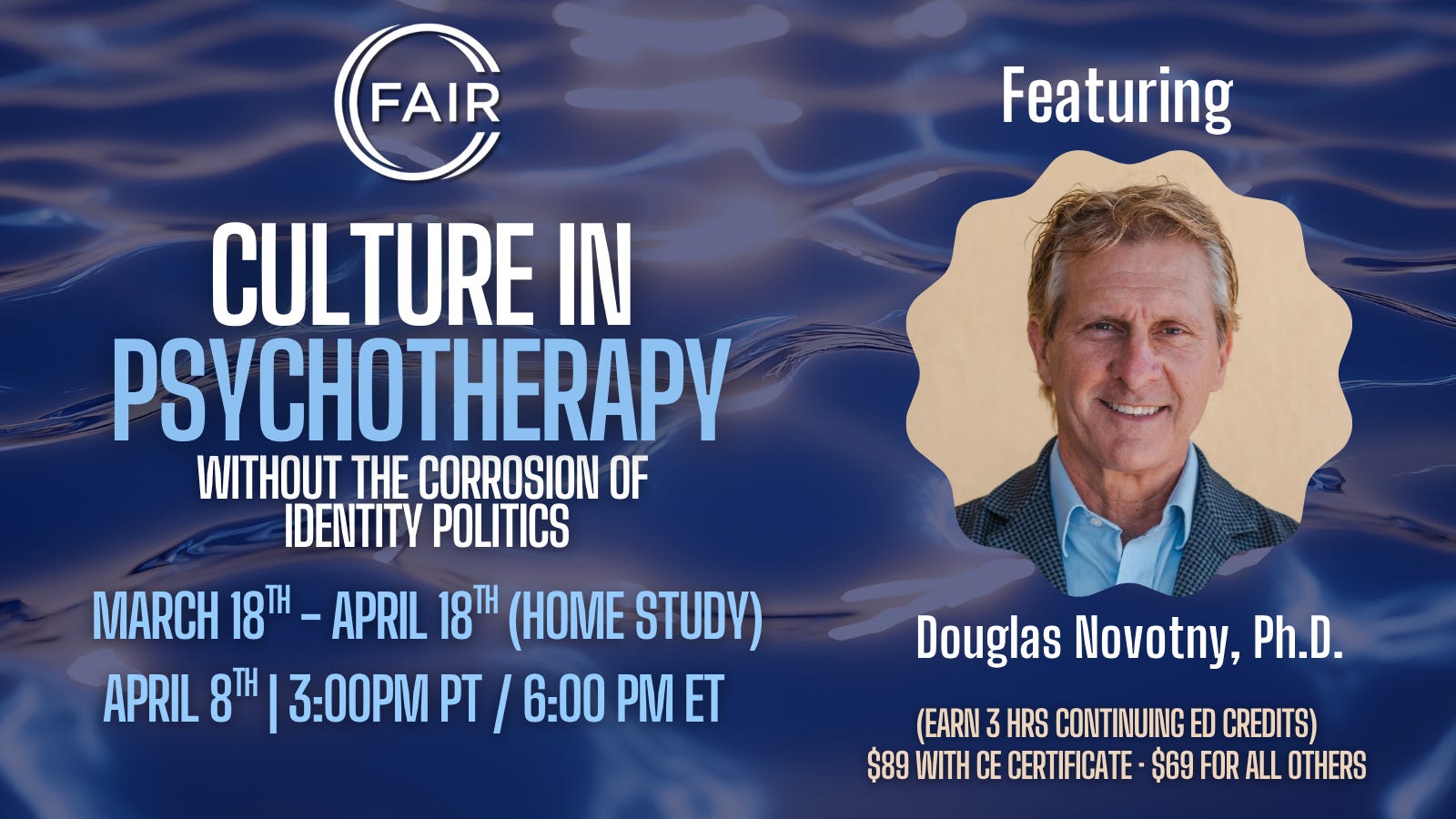
Developing more structurally intelligent approaches to culture and morality is both possible and necessary. That’s why I have partnered with FAIR to create a Continuing Education course that invites participants to explore frameworks that support deeper understanding, richer clinical thinking, and greater openness to the moral, cultural, and even soulful dimensions of psychotherapy.
Whether you’re a practicing clinician struggling to navigate cultural issues authentically, a trainer concerned about ideological constraints in professional education, or just someone committed to finding a more humane and effective approach to psychological practice, I invite you to join me and other FAIR-minded mental health workers to explore these ideas live on April 8th, or at your convenience through pre-recorded Home Study available now through April 18th.
The task is ambitious and cannot be completed in a single session. But developing a clearer outline and a shared language for these challenges is an important step forward.
Register for Wednesday, April 8th
Register for Home Study
We welcome you to share your thoughts on this piece in the comments below. Click here to view our comment section moderation policy.
The opinions expressed here do not necessarily reflect those of Fair For All or its employees.
In keeping with our mission to promote a common culture of fairness, understanding, and humanity, we are committed to including a diverse range of voices and to encouraging compassionate, good-faith discourse.
We are actively seeking perspectives on this topic and others. If you’d like to join the conversation, please send drafts to submissions@fairforall.org.

I am not a psychologist, so will not be taking your course. However, I just wanted to comment that it seems to me your work is very important.
Thank you for your thoughts on an often very challenging and dividing topic. I have been very interested lately in learning about the rise of polarisation in modern culture, so thank you for adding some more to the picture here. I would be interested to hear your perspective on some of the many polarised debates in education circles (education being more my area of focus at the moment), particularly in regards to political issues (such as identity politics) being discussed in primary schools, for example. Many thanks again, and I look forward to more from you