



Has a Loss of Community Created a Mental Health Crisis for Today’s Youth?
Zarina Macha (The Rational Female) examines the growing mental health crisis among young people and asks whether declining social connection may be part of the problem. Macha explores the effects of smartphones and social media alongside the decline of religion, civic life, and other sources of shared purpose and belonging. She considers what secular society can offer in their place, arguing that young people need meaningful community, structure, and a sense of purpose—not necessarily a return to traditional belief.
“People need community to feel connected to something greater than themselves. We need not return to superstitious beliefs to achieve this. What we need is a philosophy of how to live well, how to treat others, and how to take responsibility for ourselves and our communities — without asking the individual to disappear, and without leaving the individual to invent a whole moral world alone.”

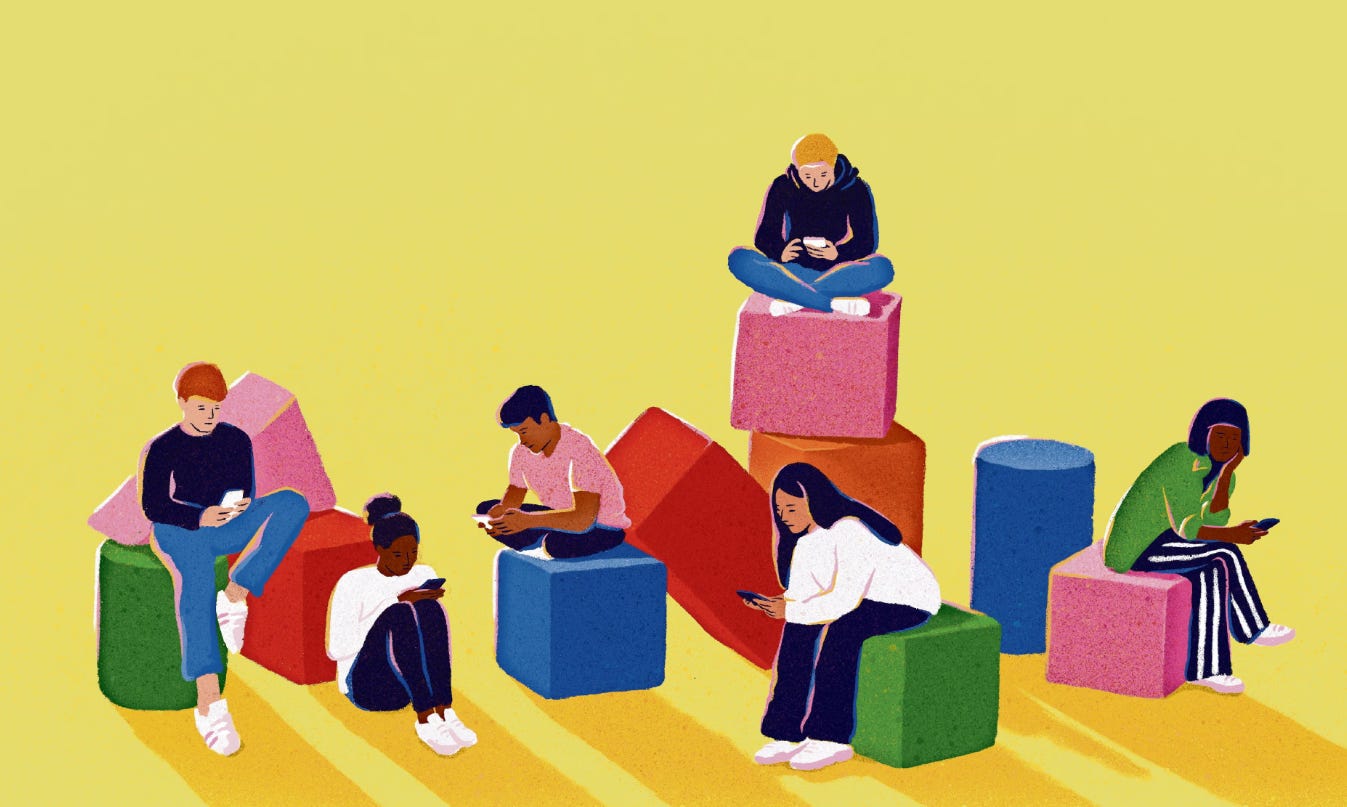
Illustration by Anna Broadhurst.
Generation Anxiety: smartphones have created a gen Z mental health crisis – but there are ways to fix it
FAIR Board of Advisors member Jonathan Haidt examines the rise in anxiety, depression, loneliness, and self-harm among young people and the potential role smartphones and social media have played.
Haidt argues that Gen Z was the first generation to experience adolescence with constant access to an online world, contributing to a decline in face-to-face interaction, physical play, and other forms of real-world social connection. He describes this shift as a “Great Rewiring of Childhood” and argues that addressing its effects will require collective action from parents, schools, and communities.
“People don’t get depressed when they face threats collectively; they get depressed when they feel isolated, lonely, or useless…”


One Reason People Are Spending So Much Time Alone
As young people face rising levels of loneliness and social isolation, one question is becoming increasingly difficult to ignore: have we designed human connection out of everyday life? In The Atlantic, Gabe Bullard examines how modern conveniences—from delivery services to self-checkout and other frictionless technologies—can quietly eliminate the small, ordinary interactions that once brought people together. His piece offers a broader perspective on the social disconnection explored in Zarina Macha’s essay, asking whether a culture built around convenience and individual choice may also be making community harder to sustain.
“When showing up for others feels hard, some strugglers have lately steeled themselves with a version of this maxim: “Inconvenience is the cost of community.” It’s a reminder, oft-repeated on social media these days, that if you don’t want to be lonely—if you want to have robust relationships—you should occasionally do things that are effortful or even irritating…”