


The Antidote to America’s Educational Decline
For FAIR’s Substack, Karen Howes writes about FAIR’s new American Experience Curriculum that offers a path for teachers to move away from indoctrination and towards encouraging a wonder that prompts questions, exploration, and discussion.
I’ve had the opportunity to review several of the lessons in the American Experience Curriculum, which is currently being evaluated by Johns Hopkins University School of Education. The course is grounded in the principles of liberal education, and provides students and teachers with the tools to engage in informed and thoughtful dialogue, as well as navigate historical and contemporary complexities.
FAIR’s curriculum encourages students to examine primary texts, analyze philosophical debates, and consider diverse perspectives. They are guided to not only build historical knowledge but also the habits-of-mind essential to democratic life: intellectual humility, analytical reasoning, and respect for others.


Why AI — not DEI — could be society’s great equalizer
For the New York Post, FAIR’s Executive Director Monica Harris writes about AI’s potential to shift how we define our worth and purpose.
This includes rethinking vocational education, investing in digital fluency across sectors, and honoring skilled trades not as fallback options, but as integral components of a resilient and equitable workforce.
The coming disruption isn’t just technological; it’s philosophical. As AI challenges the value of human labor, it will force us to reconsider what makes us valuable beyond our economic output.
This recognition of our common humanity could serve as the foundation for a new kind of inclusion, one defined by our shared vulnerability, adaptability, and inherent dignity in a machine-accelerated world.

The Age of Feelings
For National Review, FAIR Advisor Robert P. George writes about how we might label our age.
The antidote to all this is a renewed commitment to getting at the truth of things–especially the great moral and political questions that divide and vex our fractured society. The truth, not “my” truth or “your” truth–because, contrary to what many influential voices in our culture, politics, and even our institutions of higher education would have you believe, the truth about even the most controversial matters can be objectively known and cannot be altered by one’s subjective feelings or “lived experiences.” Indeed, one’s acknowledgment of truth’s objectivity is essential if one is to be what we should all strive to be, namely, committed truth seekers and courageous truth speakers. From the morality of intentional killing and the meaning of marriage to more abstract philosophical and theological propositions, there are right and wrong answers to these questions.

Whose school is it anyway?
For the Fordham Institute, FAIR Advisor Robert Pondiscio writes about why public schools cannot be both a core government service and a platform for personal or political expression.
There are two ways to respond to this. You might choose to be reassured. At least the district isn’t mandating the content. No one is forcing teachers to use it. But this invites a second thought, potentially more urgent and troubling: Hold on a second. Who gives teachers—public employees with prodigious influence over a captive audience of other people’s children—the license to choose such a politically charged curriculum? And how were school district personnel empowered in the first place to create such an aggressively political curriculum at taxpayer expense? What democratic process or recognized public authority gives them this permission? Philadelphia’s social studies materials were not created surreptitiously. Block quotes Ismael Jimenez, the district’s director of social studies curriculum, who said, “Every child should walk into a classroom and feel the revolution stirring in the air because that’s what real education is: liberation with a syllabus.”
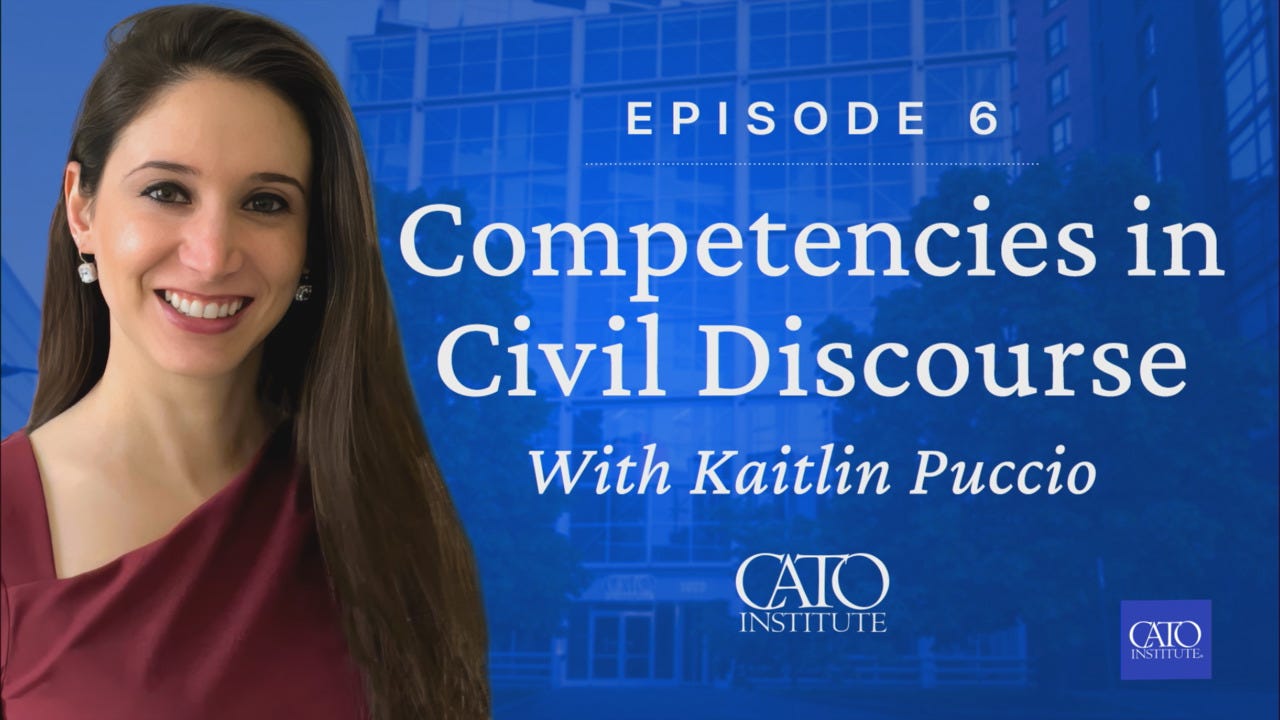
Competencies in Civil Discourse: Episode 6
In this episode of Competencies in Civil Discourse, FAIR Advisor Erec Smith speaks with attorney Kaitlin Puccio, Director at the UNESCO Chair in Bioethics and Human Rights. They discuss the ethical foundations of human dignity, bioethics in a pluralistic world, and how civil discourse can guide policy across cultural and ideological divides.


People want AI regulation — but they don’t trust the regulators
For Expression, Jacob Mchangama writes about the dilemma around regulating AI.
A recent Pew Research Center survey found that nearly six in 10 U.S. adults believed the government would not adequately regulate AI. Our survey confirms these findings on a global scale. In all countries surveyed except Taiwan, at least a plurality supported dual regulation by both governments and tech companies.
Indeed, a 2023 Pew survey found that 55% of Americans supported government restrictions on false information online, even if it limited free expression. But a 2024 Axios poll found that more Americans fear misinformation from politicians than from AI, foreign governments, or social media. In other words, the public appears willing to empower those they distrust most with policing online and AI misinformation.

FAIR News Podcast
For audio versions of our FAIR News and FAIR Weekly Roundup newsletters, subscribe and listen to FAIR News Weekly on Apple Podcasts, Spotify, Google Podcasts, or via RSS feed.
Join the FAIR Community
Join us, and become a member of FAIR.
Become a FAIR volunteer, or join a FAIR chapter.
Sign-up for a Welcome to FAIR Zoom information session to learn more about our mission.
Share your reviews and incident reports on our FAIR Transparency website.