


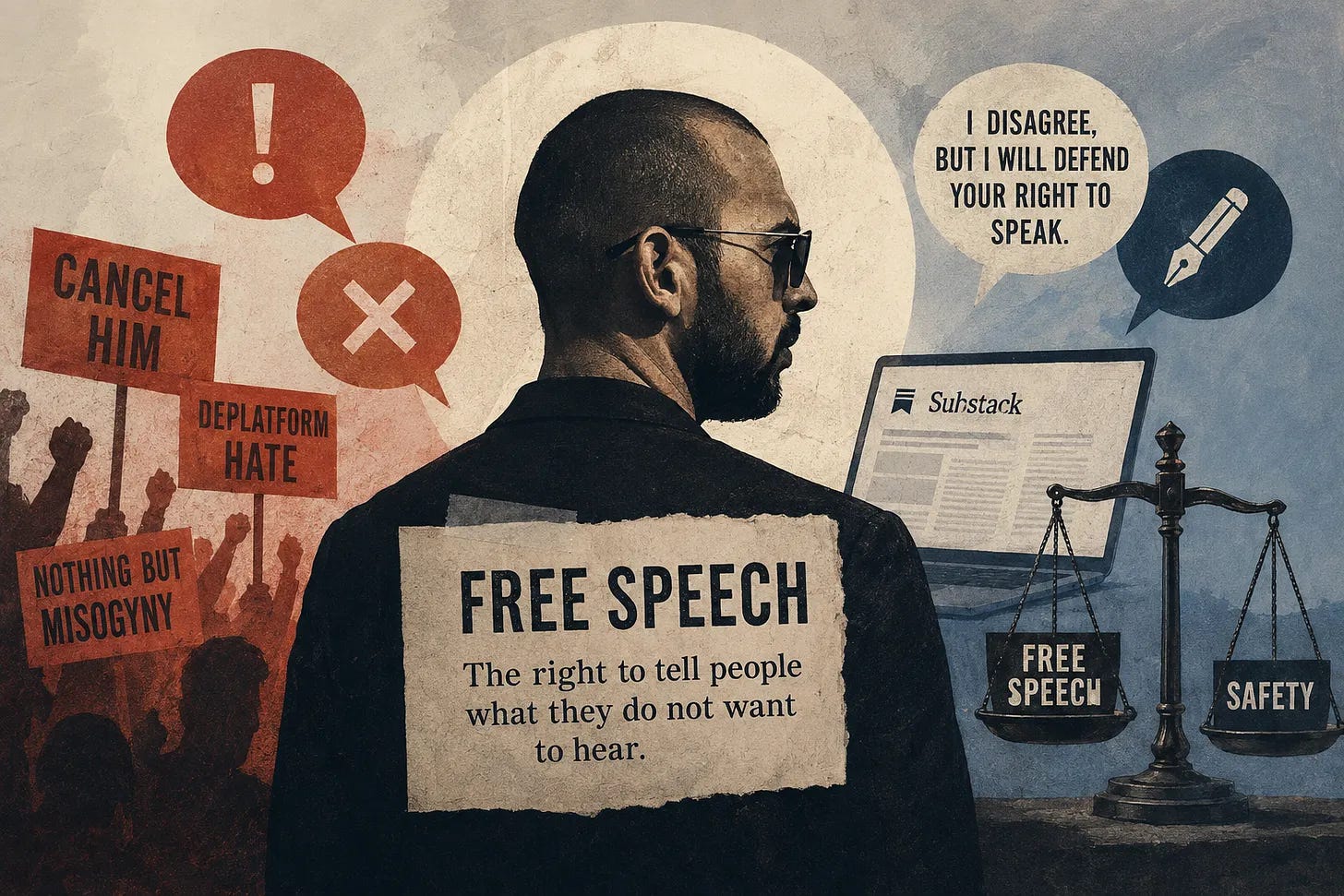
The Case Against Andrew Tate, but For Free Speech
This week, we highlighted an essay by Michael Mohr examining the controversy surrounding Andrew Tate’s presence on Substack and the broader debate over free speech, censorship, and deplatforming. While Mohr makes clear that he does not endorse Tate or his views, he argues that defending free speech requires protecting the right to express even ideas that many people find offensive or objectionable.
Mohr explores the tension between private platforms and the increasingly important role social media plays as a modern “town square.” He argues that cultural censorship and deplatforming can have consequences beyond any individual platform, particularly as society’s definitions of what is acceptable, offensive, or harmful continue to change. Ultimately, the essay asks whether free speech can truly protect everyone if it only extends to ideas that are considered acceptable by the prevailing culture.
“Free speech has one main purpose: To protect citizens’ unpopular speech. The problem with people mobbing together and deciding who can stay and who must go is that we as a society don’t have agreed-upon understandings of what is ‘moral,’ ‘good,’ ‘safe’ and ‘right.’”

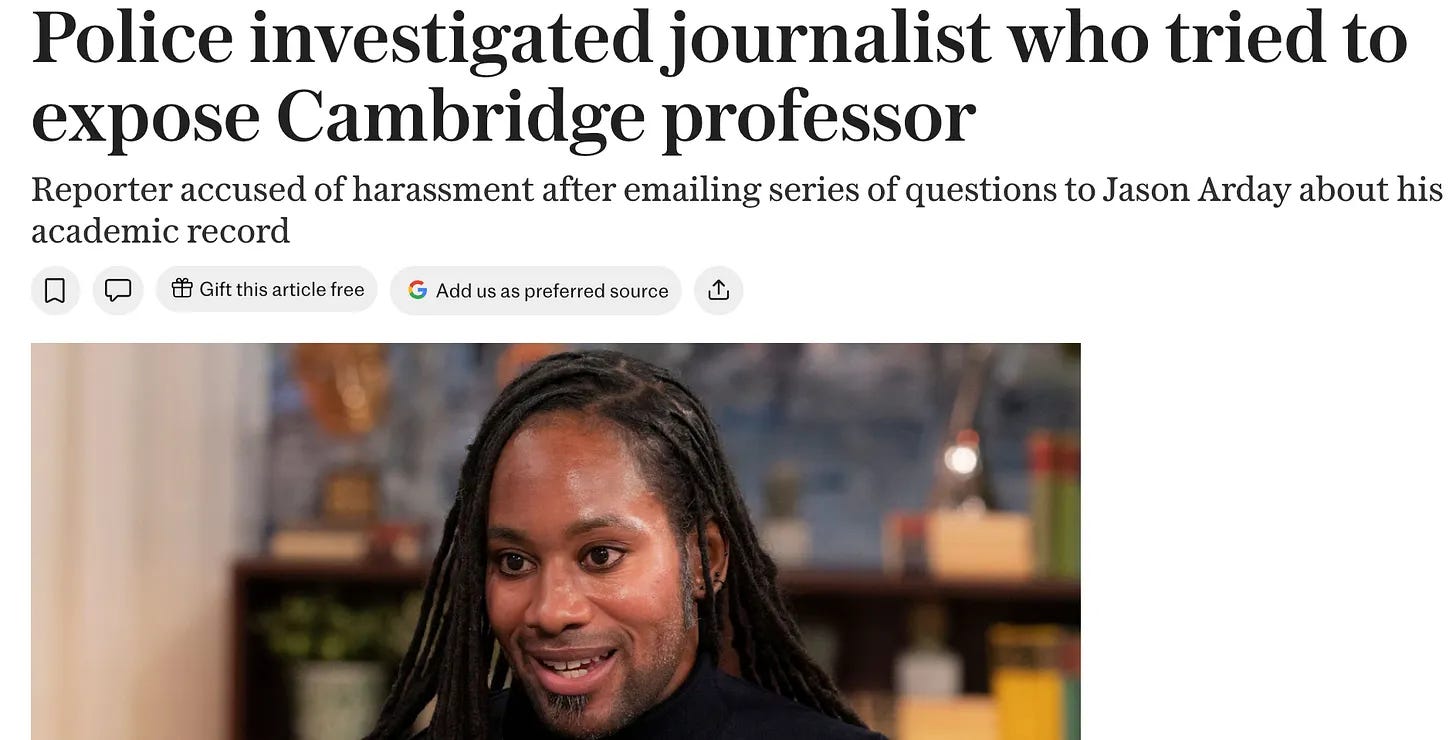
The Cambridge Fabulist
This week, Eli Steele examines the controversy surrounding Cambridge professor Jason Arday and journalist Jack Grove, who investigated allegations that Arday’s doctoral thesis contained passages similar to those in an earlier dissertation. Steele focuses not only on the disputed plagiarism allegations—which Arday denies and which remain contested—but also on what followed when Grove raised questions about the thesis.
Steele argues that Grove’s inquiry raises broader questions about academic scrutiny, institutional accountability, and the consequences of invoking accusations of racism in response to criticism. He contends that legitimate questions about academic work should be examined on their merits, regardless of the identities of those involved, while acknowledging that the underlying allegations remain unresolved.
“…white guilt and the genius of this power is that it never has to argue. It only charges racism. It makes no offer to review and pick apart the evidence … and it makes the examination of the evidence itself the crime. Arday’s black skin in this culture of victimization gave him the power to flip the script on Grove and the accused became the accuser. And the terror of being seen as a racist strikes fear in the newly accused. Grove had committed the sin of asking the question of a black man who reached not for merit but the charge of racism in response.”


Public university employees feel less free to speak out on campus, surveys show
We’re also highlighting a recent report from the Iowa Capital Dispatch examining free expression among public-university employees and students. New survey results suggest that while a majority of students do not feel their free-speech rights are restricted, more than two-thirds of university employee respondents reported feeling less free to speak openly on campus.
The findings raise broader questions about academic freedom, workplace culture, and whether professors and university employees feel able to express controversial views without fear of professional or social consequences.
“More than two-thirds of surveyed faculty said they worried at least a little bit about being reported inside their classrooms, Kysar-Moon said, and the more closely respondents pay attention to higher education policy, the more likely they are to self-censor. This could include avoiding certain topics in academic or research settings or changing their behavior or engagement with social media and public spaces.”
2026 College Free Speech Rankings
This week, we’re also highlighting FIRE’s 2026 College Free Speech Rankings, which examine the state of free expression on college campuses across the country. Drawing on years of student survey data, the rankings explore how comfortable students feel expressing controversial opinions, engaging in political discussions, and disagreeing with their peers and professors.
The findings offer a broader look at the climate surrounding free expression and speech in higher education and raise an important question: Can meaningful intellectual debate exist when students are afraid to speak openly?
“After six years of surveying almost 300,000 college undergraduates nationwide, a sobering picture has emerged: students are reluctant to speak their minds, especially on controversial political issues. Many report that they self-censor regularly, avoid certain topics entirely, and doubt their administrators would defend free expression if controversy struck.”
“The 2026 rankings reveal a bleak picture: 166 of the 257 schools evaluated received an overall score below 60 — earning a failing grade for their campus speech climate. This group includes some of the nation’s most prestigious institutions: Brown University, Carnegie Mellon University, Johns Hopkins University, Princeton University, the University of Pennsylvania, the University of Michigan, and both the University of California at Berkeley and in Los Angeles. Notably, UCLA also holds the distinction of being the lowest-ranked “green light” school this year.”