


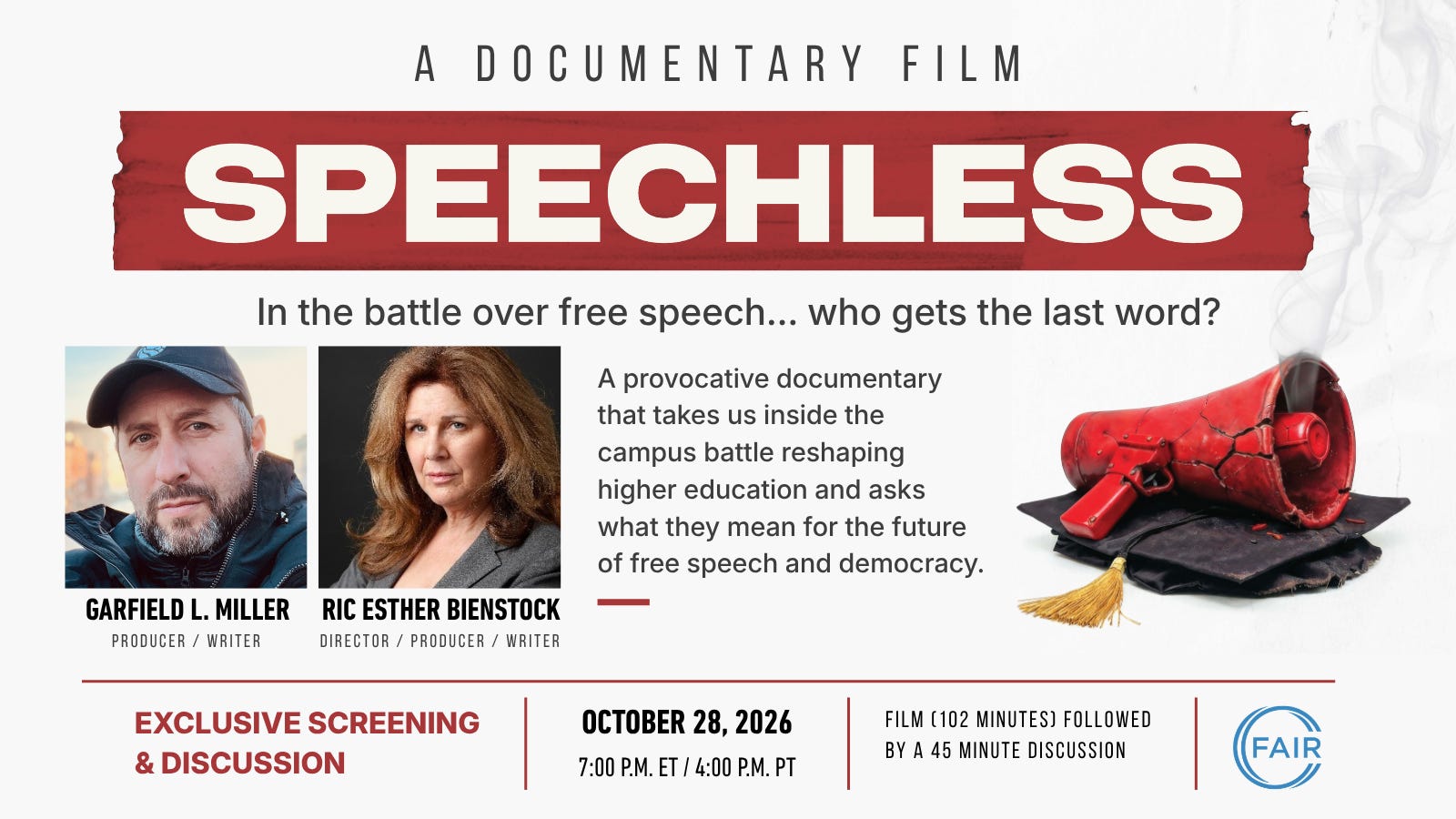
Speechless: An Exclusive Look at Democracy Today
In his essay, Matt Ginsburg reflects on his experiences at UC Berkeley and San Francisco State, tracing the shift from spirited campus debate to self-censorship and fear of offending. Emmy Award-winning filmmaker Ric Esther Bienstock’s documentary Speechless explores this transformation through controversies at Evergreen State, York College, and Stanford Law, as well as political battles over DEI in Florida. Examining intolerance across the political spectrum, the film and essay asks what happens to democracy when free expression gives way to silencing dissent. Join FAIR for an exclusive screening on October 28 at 7 p.m. ET, ahead of the film’s U.S. release.
“37% of students say they have self-censored on campus at least once or twice a month. 72% of students say shouting down a speaker to prevent them from speaking on campus is acceptable, at least in rare cases. 34% of students say using violence to stop someone from speaking on campus is acceptable, at least in rare cases.”


Resisting Cancel Culture:…Free Speech in the College Classroom
FAIR Board of Advisors member Nadine Strossen examines how campus culture has increasingly discouraged open discussion and encouraged self-censorship. Drawing on survey data and her experience as a law professor and former ACLU president, Strossen explores how social pressure and fear of reprisal can silence students and faculty, undermining the university’s mission of intellectual inquiry. She argues that resisting cancel culture requires more than defending the right to speak: educators must actively foster debate, encourage students to engage with opposing viewpoints, and create classrooms where controversial ideas can be examined rather than dismissed.
“Overall, a full 62% of respondents concurred that “the political climate these days prevents me from saying things I believe because others might find them offensive.” Moreover, almost onethird of respondents—32%—say they worry they could miss out on job opportunities or get fired if their political views became known.”
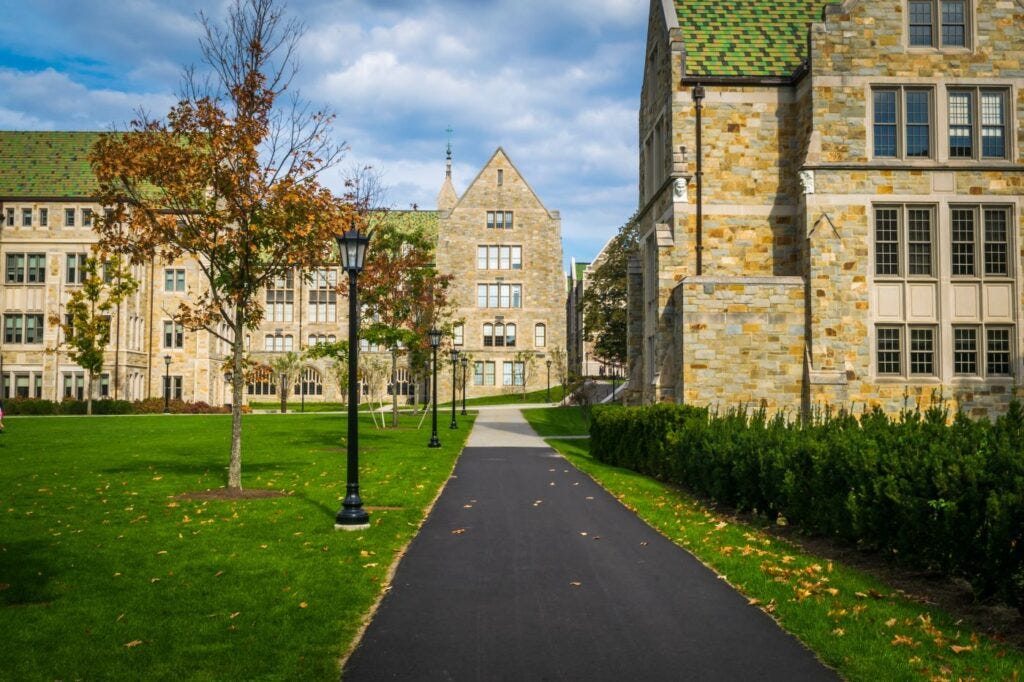
In Defense of Free Speech and the Mission of the University
FAIR Board of Advisors member Robert P. George makes the case that universities must protect the freedom to explore and debate even deeply controversial ideas. Responding to calls for campus censorship amid rising antisemitism, George argues that restricting speech based on viewpoint threatens the university’s core mission of truth-seeking and risks empowering administrators to silence dissent. He contends that genuine intellectual inquiry requires humility, a willingness to question our deepest convictions, and the courage to engage arguments we find offensive or wrong.
“When university administrators, professors, or students forbid the expression of certain points of view precisely because they consider them false, wrongheaded, or even spectacularly offensive, they are undermining the epistemological norms that must be heeded in order for the truth to be pursued authentically and well. Pursuing truth is often a difficult and uncomfortable process. It can even be terrifying—since it could be the case that certain things we desperately want to be true are in fact false, and things that we desperately want to be false are in fact true. And, of course, our wanting things to be true (or false) doesn’t make them so.”

In this episode, Jon Kay speaks with filmmaker Ric Esther Bienstock about her decade-long project Speechless, a sweeping documentary examining the rise of cancel culture, campus activism, and the social consequences of dissent.
From the Evergreen State College protests to the cultural aftershocks of The Coddling of the American Mind, the film traces how debates over language, identity, and power have reshaped public discourse.
Bienstock embeds herself inside some of the most controversial flashpoints of the past decade—featuring figures like Bret Weinstein, Kathleen Stock, Carol Hooven, and Christopher Rufo—while attempting something rare: to document, rather than judge.
“…whatever the reasons are to kind of uh give a little lift to people who might need that lift. I am 110% for that. I just don’t like that it hardened into an ideology where you force professors to make a a DEI pledge when they’re teaching physics.” (30:27)
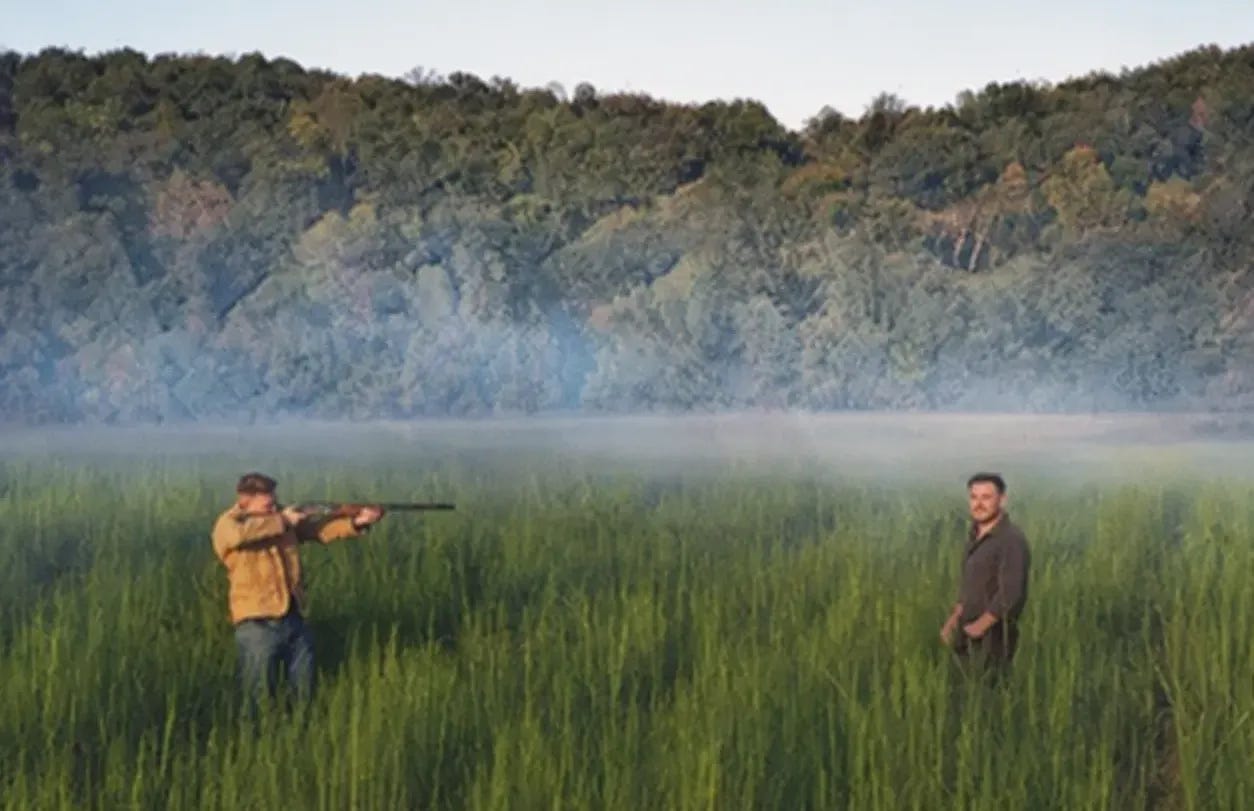
This Song Of Love
In “This Song of Love,” Michellepollino explores how music connects us across generations, from America’s folk traditions to today’s country charts, and how technological and cultural shifts are reshaping the music industry. Through the lens of astrology and music history, she examines how new platforms and corporate influence are changing who controls creative expression, arguing that music’s enduring power to bring people together across differences makes it all the more important to preserve creativity, independent expression, and human connection in times of division.