

Among my peers, I have a unique vantage point regarding cancel culture. I graduated from U.C. Berkeley in 1982, when memories of the Free Speech Movement were still fresh. After retiring, I went back to school and earned an MFA in creative writing from San Francisco State in 2019. During this time, I witnessed how free speech, a concept that had been revered in my undergraduate days, was actively being suppressed. One could never be certain what might raise the ire of fellow students. I had many awkward moments when the culture of political correctness won out over the right of free speech and self-expression: one time I was chastised for including a few words of Spanish in a play because it was not my native language.
In contrast to my undergraduate experience, it now felt as though speech had become weaponized, vocabulary circumscribed, and the promotion of free expression minimized. Students were censoring themselves, afraid to use language or take positions that might offend. I began to act the same way. Even at my advanced age, retired after a successful career, I wanted to get along and make friends with other students. Who wants to be a pariah? It’s not surprising to me that the Foundation for Individual Rights and Expression (F.I.R.E.), an organization that surveys students regarding freedom of expression, states that across universities in California today:
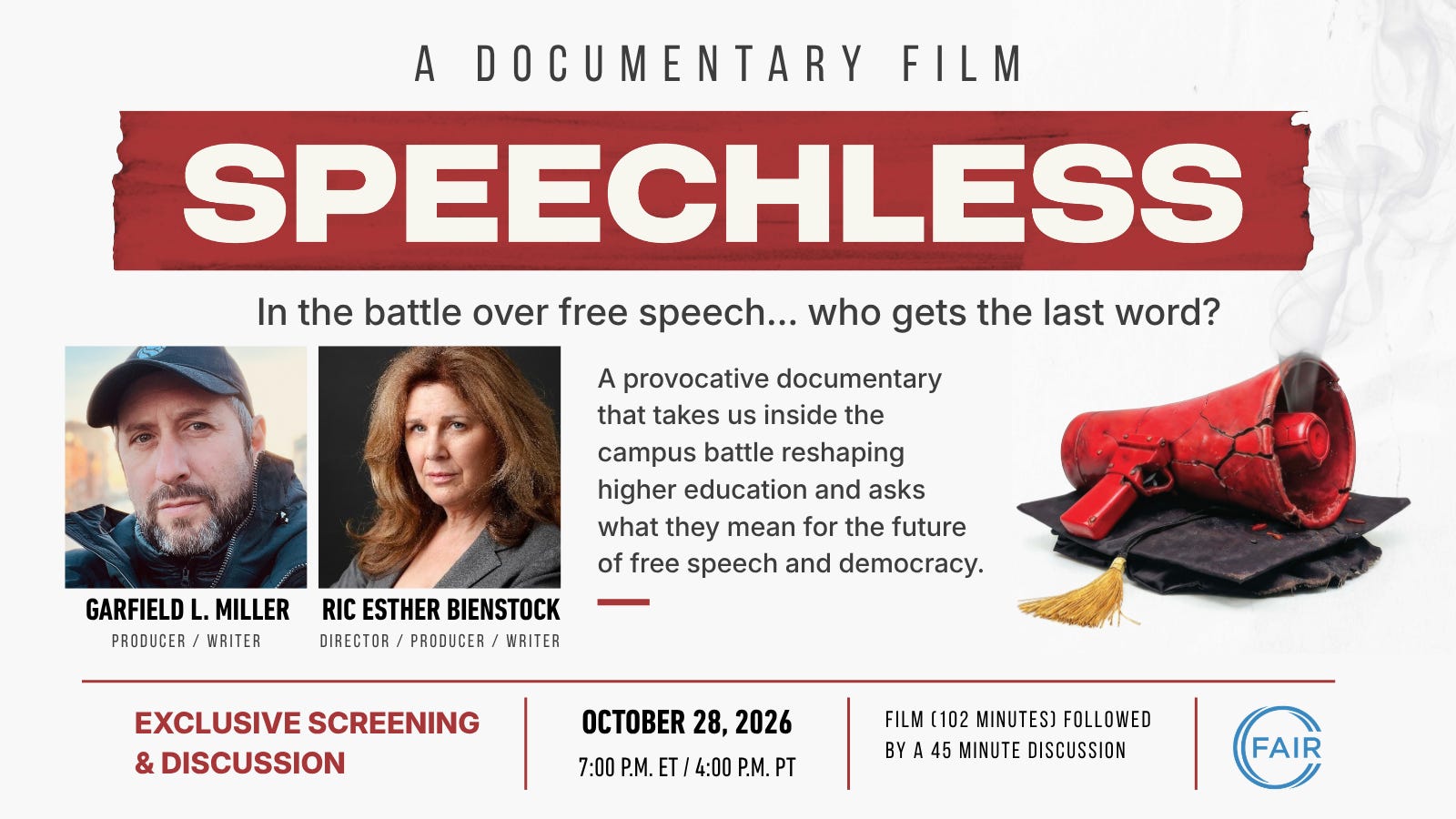
For anyone curious how this radical transformation came to be, a fantastic new film has the answer. Speechless is a documentary by Canadian filmmaker Ric Esther Bienstock. The film chronicles the emergence of cancel culture across a swath of college campuses over the last decade. It has screened in Canada and the U.K. but has yet to open in the U.S., which is why FAIR’s upcoming screening on October 28th at 7pm ET is so special!
Based on Bienstock’s interviews, early reviews, and podcast transcripts, the film seems to track what I experienced. The power of telling these stories is that they give everyone the opportunity to witness the cultural shift that has so radically transformed the college experience.
Bienstock, a self-described “lefty,” is an accomplished filmmaker. She has won an Emmy Award, two Edward R. Murrow Awards, and multiple Canadian Screen Awards. Her previous works include a documentary about the transatlantic slave trade hosted by Samuel L. Jackson. She also graduated from university in the early ’80s and begins her exposé by telling viewers:
“For me, university was a place where you wrestled with new ideas. Sex, politics, religion, war – we argued about all of it. But somewhere along the way, the climate changed. Students didn’t just disagree with ideas. They felt harmed by them. And the only way to feel safe was to silence the people expressing them.”
In 2015, after reading the essay The Coddling of the American Mind, by Jonathan Haidt and Greg Lukianoff, which described alien concepts like “safe spaces,” “micro-aggressions” and “cultural appropriation,” Bienstock wondered what had caused university life to change so much. It appeared to her that, in an effort to include and protect, we had inadvertently created new, more easily twisted forms of exclusion and censorship. That her own children were of university age added extra urgency to her concern. She decided to put her camera to work, hoping to document this alarming cultural phenomenon.
Speechless captures the rise of cancel culture as it emerged from left-leaning politics and began to spread across the political spectrum. The story begins in 2017 at Evergreen State College in Washington, where a white biologist objected to the school’s “Day of Absence,” which asked that white people stay off campus for the day in recognition of the contributions made by people of color. His resistance ignited a firestorm that reportedly sizzled on camera. According to one review, Bienstock herself is branded a white supremacist for asking a student basic questions. At York College in Pennsylvania, a black rhetorician was vilified after challenging a colleague who insisted that forcing students to learn standard English is a form of white supremacy. The colleague states his case, not surprisingly, in standard English. And at Stanford Law School, Tirien Steinbach, the associate dean of diversity, stepped to the podium as protesters drowned out—effectively canceling—a conservative judge. We hear her side of things after her resignation, having been blamed for her handling of the situation.
But Speechless is no right-wing hit piece. After exploring the impact on campus of the Hamas attacks of October 7 and Israel’s subsequent response, Bienstock moves on to reveal the reactionary intolerance on the right. She brings us into the present moment as she and her team trail conservative activist Christopher Rufo while he carries out Governor Ron DeSantis’s crusade against progressive pedagogy and dismantles various DEI programs at New College in Florida.
College campuses today appear to be as polarized as ever. Speechless doesn’t set out to offer solutions, but instead shows how we got here. The film promises a front-row seat for anyone interested in this aspect of the culture wars. Those wondering how we went from lionizing Mario Savio on the steps of Sproul Hall to widespread self-censorship, and then to the defunding of DEI programs, will want to see it. I know I do.
We welcome you to share your thoughts on this piece in the comments below. Click here to view our comment section moderation policy.
The opinions expressed here do not necessarily reflect those of Fair For All or its employees.
In keeping with our mission to promote a common culture of fairness, understanding, and humanity, we are committed to including a diverse range of voices and to encouraging compassionate, good-faith discourse.
We are actively seeking perspectives on this topic and others. If you’d like to join the conversation, please send completed drafts to submissions@fairforall.org.

If this becomes available on a streaming platform in the US, please share details. I’m not optimistic about an American studio choosing to distribute a film like this.