


“Can We Mute the Hate Speech, Please?”
For FAIR’s Substack, Pedro Frigola recounts a California school board meeting where a parent’s policy concerns were interrupted by a board member labelling her remarks “hate speech.” This incident highlights a broader concern: when policy disagreement is reframed as inherently “hateful,” it can shut down legitimate democratic participation and weaken accountability for elected officials.
Reasonable people will disagree about which path to take, but that is the point of public comment. Yet in that moment, one side of that debate wasn’t treated as a position, but as a voice to be “muted.”
People take note when this happens. Speaking in front of a school board can be daunting — not just for the person speaking, but also for everyone else listening. That was certainly true for me. Whether they are on Zoom, physically in the room, or watching the event later, participants learn which arguments are safe to express and which ones carry a cost.
Some people will choose to keep speaking anyway. But many will not.
Over time, the range of acceptable viewpoints narrows not by formalized rule, but by signal. The meeting still looks “open.” The microphones are still there. But the boundaries have shifted, and that has consequences. You lose the parent who came to ask a budget question and decides it is not worth it next time. You lose the observer who has a similar concern but chooses to stay silent. The community loses the expectation that public officials will engage with criticism rather than deflect it. Once that expectation erodes, effective governance suffers, as well.

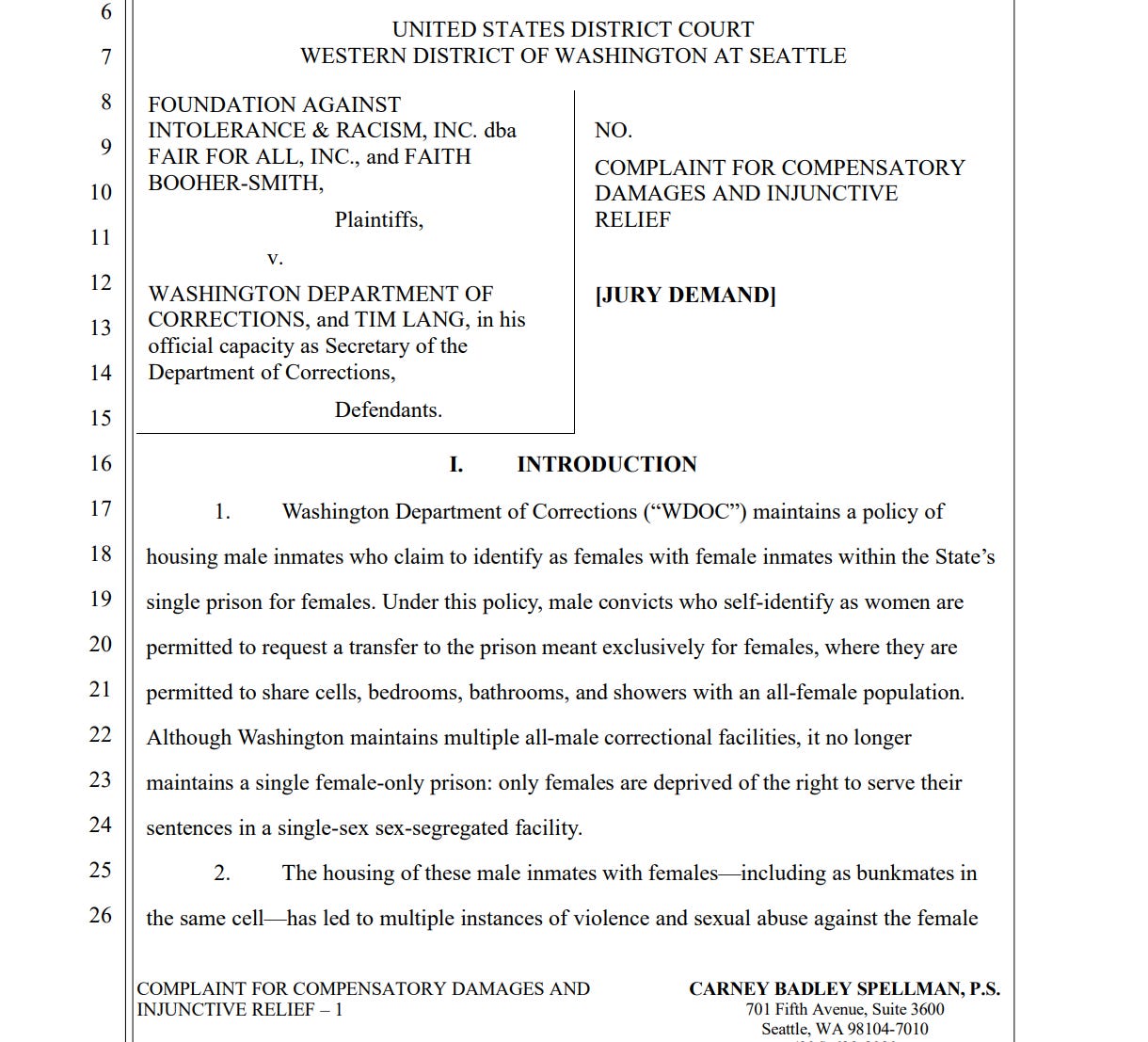
AFPI Files Suit Challenging Washington Policy That Houses Men in Women’s Prison
For the America First Policy Institute, Leigh Ann O’Neill shares a press release regarding a new lawsuit filed in partnership with FAIR, challenging the Washington State Department of Corrections’ policy of housing male inmates who identify as women in the state’s prison for women, a policy the complaint alleges has led to violence, sexual abuse, intimidation, and ongoing fear among female inmates.
The lawsuit asserts that Washington’s policy violates the Eighth Amendment’s prohibition on cruel and unusual punishment and the Fourteenth Amendment’s guarantee of equal protection. It argues that female inmates are being subjected to foreseeable and preventable harm while the state prioritizes accommodations for male inmates who identify as women over the safety, privacy, and dignity of the women already housed there.
“Fairness begins with telling the truth,” said Monica Harris, executive director of Fair for All. “Women in custody are wholly dependent on the state for their safety. When officials ignore reality, ignore repeated warnings, and ignore the women living with the consequences, the law has to step in. No woman should be told that her safety, privacy, and dignity matter less because the state prefers ideology to common sense.”
The complaint describes the August 7, 2025, attack on Booher-Smith and alleges that prison officials had advance notice of the risks posed by certain transferred male inmates, including through prior complaints and litigation. It also alleges ongoing harm to additional Fair for All members at the facility; the nonprofit is involved as a plaintiff to advocate for an entire class of women who are threatened.

Let’s Return to Teaching Students How to Argue
For The Coddling Movie, Gregory Roper argues that education has drifted too far toward emotional protection at the expense of resilience and intellectual growth. He suggests that shielding students from discomfort, such as avoiding challenging ideas, leaves them less prepared for real-world adversity.
We hear all the time that America is hopelessly polarized, that the electronic landscape allows us to stay in our own hermetically-sealed communities, and that no one can speak with anyone across the aisle. For decades now, the Left has believed that those who disagree with it are not just wrong but evil; in the last three election cycles, we have seen those on the right taking on the same position.
What if the problem is not our politics but the way we are taught to argue?
For four decades, American students have been taking misconceived “rhetoric and composition” classes, which now are almost completely under the ideological control of the woke. We need to fix that so we can return to a republic of vigorous, fair, thoughtful, and productive discussion.

Is There Life After Being Cancelled?
For his Substack, former Seattle principal Ed Roos reflects on the personal and professional fallout following his cancellation in 2020 amid a public controversy. He describes how his career path has shifted and shares his ongoing struggle with PTSD linked to what he terms “revenge culture.”
It has been almost six grueling, at times hopeless, years since I lost my livelihood due to cancel culture, which I prefer to call revenge culture. In the immediate aftermath, I made a vow to not let this destroy me. I committed to staying as mentally and physically strong and healthy as possible. I embarked on a healthy dose of endorphins through a healthy diet, exercise, ‘live in the moment’ meditation, sun exposure, hikes, snowshoeing, skiing and walks in nature. Even during the isolation of COVID, I forced myself out of bed and into the elements. I wouldn’t allow myself to wallow in the wreckage; I was determined to overcome it.

Why Substack Is Right Not to Ban Andrew Tate
For The Overflowings of a Liberal Brain, Helen Pluckrose makes the case that Substack should restrict bans to clear cases of incitement to violence, rather than policing “harmful” or offensive ideas. She warns that expanding moderation based on subjective notions of “acceptability” risks ideological bias and inconsistent enforcement. Instead, Pluckrose defends a “marketplace of ideas” approach, where users — not platforms — decide what to engage with, ignore, or block.
Once a platform begins moderating speech on the basis of content rather than direct incitement to violence, it enters an inherently subjective moral terrain. It must then justify which ideas are “acceptably” horrible and which are unacceptably so. This requires increasingly complex rules of moderation, heightening the risk of political and cultural bias. It also becomes difficult to prevent the boundaries of allowable speech from steadily contracting.
If Substack justified banning ideas on the basis that they are simply too objectionable, it would then have to contend with the implication that it implicitly endorses those that remain. It would voluntarily abandon the principled defence of free speech as a system in which ideas compete and bad ones can be challenged and defeated as the basis for which it declines to moderate content. This gives activists, fuelled by moral outrage, ammunition to make endless demands using the precedent of already banned ideas, and defences against that will necessarily be subjective and give the appearance of ad hoc rationalisations.
Note to readers: We have paused the FAIR News podcast. If you prefer listening, rather than reading these Roundups, an audio version is available directly on the Substack app. Thank you for tuning in!