



How Librarians’ New Social Justice Mission Goes After the Privacy of Library Workers
This week, we featured an essay by Kristin Antelman examining how the library profession’s growing emphasis on social justice advocacy may be reshaping its longstanding commitments to institutional neutrality and intellectual freedom. Focusing on DEI training, employee privacy, and workplace culture, Antelman argues that ideological conformity within libraries can erode the trust these institutions have historically earned from the public.
Rather than dismissing libraries’ important role in advancing access to knowledge, the essay contends that their greatest strength lies in serving as neutral spaces where diverse viewpoints can coexist. Antelman suggests that preserving privacy, encouraging viewpoint diversity, and recommitting to the profession’s foundational values are essential if libraries are to remain trusted institutions for future generations.
“When a privacy-defending public service entity such as a library fails to protect the diversity of thought and privacy of its own employees, it has shown itself to have profoundly lost its way.”


Report Finds Books Aren’t Vanishing From Schools. But That’s Not the Whole Story
FAIR Board of Advisors member Robert Pondiscio examined new research on the role of whole books in today's classrooms. While recent data suggests that novels have not disappeared from schools, Pondiscio argues that too many students—particularly those in underserved communities—are reading too few complete works and missing the unique cognitive and educational benefits that sustained reading provides. His essay highlights why cultivating deep reading habits remains essential for literacy, critical thinking, and meaningful engagement with literature in an increasingly fragmented digital age.
“The researchers’ most troubling finding is that teachers serving disadvantaged students consistently assign fewer books. Students in high-poverty schools or majority nonwhite schools, multilingual learners and students with disabilities all appear less likely to experience sustained encounters with complete works of literature.
That matters, because reading a book is not just an extended version of reading a passage. It requires different cognitive habits…”

The Science of Reading Has Won the Argument. Has It Won the Classroom?
FAIR Board of Advisors member Robert Pondiscio explored the progress—and remaining challenges—of the science of reading movement. While evidence-based literacy instruction has gained widespread support in state policy and school districts, Pondiscio argues that meaningful reform depends on what happens in classrooms. He examines why teacher preparation, curriculum, and sustained implementation remain critical to ensuring all students receive effective reading instruction grounded in the best available evidence.
“The first phase of reading reform was winning the argument against bad ideas. Mission (mostly) accomplished. The next phase is harder: building systems where good ideas can survive contact with reality and resistance. That means better teacher preparation, curriculum selection, and coaching. It means less initiative churn and more consistency, follow-through and patience.”

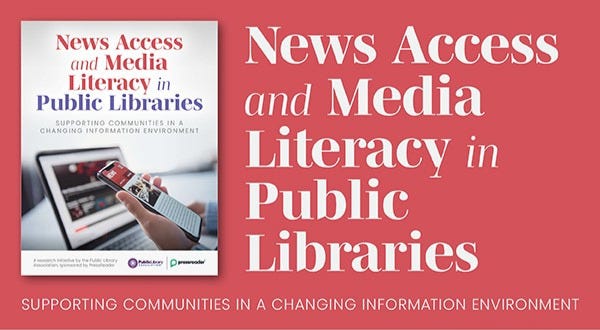
Public libraries have long served as trusted centers for learning, and today that mission extends beyond books. A new report from the Public Library Association examines how libraries are helping communities develop media literacy, strengthen digital skills, and navigate an increasingly complex information landscape while continuing to provide equitable access to reliable information. As misinformation becomes easier to spread and technology continues to evolve, these skills are increasingly important for helping people think critically, evaluate sources, and engage confidently in civic life.
“Among the report’s key findings:
Public libraries are on the front lines of media literacy, helping patrons evaluate sources, navigate digital content, and access trustworthy information every day.
More than 65% of respondents said patrons struggle to use digital resources, while staff training emerged as the top investment needed to help libraries meet growing demand for digital literacy support.”