



The Neutrality Lodestar: Reclaiming the Library from Ideological Capture
For FAIR’s Substack, academic librarian Kyle Breneman argues that major library organizations like the American Library Association (ALA) have abandoned traditional neutrality and intellectual freedom in favor of ideological activism. He highlights the ALA’s 2021 resolution condemning “neutrality rhetoric” as complicit in “white supremacy and fascism,” along with its updated Code of Ethics that commits librarians to advancing social justice, DEI, and critical theory-inspired approaches. Breneman points to the Association of Library Professionals (ALP), as a counter-movement to reclaim neutrality as the “lodestar” of the profession, defending libraries as institutions serving all patrons through open inquiry rather than partisan advocacy.
Many librarians are recognizing that our profession has become heavily invested in one creedal idea: that social justice activism is the only way to be a librarian. Our professional associations issue resolutions inveighing against neutrality and calling on librarians to commit themselves to political and cultural activism in the service of social justice.
A steady stream of charged rhetoric (“book banning!”), and politically oriented professional development opportunities make it clear that librarians who disagree with the illiberal progressive political agenda (or who simply believe that libraries and librarians ought to be neutral instead of political), are either expected to either adopt these activist roles or remain silent. More and more librarians who are alarmed by these developments are making their way to organizations like ALP, which seek to return the profession to its first principles.

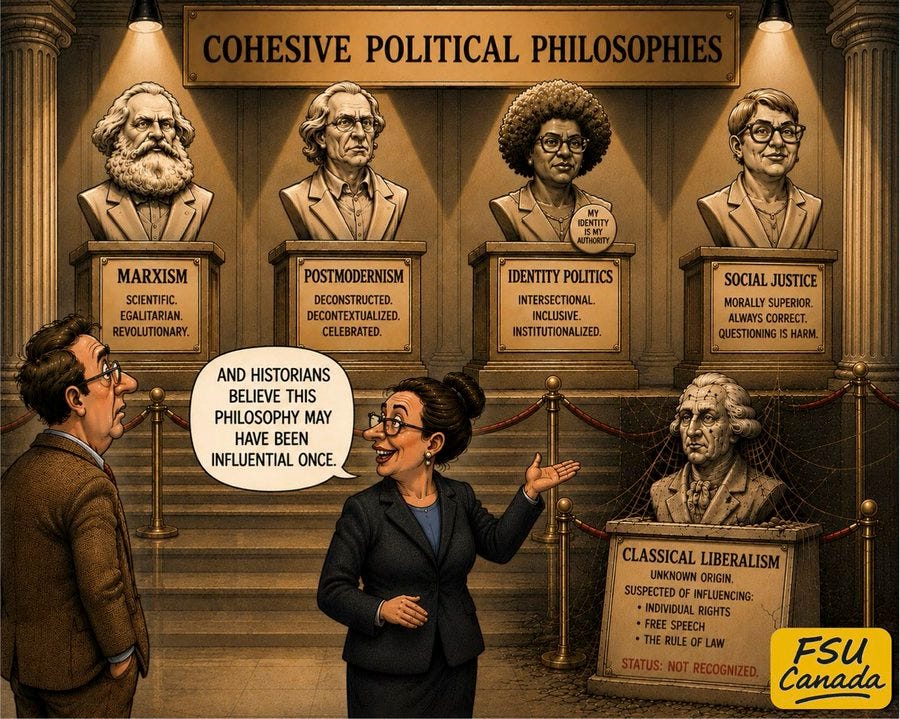
The B.C. Human Rights Tribunal Just Declared Classical Liberalism Incoherent
For Culture War Musings FAIR Advisor Lisa Bildy writes about the B.C. Human Rights Tribunal’s dismissal of a complaint by political science professor Dr. Joshua Gordon against Simon Fraser University. Gordon alleged he was denied a tenure-track position due to his classical liberal beliefs, which clashed with the university’s activist DEI demands. The Tribunal ruled (without a hearing) that these views lacked the “cohesion and cogency” to qualify as a protected political belief, while treating DEI ideology as the default neutral position.
Classical liberalism emerged during the Enlightenment as a political philosophy centred on individual rights, freedom of conscience and expression, equality before the law, and limits on state power…It is the only political philosophy that treats the right to free speech as inviolable. These principles became foundational to modern Western institutions and offered a way to restrain our tribal impulses by grounding political order in universal legal equality rather than in the claims of groups or castes.
But group rights are all the rage today, and along with them an intolerance for any expression to the contrary. Despite Dr. Gordon’s strong teaching evaluations, his “responses with respect to EDI” were deemed insufficient by the activist Faculty Group – five faculty members who opposed his appointment and held enough votes to sink it. Their concern? Gordon’s statement indicated that he treated people equally, without regard to race, gender, or sexual orientation. That is no longer acceptable. Under activist EDI, one must not treat people equally; one must treat them unequally, according to a shifting hierarchy of “marginalized” identities.

Gad Saad’s “Suicidal Empathy” Is the Misdiagnosis
For Man of Steele, FAIR Advisor Eli Steele reviews Gad Saad’s new book Suicidal Empathy: Dying to Be Kind, arguing that Saad correctly identifies self-destructive Western policies, but misdiagnoses the root cause as excessive empathy. Steele contends the true driver is “white guilt” masquerading as empathy, which leads to performative compassion, racial essentialism, institutional self-sabotage, and policies that prioritize absolution over reality or individual humanity.
This distinction exposes the flaw in Saad’s framework. Empathy is an individual emotion, triggered by a face, a voice, a wound, a human being standing before us. In America’s racial politics, what often triggers the public display of “empathy” is not contact with suffering but the pressure of guilt. When whites took to the streets after Trayvon Martin, Michael Brown, and George Floyd, the driver was not “I feel your pain.” It was, “I fear being on the side of the racists, and I must prove my innocence.”
Genuine empathy flows outward toward another person. What white guilt produces flows inward and toward releasing one’s own moral distress. This is guilt-alleviation dressed as compassion. Look at the protestors and their signs after Floyd’s death, many of them self-referential performances of innocence that improved the lives of blacks not one iota. What Saad calls “suicidal empathy” is not empathy corrupted by excess or “misfiring.” It is white guilt masquerading as empathy from the start, never really about the victim, but the performer’s need to be seen as innocent.

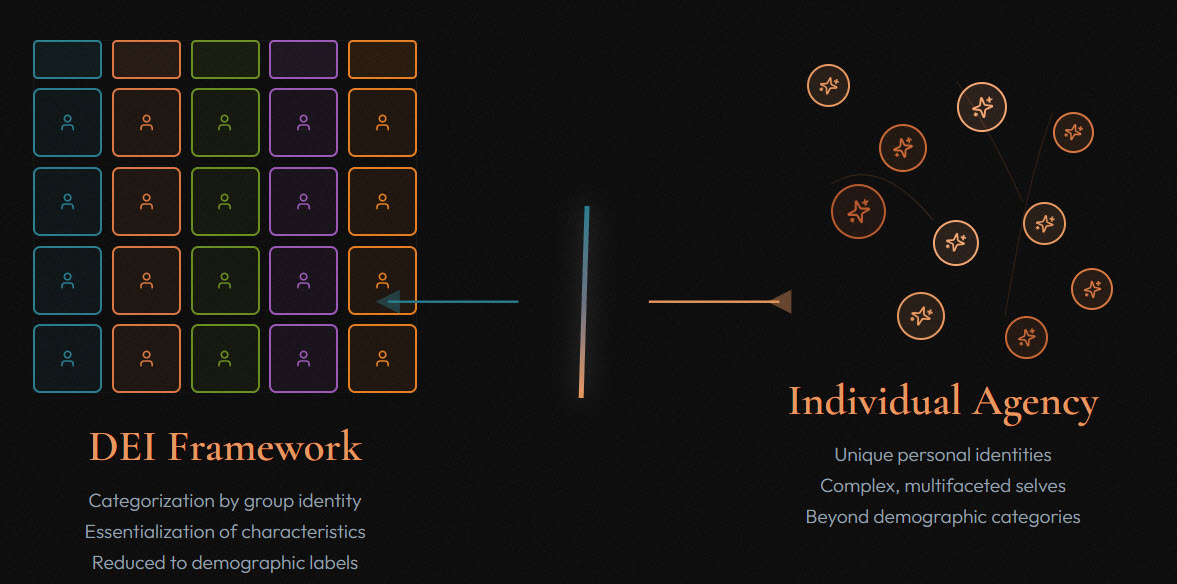
Does DEI Strengthen or Harm Intellectual Freedom?
For Heterodoxy in the Stacks, Michael Dudley and Kyle Breneman critique an American Libraries Association post claiming that “Equity, Diversity, Inclusion, and Accessibility” provide the foundation for intellectual freedom in libraries. They argue that DEI fosters ideological conformity, self-censorship, and speech restrictions, ultimately harming intellectual freedom. The authors instead advocate institutional neutrality, viewpoint diversity, and treating patrons as autonomous individuals.
The greatest misunderstanding in this debate is that neutrality demands that the librarian actually be objective and unbiased. Not at all: it only asks that the librarian recognize that their users will hold a wide range of views, such that they should (as an ethical commitment) not permit their own biases to prevent them from making available in their collections a diverse range of perspectives, many of them with which they may personally disagree. As such, far from conflicting with the needs of a diverse, pluralistic society—replete as it is with people representing many different racial backgrounds, ethnicities, faith groups, and belief systems—library neutrality (we would argue) is the necessary ethical framework for recognizing and serving this diversity…and for granting individual library users from these backgrounds the freedom and autonomy to pursue their queries and meet their informational needs.
Author Discussion: “Black Women Speak on Gender Ideology”
For her blog, 2026 FAIR Artist Grant Winner N3VLYNNN hosts a discussion with two co-authors of her newly released anthology, She Holds The Line: Black Women Speak on Gender Ideology. The three women share their essays, poetry, and personal journeys of “waking up to the harms of queer & trans ideology as LGB and detrans black women.”
Join us for an incredibly vulnerable and thoughtful, yet loving and lighthearted discussion… This amazing project [She Holds The Line] was made possible by an Artist Grant from FAIR in the Arts. Thank you Fair For All for believing in this project and investing in my vision!
Note to readers: We have paused the FAIR News podcast. If you prefer listening, rather than reading these Roundups, an audio version is available directly on the Substack app. Thank you for tuning in!
Yayyy!! Thank yew for sharing my author discussion 🥰 Enjoy! We sure had a blast creating it.
FAIR seems to be trending very, um, blackward these days. What's up with that?