

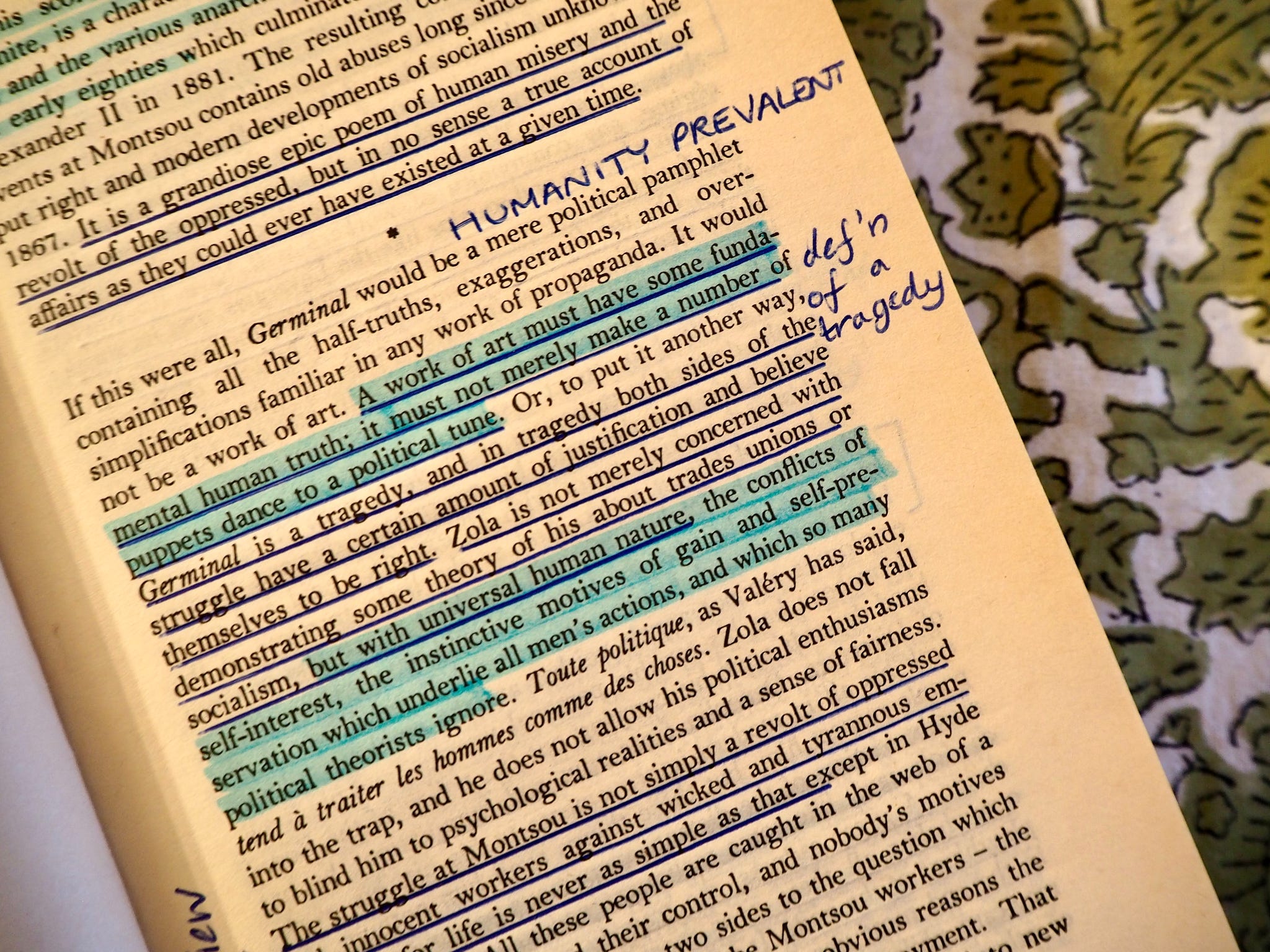
From my first encounters with literature as a child — Anne of Green Gables and The Secret Garden — I had a sense I was in contact with something sacred and eternal. As a teenager working part-time at my neighborhood bookshop in Toronto, I marked up my novels with passionate highlights, asterisks, and margin notes on sentences that seemed to transcend earthly boundaries. My old copy of Émile Zola’s Germinal contains my favorite margin note in all-caps: HUMANITY PREVALENT. A novel about the plight of coal miners in 1860s France, Germinal is political but its primary concern is something much more profound. This is precisely why it endures — and why a fifteen-year old on her summer vacation in 1990s Canada found it gripping and moving and unforgettable.
In his 1954 introduction to Germinal, Leonard Tancock observed: "A work of art must have some fundamental human truth; it must not merely make a number of puppets dance to a political tune . . . Zola is not merely concerned with demonstrating some theory of his about trade unions or socialism, but with universal human nature." His conclusion: "Humanity, then, is the real hero of Germinal.”
Herein lies the tragedy of the modern literary world. Reaching for the universal, the transcendent, and the eternal in works of fiction is not just de-emphasized, it is actively discouraged by those with the power to publish these books. Over the past ten years, the industry has shifted sharply to focus on topics and criteria that divide us— on parameters that restrict, muddle, and sideline artists and undermine literature as a force that unites, illuminates, and uplifts.
My journey as an author, first published by a Big Five publisher in 2017, coincided with the rise of this new, flattening orthodoxy. Seemingly overnight, literary gatekeepers made inclusivity their responsibility and primary purpose: agents heavily prioritized identity categories in their bios and wish lists; publishers hired sensitivity readers to screen manuscripts and ensure words did not "trigger" readers; and literary estates altered the works of great authors like Roald Dahl and Ian Fleming posthumously to align them with present-day progressive standards. Literary art was now judged by criteria unrelated to its quality or substance. The vision of the writer was subjugated to the anticipated feelings of a subset of readers. "Everyone has a story to tell" became the industry mantra, but only if you tell it the right way — and only if your profile checks the right boxes.
Working on my sophomore novel in this new regime, I second-guessed everything I wrote, my fingers freezing at the keyboard. Instead of focusing on the pursuit of beauty — what had always been my motivation to write — I was preoccupied with whether gatekeepers would find my work "acceptable." As a fiercely independent person who has always charted my own course, resisting labels, tuning out trends, and having no desire to make political statements with my work, I felt immense pressure on all of these fronts. An intrusive ogre loomed over my shoulder, evaluating my sentences against a politically-charged rulebook, filling me with dread, and choking my inspiration.
I wasn’t alone. This was happening to writers the world over. In 2021, Sir Kazuo Ishiguro spoke out about the "climate of fear" and self-censorship spreading among less established writers, calling it "a dangerous state of affairs." Lionel Shriver described the "universal cowardice at the top [of publishing] and complete capitulation to orthodoxy in younger staff who you would think have no power, but…they've started running the place." A mass muting was in progress: artistic expression was being tamped down and distorted to meet a set of non-negotiable requirements. I was dismayed when a young, aspiring novelist wrote to me: "I added a progressive left lean to the ending of my novel . . . I think it's just aligned with my views to not seem too forced but I probably wouldn't have done it if I wasn't afraid of getting it seen otherwise."
As a lifelong believer that literature is the expression of the human soul — divinely inspired to illuminate the human condition and offer meaning and light in pain and darkness — I wasn't willing to alter my work to meet external standards. When pitching my new novel, I ran straight into the brick wall of gatekeepers, who told me my writing didn't honor the current political and social climate, lacking relevance and committing the ultimate crime of insensitivity. One literary agent said my characters’ response to the 9/11 tragedy, written from my Xennial vantage point, would offend Gen Z readers, many of whom were toddlers or not yet born on 9/11, who could not fathom their behavior. Surprised by the intensity of emotion surging inside me, I replied:
"Part of [literature's] purpose is to enlighten people with a point of view about the human condition . . . To offer a porthole out of their own bubble. Yielding to others' sensitivities, expectations, or ideologies not only interferes with that enlightenment, but also puts a stranglehold on the creative process. This leads to more and more homogeneous and theatrical literature, with authors more concerned about offending people and saying the 'right thing' than producing beautiful and genuine art. What a tremendous loss to the world. Wuthering Heights would not exist if Emily Brontë had shaped her story around societal sensibilities or adjusted it to fit other people's expectations."
The world of literature, the domain of my childhood dreams, was turning into a factory spitting out compliant products disconnected from the divine and worshipping at an ideological altar. In this construct, the artist shrivels into a useful cog, only welcome if they are willing to fall in line. There is no expansion and illumination of human nature. There is no pursuit of truth and beauty. There is no true human variety, which is how literary fiction has always enhanced empathy and theory of mind more than any other genre. Humanity, I realized as I remembered my old Germinal margin note, is no longer prevalent. Literature is dying.
• • •
Then a new ogre swung into the frame like a wrecking ball. My social media feeds began filling with AI hysteria, with people I know “writing” AI-assisted books and chirping shiny talking points about the mass expansion and enhancement of creativity. LLMs and AI writing tools like Sudowrite were praised as “a salvation” by mainstream media including The New Yorker. (Sudowrite’s FAQ reads like sacrilege: “Is this magic? . . . Yes. But so is life, isn’t it?”)
The flattening of art and subversion of artists was only a precursor to the next, devastating chapter: the active overwriting of the human voice and soul by unstoppable technology, once again billed as “progress.” In hot pursuit of profits, mainstream publishing has taken no stand against the infiltration of AI despite the widespread outcries of authors, many of whom ardently support the dogmatic approach that paved the way for it. The system is forcing us into a brave new world where authenticity, variety, nuance, complexity, and strife are replaced by performance, compliance, uniformity, submission, and ease. What will happen if beautiful, heartfelt, human art — produced through struggle and expressed without mandates and machine intervention — disappears? Our civilization will lose its inner life: numbed by the algorithms, unable to think and feel deeply, with nothing to hold onto when the world goes dark. This blow could be as devastating as nuclear war — not to our bodies, but to our souls.
When I discovered FAIR, relief flooded through me. Nothing is more revitalizing than learning you are not alone when the system insists that you are the problem. I found kinship with artists around the world, from all backgrounds and demographics, spanning every medium and tradition, who believe true art — beautiful, excellent, and unapologetically human — is worth fighting for.
A few months later, I founded Dogstar Press as a refuge from ideology and artifice: a literary press uniquely devoted to beauty, sincerity, and fiction as an exclusively human art form. As AI-written and AI-assisted novels slip into the publishing machine without disclosure, Dogstar is defending the human voice and the pursuit of beauty without constraints. Our 100% Human seal — deliberately pro-human, not anti-AI, and backed by a legally binding verification process — is a badge of authenticity for readers who believe literature can only be conceived and crafted by people.
The hyper-political, hyper-digital life that has been forced upon us is a toxic condition, antithetical to our natural, God-given one. As human beings we are part of an ancient lineage, wired to seek meaning and look for silver pinpricks in a pitch-black sky to guide us. This is the role of literature and all forms of art. As the algorithms thrum away, silent and ruthless, artists seeking truth, meaning, and beauty are the last link keeping people’s hearts and senses awake. We must stand together and find patrons to sponsor this life-affirming work. It is the only way humanity will prevail.
Kimberley Tait is a novelist, writer, editor, brand builder, and founder of Dogstar Press—the independent publisher devoted to beauty, sincerity, and 100% human fiction. She is part of a New Romantic movement rising above the age of algorithms.
We welcome you to share your thoughts on this piece in the comments below. Click here to view our comment section moderation policy.
The opinions expressed here do not necessarily reflect those of Fair For All or its employees.
In keeping with our mission to promote a common culture of fairness, understanding, and humanity, we are committed to including a diverse range of voices and to encouraging compassionate, good-faith discourse.
We are actively seeking perspectives on this topic and others. If you’d like to join the conversation, please send completed drafts to submissions@fairforall.org.

Who wrote this? It’s good, but I don’t see a name anywhere.
Let's get names posted properly -- I almost trashed this wonderful piece of writing for its seeming anonymity. I also stopped reading much of what FAIR sends as I have found FAIR to be TOO gentle in its approach to idiocy. But this piece, Kimberley, is spot on and composed with passion and alacrity. Brava! One note: you use the word "beauty" a lot, which is fine. However, there are blistering, brilliant works which that word doesn't describe or at least doesn't connote. I may find the "ugly" beautiful, but it's probably not the word some would associate with horrors like "The Jungle" by Sinclair, "Blood Meridian" by McCarthy, or "The Rape of Nanking" by Chang.