

On September 10, 2025, a single gunshot on the campus of Utah Valley University silenced the voice of conservative activist Charlie Kirk and sent shockwaves through the very foundation of American democratic discourse. Kirk, co-founder of Turning Point USA, had dedicated his career to revitalizing the kind of vigorous debate that once defined American college campuses: the spirited exchange of ideas that our founders envisioned as essential to a healthy republic.
Whether one agreed with Kirk’s politics or not, his mission was fundamentally American: to ensure that college campuses remained vibrant marketplaces of ideas where students could engage with challenging viewpoints and learn the art of civil disagreement. His assassination on a university campus symbolizes a broader crisis threatening the conscience of American democracy itself.
Just weeks before Kirk’s death, the Foundation for Individual Rights and Expression (FIRE) released its 2025 College Free Speech Rankings, revealing a democracy in distress. The rankings show “a continued decline in support for free speech among all students, but particularly conservatives,” with Harvard University retaining “its position as the lowest-ranked institution for free speech for the second consecutive year.”
Of the 257 schools surveyed, representing more than 58,000 student responses, the data reveals an academic landscape increasingly hostile to the very debates that democracy requires. While the University of Virginia claims the top spot, institutions like Harvard, Columbia, and New York University all received “Abysmal” ratings.
When FIRE CEO Greg Lukianoff warned that “administrators largely failed in their response, clamping down on free speech protections instead of fostering spaces for open dialogue,” he was diagnosing a critical breakdown in democracy’s essential training ground. The tragic irony: Kirk was assassinated while attempting to do exactly what universities should encourage.
America’s colleges and universities have long served as laboratories of democracy – places where the next generation learned not just what to think, but how to disagree constructively. These campuses have long been heralded as democratic training grounds, where young Americans learned that citizenship requires the courage to speak unpopular truths and the wisdom to listen to opposing viewpoints.
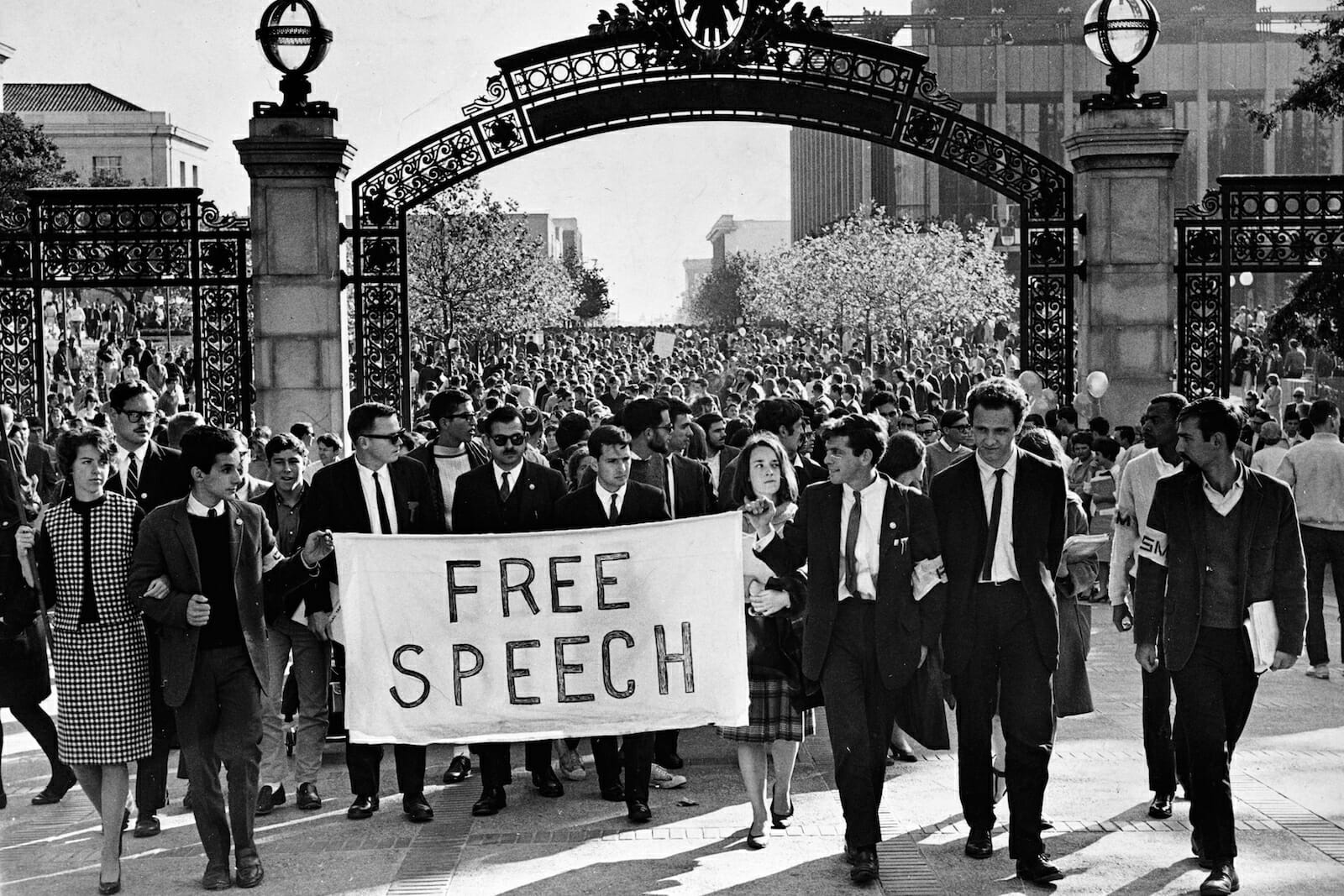
The Berkeley Free Speech Movement of 1964 established that universities must be places where uncomfortable truths can be spoken and challenged. When students protested the Vietnam War, they were practicing the kind of dissent that James Madison and Thomas Jefferson understood as essential to preventing tyranny. Even controversial speakers served a vital democratic function, forcing students to grapple with competing visions of America.
This tradition of campus debate mirrors the intellectual combat that characterized America’s founding. The Federalist Papers emerged from precisely this kind of vigorous public discourse. Madison, Hamilton, and Jay published essays in newspapers, engaging with anti-Federalist critics, and refining their arguments through sustained and often heated debate. What made the Federalist Papers powerful wasn’t that they silenced opposition, but that they answered it. This is the model Kirk sought to restore to modern campuses: ideas competing openly, arguments tested publicly, and citizens learning through engagement rather than enforced agreement.
And that’s why our current trajectory is so deeply troubling.
When campuses become echo chambers or battlefields rather than forums for reasoned debate, they’re severing the pipeline that has produced generations of democratic citizens. When elite universities like Harvard consistently rank at the bottom for speech climate, they’re not just failing their students; they’re failing democracy, itself. Consider the implications: if the next generation of leaders cannot engage in respectful disagreement during their college years, how will they navigate the complex challenges facing our republic?
More troubling still is that students themselves increasingly reject free speech principles, willing to prevent speakers from both ends of the political spectrum from appearing on campus. If students cannot feel free to dissent on campus, where will they find that freedom? And if they cannot find it there, what does that portend for our republic?
Ultimately, Kirk’s assassination represents the logical endpoint of a culture that has forgotten how to disagree without demonizing. His assassin reportedly told his roommate he “had enough of his hatred,” revealing how political disagreement has been reframed as a form of personal attack. This dangerous conflation is reinforced by a broader cultural shift: when four out of five Americans believe that “words can be violence,” society creates a framework in which actual violence becomes a seemingly proportional response to speech. If words can be construed as violence, then violence in response to words becomes a form of self-defense—a catastrophic corruption of democratic principles that transforms debate into warfare.
Historical precedent shows what happens when societies lose the ability to engage in constructive disagreement. The Weimar Republic’s collapse reflected the breakdown of democratic norms and the rise of movements that viewed opponents as enemies to be destroyed rather than fellow citizens to be persuaded.
But we can choose a different path.
The answer lies in recovering the democratic arts that once made American campuses the envy of the world. FAIR’s American Experience Curriculum addresses this need at the root: equipping young Americans with concrete skills for democratic engagement before they set foot on campus. When students learn to build evidence-based arguments and identify our shared values despite disagreements, they master the intellectual and social skills that democracy requires. Young people who understand the philosophical principles underlying American pluralism also understand that the First Amendment isn’t just a legal technicality; it’s a practical recognition that truth emerges through competition between ideas, not through suppression of dissent.
This vision of civic education isn’t a pipe dream; it’s achievable. The success of schools like the University of Virginia in FIRE’s rankings proves that institutions can choose to prioritize intellectual freedom and produce graduates who are better prepared for citizenship in a diverse democracy.
The conscience of democracy lies not in ideological purity, but rather in our courage to engage with ideas that challenge us, in seeking truth through dialogue rather than decree, and in recognizing that our opponents might occasionally be right. The conscience of democracy depends on voices willing to speak uncomfortable truths. When those voices fall silent—whether through violence, censorship, or self-imposed conformity—democracy, itself, begins to die.
The question we must ask ourselves is whether we still believe in a nation where ideas compete freely, dissent is patriotic, and the next generation learns that democracy’s strength lies not in silencing opposition, but in proving our ideas superior through open debate. The future of our republic may well depend on how we answer that question.
We welcome you to share your thoughts on this piece in the comments below. Click here to view our comment section moderation policy.
The opinions expressed here do not necessarily reflect those of the Fair For All or its employees.
In keeping with our mission to promote a common culture of fairness, understanding, and humanity, we are committed to including a diversity of voices and encouraging compassionate and good-faith discourse.
We are actively seeking other perspectives on this topic and others. If you’d like to join the conversation, please send drafts to submissions@fairforall.org.

Yes, "The tragic irony: Kirk was assassinated while attempting to do exactly what universities should encourage." It seems universities are have lost their way and do not foster critical thinking or respectful debate because they seemingly have abandoned: "ideas competing openly, arguments tested publicly, and citizens learning through engagement rather than enforced agreement."
The current educational stance of stifling healthy debate and teaching that words are violence necessitating self-defense, which can lead to assassinations, is deeply troubling.
Thank you for this excellent piece which is shedding light on the decline of universities to prepare the next generation for being a part of a healthy democracy.
I appreciate how you're directly pointing to one of the fundamental questions that underlie the need for Free Speech and its robust protections - "How can we try to best live together, even as we must accept that we will have many competing visions on what 'best living together' should look like?"
So, rather than being forced to accept the premise of "all needing to agree" that (mis)informs so many fundamentalist framings, both Left and Right, we must continue to advocate some basic acceptance that uniformity of belief is impossible, and then look beyond it to continuously explore compelling visions of greater possibilities. In other words, "towards a more perfect Union."