

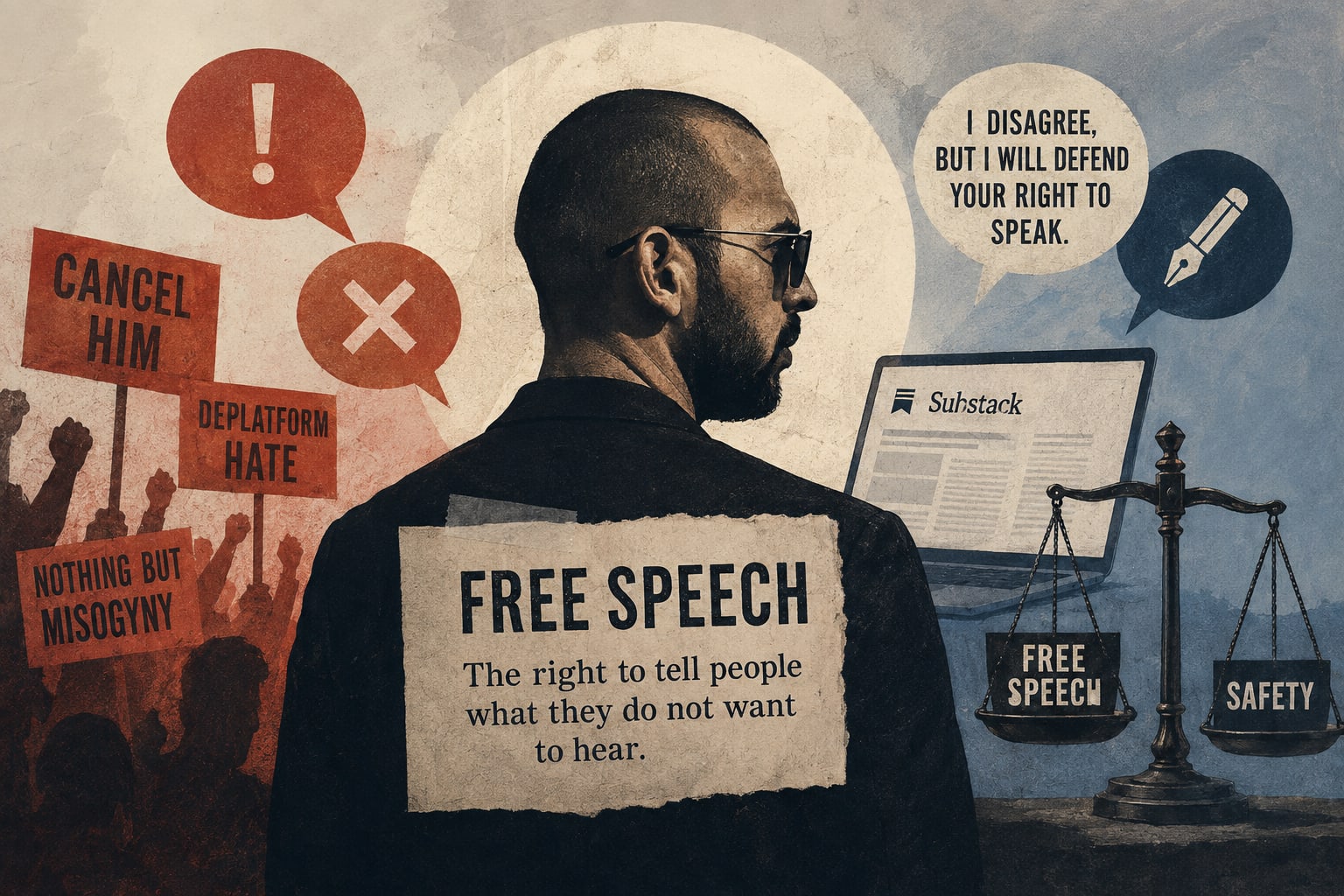
“If liberty means anything at all, it means the right to tell people what they do not want to hear.” – George Orwell, Animal Farm
Recently, everyone was buzzing about the latest Substack drama like flies around fresh waste.
Yes, it is true: Andrew Tate, a prominent misogynistic manosphere influencer, is on Substack. Apparently, he has been on the platform since 2024 but only now, after being booted from Meta for “harmful language”, has he moved his subscriber base to Substack. He instantly (and briefly) shot up to #1 bestseller, but has since gone down some slots.
Predictably, there was a furor about it and many argued for his removal from the platform based on his harsh ideas, strong opinions and sexual assault and abuse accusations.
However, they are only accusations. In America we have the rule of law and due process. Innocent until proven guilty. A process that helps provide time for investigations, protects the wrongly accused and better helps to ensure justice. This is a legal practice in any rational democracy.
So, whether you love or hate Tate, he should be allowed on Substack. Why? Because of free speech.
In my view cultural censorship, deplatforming, cancelling, online mobs, campaigns to prevent an author from even getting published to begin with, even book banning, is just as bad and in some ways perhaps even worse than legal censorship.
Free speech has one main purpose: To protect citizens’ unpopular speech.
The problem with people mobbing together and deciding who can stay and who must go is that we as a society don’t have agreed-upon understandings of what is “moral,” “good,” “safe” and “right.”
My point: Society contains multitudes. As a result, open forums like Substack will host many conflicting personalities, ideologies, religions, ideas, and posts that the mainstream may consider outdated, vile or offensive. But I support all people’s right to have bad, caustic ideas because I believe in free speech. We’re all diverse in ideas and word definitions change rapidly. As a result, it could be me or YOU caught by cancel culture next. The idea that we’d be able to be expelled from a platform for having an opinion should be anathema to everyone who cares about democracies.
The only exceptions, of course, are direct, specific calls for violence against an individual or group– “fighting words.” Look, I get it. Substack, like Meta, is a private company. They can technically expel anyone they want if that person violates their guidelines. That’s what Meta did, essentially for “Hate Speech.” Okay. Fine. Fair enough. And if Substack chooses to do that with Tate: Fine. I don’t subscribe to Tate. He clearly has an audience composed mostly of young, insecure men who feel unduly jettisoned by Feminism.
What then is the point? We as Americans and as defenders of Western democracies should use a very high standard for removing someone from a platform. Theoretically the “town square” is now on social media. Yet social media is owned by private companies, one of which, Meta, operates like a monopoly. The whole idea of a democratic nation is that we have the right to criticize our government for any reason. In autocratic nations dissent is crushed. But in democracies we have the right to speak out without fear of state retribution. This isn’t even fully true in some democracies today such as the UK, unfortunately.
As I mentioned earlier, cultural banning, cancellation, and deplatforming is just as bad if not worse than legal banning. No books in America are fully banned everywhere—as far as I know. Sure, some districts have banned certain books in libraries and schools (this is very bad and I hate it as well)…but you can still buy those books on platforms like Amazon. But, when you remove someone from a major platform their voice is actually gone from the public ‘square’.
Why defend someone with as reprehensible views as Andrew Tate? Simple: If you look at culture on both political sides over the past decade the definitions of what is moral, right, good, and normal have changed drastically.
Think about identity politics and ideology over the past ten years. Definitions change rapidly. In 2026 if you ask a cross-section of ages, nationalities, races and genders what racism, sexism, misogyny, capitalism, etc. are you’ll get a plethora of wildly divergent answers. My point: It could be YOU next that faces undue censorship or retaliation for voicing what you as an individual believe or espouse. Not that you will sound like Andrew Tate, but that culture changes, faster now than ever before due to tech and the internet. To be safe—to protect us all—we should protect free speech for everyone, both legally and culturally, unless, as I mentioned earlier, someone is specifically calling for violence. I do not see any other way around this Gordian knot.
If offensive ideologies aren’t banned, what is there to protect us? The answer yet again is free speech. It’s not that actions don’t have consequences or that words can’t cause psychological harm, just that being unpopular shouldn’t be a crime (figuratively or literally). We all have the power to ignore those we find offensive, to support speakers we align with, to engage educationally with opinions we dislike and most importantly—thanks to free speech—voice that dislike openly, publicly and safely.
We welcome you to share your thoughts on this piece in the comments below. Click here to view our comment section moderation policy.
The opinions expressed here do not necessarily reflect those of Fair For All or its employees.
In keeping with our mission to promote a common culture of fairness, understanding, and humanity, we are committed to including a diverse range of voices and to encouraging compassionate, good-faith discourse.
We are actively seeking perspectives on this topic and others. If you’d like to join the conversation, please send completed drafts to submissions@fairforall.org.

Author of the piece here. Just want to clarify: I'm NOT defending Tate's character or anything related to him. I'm solely arguing for all our right to free speech whether legally or culturally.
I've been reading a lotately about just how critical it is to have an "all allowed" right to free speech in a democracy, even moreso than under authoritarian systems. How could that be one might rightly ask? Our answer can be found in nearly every state that emerged from the breakup of the Soviet Union, as well as many fledgling nations in Africa, the Middle East, India in the 1950s...
The first thing most countries did when they had elections was to vote the majority ethnic group into power, who then took over the state media. That so many of these states are virtually mono-ethnic tells you what happened next (assuming you weren't around during the 1990s ethnic cleansing campaigns).
In Iraq, as soon as they were granted elections the majority ethnic and religious group took command of every important post or ministry, setting off an immediate civil war. We could go on, but the key here is that in all cases, those in power controlled radio, TV, news outlets and what was allowed to be said and taught. But it wasn't just the State, it was the voice of the actual majority. The state was often just amplifying the strongest opinions of their group.
The protection to say what you believe and to practice where you put your faith; it's more than the cornerstone of democracy, it's the entire foundation. A lot of other rights can be bent or suppressed for a time, but this is the one that must remain untouched.