

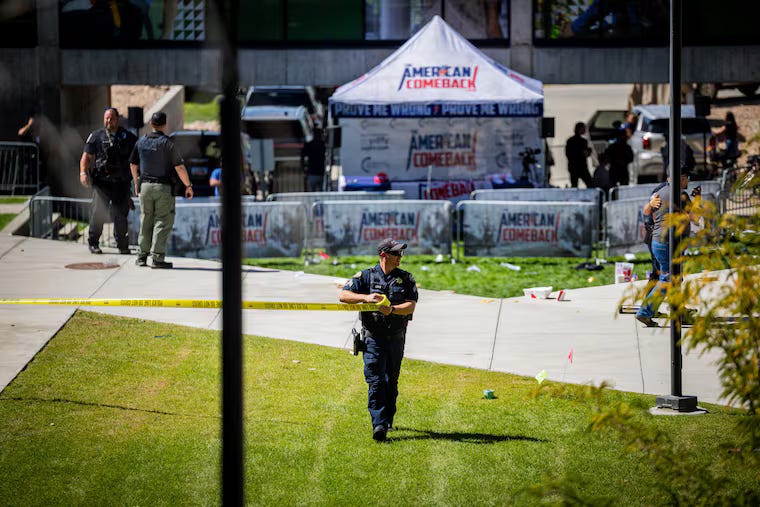
Charlie Kirk’s assassination at Utah Valley University on Wednesday represents more than the tragic loss of a single life. Whatever one’s views of his political positions, this act of violence strikes at the heart of our democratic discourse and demands our urgent attention—not as a momentary crisis, but as part of an enduring pattern that reveals fundamental truths about human nature and the perpetual threat to civilized society.
As I’ve been processing this tragedy, I keep coming back to something that's both deeply disturbing and strangely familiar: we've been here before.
The assassination of political figures is not new to American society. In the span of just five years—from 1963 to 1968—our nation lost John F. Kennedy, Malcolm X, Martin Luther King Jr., and Robert F. Kennedy. All of these men were killed for their ideas, their leadership, their willingness to challenge prevailing orthodoxies. And the reactions we hear today echoed those we heard then: “This isn’t who we are.” “This cannot be where we’re going as a country.” “America is better than this.” “This has to stop.” “We've never seen anything like this before.”
But the uncomfortable truth is that we have seen this before. We have been here before.
It’s a pattern that has persisted throughout our country’s history. The assassinations of presidents Lincoln, Garfield, and McKinley in earlier eras. More recently, we’ve seen attempts to take the lives of Presidents Reagan and Trump. We’ve seen ongoing threats of violence against members of Congress and an escalating climate where political disagreement increasingly translates into personal enmity.
In the aftermath of Kirk’s assassination, social media platforms were filled with celebrations of his death from ordinary Americans. These weren’t extremists or fringe actors; they were citizens expressing satisfaction with political violence:
"do matt walsh next"
"Trump next please"
"Charlie Kirk is dead, YAY!!!! One less mysoginist piece of shit on the planet. Do trump next!!!! NOT SORRY!!!!!"
"That's the best news! Do trump next!"
It might be tempting to think that Kirk's assassination and last year’s assassination attempt on Trump are signs of the moral failing of progressives, that the violence we’re seeing now is coming solely or primarily from the left. But this same tendency toward violence claimed four of our most transformational liberal leaders in the 1960s. And it claimed the lives of Democratic Minnesota Rep. Melissa Hortman and her husband in June.
It’s pointless to debate how much violence is coming from which “side,” or who is more savage now. The uncomfortable truth is that times change, circumstances evolve, political environments shift, and leaders rise and fall. What remains constant is our fundamental human nature, the duality that gifts us with the capacity for extraordinary beauty and compassion alongside the potential for unimaginable cruelty and evil.
The capacity to commit savagery is within all of us.
This recognition forms the philosophical foundation of FAIR’s mission. We work to advance civil rights and promote understanding precisely because we understand the urgent need to cultivate the better angels within our human family. As much as we advocate for our collective potential, we cannot ignore the darker impulses that reside within all human beings.
Robert F. Kennedy, speaking to a crowd in Indianapolis on the night of Martin Luther King's assassination, drew upon ancient wisdom to address this challenge. Quoting the Greek playwright Aeschylus, he urged his audience to "dedicate ourselves to what the Greeks wrote so many years ago: to tame the savageness of man and make gentle the life of this world."
Kennedy understood what we must also grasp now. The capacity for violence and dehumanization is not an aberration that occasionally infects our political discourse; it is part of the permanent human condition, a tendency that must be consciously and continuously resisted through the work of civilization itself.
The 1960s felt as turbulent and divided to those living through them as our current moment feels to us. We faced the same polarization, the same dehumanization of political opponents, the same sense that society was fracturing beyond repair. Yet that generation faced a choice: succumb to the savageness or work toward something better. They chose the latter, achieving imperfect but meaningful progress toward a more just society.
We now face the same choice.
FAIR's mission—advancing civil rights and liberties while promoting shared values and mutual understanding—represents our contribution to this ancient project of civilization. When we teach students to engage thoughtfully with challenging ideas rather than simply rejecting them, we work against the savageness. When we create spaces for passionate disagreement without dehumanization, we make gentle the life of this world. When we insist that free speech protections extend especially to views we find offensive, we choose our better angels over our worst impulses.
This work requires acknowledging that the tendency toward political violence is not a temporary madness that has infected our democracy, but a permanent feature of human nature that must be consciously countered. It demands that we resist the easier path of viewing our opponents as monsters and choose instead the harder work of engaging with them as fellow human beings who happen to hold different views.
Sadly, Kirk’s assassination will not be the last act of political violence we witness. The comments celebrating his death will not be the final expressions of dehumanizing rhetoric we encounter. The question is not whether we can eliminate these tendencies from human nature, because we cannot. The question is whether we will choose to feed our capacity for wisdom and compassion or surrender to our worst impulses.
FAIR’s work has never been more essential than it is at this moment. We stand at a moment when Americans must decide whether political differences justify violence, whether free speech belongs only to those with whom we agree, and whether democratic institutions can survive the current climate of mutual hostility.
The capability to commit savagery exists within all of us. But we also possess the capacity to choose differently—to “tame the savageness of man and make gentle the life of this world.”
The choice is ours. Let us choose wisely and go forth into this world as gentle people.
We welcome you to share your thoughts on this piece in the comments below. Click here to view our comment section moderation policy.
The opinions expressed here do not necessarily reflect those of the Foundation Against Intolerance & Racism or its employees.
In keeping with our mission to promote a common culture of fairness, understanding, and humanity, we are committed to including a diversity of voices and encouraging compassionate and good-faith discourse.
We are actively seeking other perspectives on this topic and others. If you’d like to join the conversation, please send drafts to submissions@fairforall.org.

"It’s pointless to debate how much violence is coming from which “side,” or who is more savage now." The reason it's pointless is that it's just a matter of obvious fact. And it should be taken into account from a tactical perspective. The left routinely shuts events down by threatening violence. Many orgs and venues have rules that say that the entity holding the event must bear the cost of security. So it is very hard for non-left orgs to have events, they have to pay so much more for them than the left orgs, because they are being threatened. I think that, since everybody knows that the left is doing most of the violence, the key tactic is for non-left to be clear that they are going to show up to left events and that they clearly need security to protect them. Then the left orgs will have to bear the cost or the event be canceled. Levels the playing field for the orgs.
“Excellent argument, Monica.
One might hope that higher education would have a role in quelling the violence and normalizing civility. About half our population earn college degrees; graduates provide leadership in many organizations and institutions. What they learn in college provides the foundation for the example they will provide to others.
How are colleges and universities doing? According to FIRE's latest survey of 270 institutions, not so well.
https://rankings.thefire.org/?utm_source=substack&utm_medium=email
Berea College, recently rated the best school for upward mobility Washington Weekly, earned a failing grade for its support of free speech and academic freedom (as did a majority of the schools surveyed). It was also ranked in the bottom half or the 270 schools that participated. A majority of the Berea student respondents believed that shouting down someone who expressed offensive views was appropriate while nearly a quarter even endorsed the use of violence to prevent the expression of potentially hurtful views. Anytime we justify denying others the freedoms we claim for ourselves we are committing a micro-oppression and slope toward violence is well lubricated by our innate narcissism.
Disheartening...”
Berea College dismissed me from my tenured professor position for cause in 2018 (I had the audacity to develop and distribute a survey asking about community perceptions and judgments about hostile environments and academic freedom). The FIRE survey also revealed that Berea College has nearly a 7 to one liberal to conservative student ratio. Eastern Kentucky University about 10 miles away admits student who are similar in many ways to Berea College students but its liberal to conservative ratio is nearly 1:1. Selection bias? EKU also ranked #10/270 schools on Fire’s survey.