

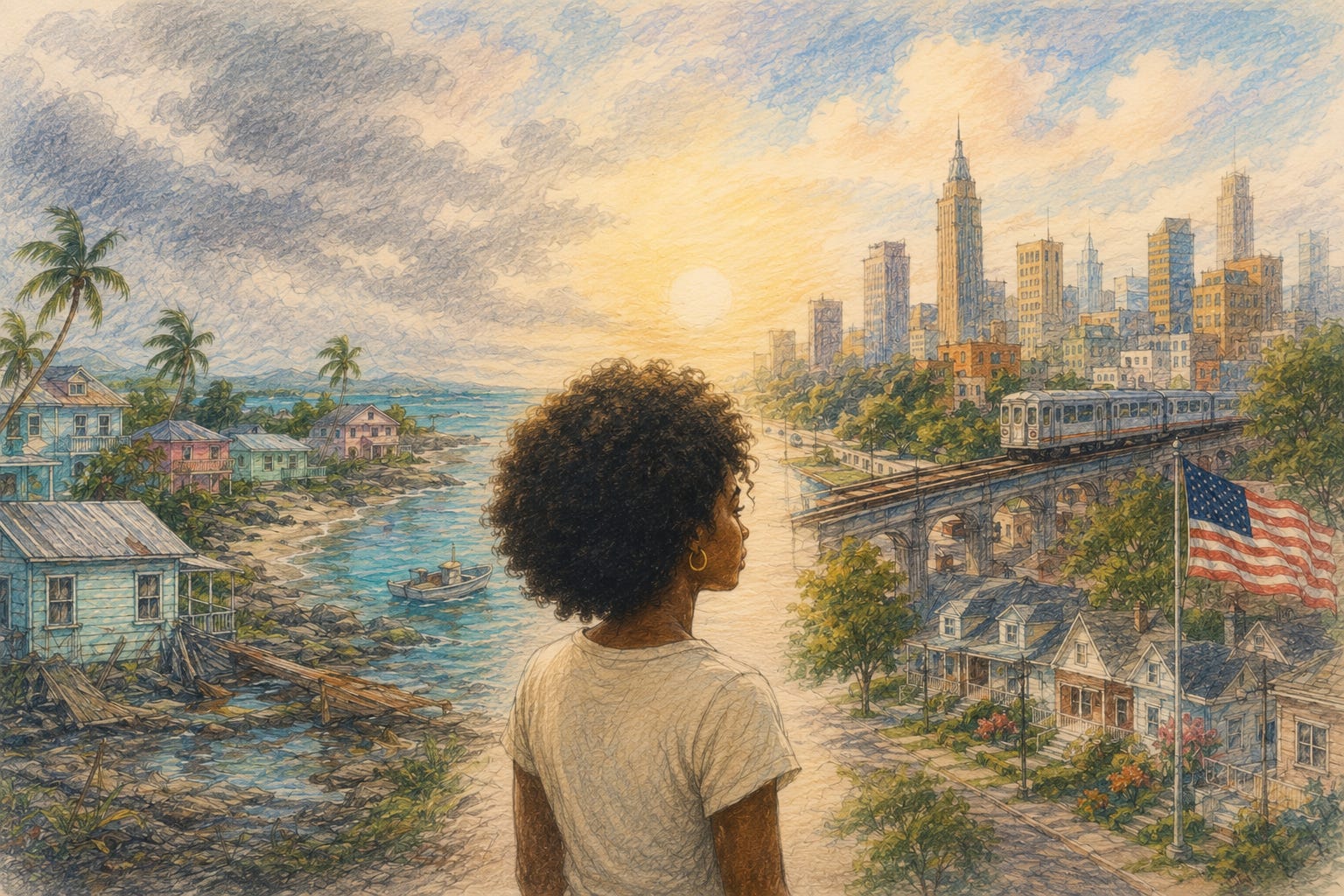
With America’s 250th anniversary having just passed, many conflicting opinions on the nation have risen to the surface. There are those who are enamored with our great nation and whose faith in the American dream is unshakable. On the opposite end of the conversation are those who see endless issues with the USA and can’t wait to emigrate elsewhere. While both stances are valid in their own rights, I feel the truth is somewhere more in between.
As a Bahamian-American raised primarily outside of the US, I feel uniquely able to bridge this gap. I have experienced life in a developing nation, and the hustle of modern American life.
Growing up on the tiny island of Nassau–147 square miles and less than the length of the average marathon–I was fortunate to have a two-parent household, a private education and enjoyed a middle-class lifestyle. Despite these privileges I was only partially shielded from the reality at hand. Many Bahamians can’t swim–which is dangerous when you live in a country surrounded by water, many don’t pass grade school, and have no post-secondary education options unless they leave the country. While Nassau has two hospitals—one private and one public, both lacking in many ways–other islands–such as Grand Bahama where I lived for three years–have no real medical facilities.
Food and water are also a national concern. The majority of food in the Bahamas is imported, as a result supply chain issues, governmental corruption and resource scarcity have increasingly devastating effects on the population. Water that isn’t bottled is unsanitary for drinking and alternatives, such as rainwater collection, are costly and hard to maintain.
Additionally , the nation operates on an insufficient power grid as a result of the government catering to the power needs of ever-expanding hotels. These touristic hubs take precedence over residential neighborhoods and the daily power needs of locals because tourism is the nation’s sole industry–there is an economic reliance on foreign comfort. Most homes, excepting those who can afford a generator of which my family was not one, are without power daily for substantial lengths of time. The frequent on/off of the power damages appliances, and interrupts business. It also makes it impossible to cool homes–the ones that have air conditioning–which is hazardous in a hot humid nation.
The geographical location of The Bahamas also makes it a prime target of severe yearly hurricanes. Candle light baths with salvaged water and cold rationed dinners were not uncommon during hurricane season. Coupled with high rates of violence, an astronomical cost of living, an internationally valueless dollar, a corrupt government and storms that can leave locals without adequate food and water for weeks to months, the Bahamas is a travel beauty but a living disaster.
Hurricane Dorian, for example, was a category five storm that decimated the nation after stalling over islands like Grand Bahama for three days (storms usually blow through in a matter of hours). Dorian flooded 80% of the island, left the island’s only airport out of commission and forced locals to rely on foreign aid. It also led to an unreported death toll in the dozens without any concrete plans to rescue people or rebuild infrastructure.
Despite the hardship of life in the Bahamas, I love the country of my childhood and celebrate its joys just as I love my present American home.
I moved to America after losing a lot: My parents gave up their dream of owning a house in their home nation in favor of moving to a nation of greater stability. I had to, in the middle of high school and in the months precursing covid, change schools which brought a total cultural whiplash. Travel is expensive and time consuming, as is filing mountains of paperwork to demonstrate that your family are decent law-abiding people. Paper work that often makes no sense without legal guidance becomes an all day task. Packing is busy and even busier when you realize you will have to sell or leave behind boxes of belongings that meant so much to you. Learning that the humane society you had spent years volunteering at had become a watery death trap for pets and the brave workers who stayed with them during the storm reminds you that you have lost a lot and yet still less than others.
Walking away with my life, family, pets and most important belongings was a sobering experience and has given me a deep appreciation of our American nation. While we can argue about the government, bicker about history, acknowledge that the American dream is fleeting or take issue with any number of things across the country, one thing remains true: This is a great nation. That doesn’t mean perfect or always unified, but it does mean great. We live in a nation where we can freely voice opinions, contact our leaders, demand representation, access any part of the country reliably through public transport, and receive medical care from a licensed doctor who is up to date on modern medicine (however expensive it might be). We can select our educational paths, shop online and in-person, and reliably expect both the availability of products and the consistency of pricing.
I will never forget the first time a package arrived at my door after I moved to the United States. It felt like magic. I will never forget my first time in a Super Walmart. I thought it was a mall—I couldn’t imagine such abundance. I will never forget my first time riding a train or visiting a library or museum, many of which are free in America. Having police that respond in minutes, a court system that takes its cases seriously, and being able to vote in ways that bring about impact are all things that as an American I am thankful for and as a Bahamian am amazed by.
So, as we move beyond July 4th and continue our celebration of the 250th year of this great nation, I hope that we can all remember that it is ok—and even good —to love your home nation, to love your American nation and to simultaneously recognize its faults. Our areas for growth should not detract from our greatness and do not detract from the value of celebrating 250 years of that American greatness.
We welcome you to share your thoughts on this piece in the comments below. Click here to view our comment section moderation policy.
The opinions expressed here do not necessarily reflect those of Fair For All or its employees.
In keeping with our mission to promote a common culture of fairness, understanding, and humanity, we are committed to including a diverse range of voices and to encouraging compassionate, good-faith discourse.
We are actively seeking perspectives on this topic and others. If you’d like to join the conversation, please send completed drafts to submissions@fairforall.org.

Thank you so much for writing this. I teach at an elite college and most students do not love America and cannot think of a single good thing about the country. How do I know? Because I ask my classes and this is how they respond. Coming from a black working class background in the South, the child of two parents who did not finish high school, who spent his first ten years without hot running water, etc. to arrive at my current station among the top ten percent I know America is great. To quote Obama, "In no other country is my story even possible."
Well said. I've always thought that if more people visited other countries similar to the beautiful Bahamas, which I visited many years ago, they would learn firsthand how much we take for granted and how fortunate we are to live in America.