

After Charlie Kirk’s assassination, a new debate over free speech has erupted on the right. For the last decade, conservatives have championed free speech, but this incident has split that consensus. Voices like Matt Walsh and Senator Rand Paul support consequences for those celebrating Kirk’s death, forcing the right to confront whether defending speech still matters when it’s unpopular or offensive.
Yet, when Attorney General Pam Bondi said in an interview “there’s free speech, and then there’s hate speech,” virtually everyone on the political right called her out, including Matt Walsh.
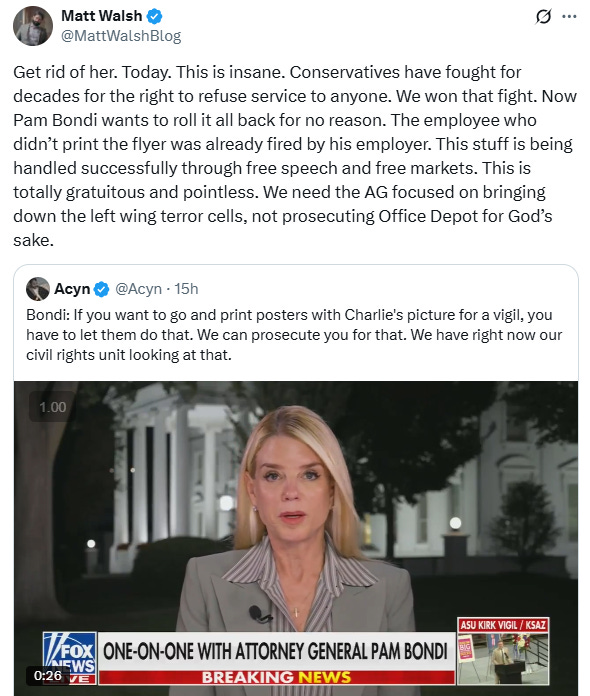
Censorship is dangerous because it silences voices that present alternative information, counter arguments, and diverse viewpoints that may not align with the approved narrative—even when those voices speak important truths. By squelching an exchange of information and limiting perspectives, we restrict our ability to learn more and get to a richer, more comprehensive understanding of reality.
But while defending free speech is crucial, how we protect it matters just as much.
One of the most common defenses of free speech floating online is “Hate Speech is Free Speech”—a line that has almost universally been adopted by defenders of the First Amendment in response to Attorney General Bondi’s comments.
At first glance, this might seem like a straightforward approach. But every time I hear someone say, “Hate speech is free speech!” I cringe a little inside.
I first remember encountering this phrase in 2016 when Ben Shapiro spoke at California State University, Long Beach. That event was chaotic, to say the least. Some students I helped at the time invited Ben, only for the university to uninvite him. It was only after the situation gained national attention that he was allowed to speak. But not without fierce opposition that sought to cancel and threaten his supporters.
For example, a professor implicitly threatened one of my students, arrogantly claiming, “I lift bro.” Despite the chaos, the students and Young America’s Foundation managed to pull off the event, navigating a logistical nightmare with the university administration and media largely against them. And at the event itself, there was a wall of students who used their bodies to press against the emergency exit while someone pulled a fire alarm.
Meanwhile, I helped organize a counter-protest to show that not everyone at Cal State Long Beach was opposed to Ben Shapiro or free speech. I even made most of the protest signs, pictured below.
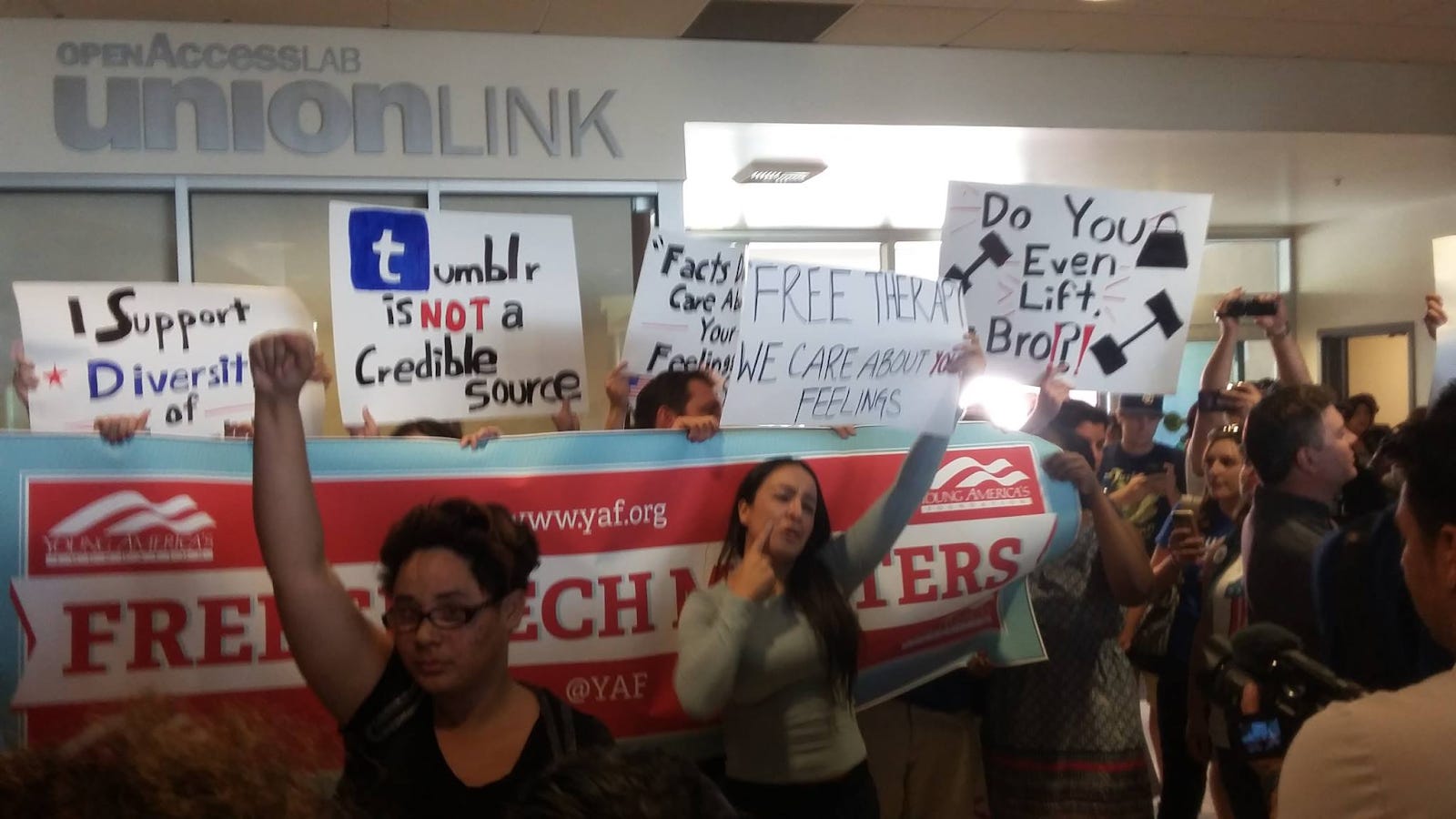
We were determined to show that supporting free speech doesn’t mean endorsing every idea or opinion out there—it means defending the right to express them. But what I didn’t photograph were the signs brought by others which read, “Hate speech is free speech.” Even back then, I knew this phrase was problematic.
What are free speech advocates trying to say when they use the phrase? They likely mean that hate speech, however offensive, shouldn’t be censored. Fair enough. Censorship is indeed dangerous. But that’s not what most people hear.
When you say, “Hate speech is free speech,” it sounds like you’re equating the two, and it speaks only to a segment of the country who already supports free speech. Meanwhile, when someone who supports censorship hears that slogan, they can easily respond, “Yes, exactly—free speech is hate speech that’s why it should be silenced.”
The slogan oversimplifies the complexity of free speech as a principle. Free speech is about allowing a marketplace of ideas where the best ideas can rise to the top, even if some of those ideas are offensive or unpopular. It’s about trusting the process that truth and reason will prevail over time through open discourse. But when we defend free speech by equating it with hate speech, we hand our critics a weapon to use against us.
Instead of saying “Hate speech is free speech,” we should emphasize why free speech matters in the first place. A better line could be “Challenge, don’t silence!” or “Banning hate speech is dangerous.”
These lines help remind people that free speech applies to all speech (excluding true threats, defamation, perjury, blackmail, or true incitement) and that the same protections that allow someone to say something offensive also protects those who challenge that offense. We should convey that the best way to prevent hateful views from spreading is through the free expression of views which prove hateful views to be wrong and more positive views to be right.
It’s not that we need to treat all views as morally sound. But when we try to suppress the expression of even truly reprehensible ideas, they don’t disappear—they go underground, fester, and return in uglier forms.
Advocating for free speech isn’t about defending the indefensible—it’s about ensuring everyone has a voice so that all views can be exposed and debated. Censorship is the real threat, not the difficult conversations that come with a truly free exchange of information and views in an open society.
As Charlie once said, “Hate speech does not exist legally in America. There’s ugly speech. There’s gross speech. There’s evil speech. And ALL of it is protected by the First Amendment. Keep America free.”
The reason we defend hate speech is not because we defend hate. We defend all speech, because silencing one voice endangers all voices.
We welcome you to share your thoughts on this piece in the comments below. Click here to view our comment section moderation policy.
The opinions expressed here do not necessarily reflect those of the Fair For All or its employees.
In keeping with our mission to promote a common culture of fairness, understanding, and humanity, we are committed to including a diversity of voices and encouraging compassionate and good-faith discourse.
We are actively seeking other perspectives on this topic and others. If you’d like to join the conversation, please send drafts to submissions@fairforall.org.

It wasn't the 'speech' that was offensive.
It was the *celebrating*. Celebrating an ASSASSINATION. And then to 'justify' it, the left began the dehumanizing verbiage: bigot, racist, fascist, misogynist (seriously???), and 'pedo supporter', 'rapist supporter', 'nazi'. All based on lies. Lies that the left invented and retold, and retold, and retold.
Go look on FB at the *vile* names they are using for Erika Kirk. All because A) 'they' don't think she is grieving 'properly' (i.e. white pantsuit, full make up, jewelry) and B) she was married to Charlie - who they now assign all the above names to.
We don't need new censorship arguments, but I can certainly accept that we need a new definition for "Humanity".
We need to not give the concept "hate speech" the legitimacy of even using it. There is no such thing as "hate speech" - it was a concept devised by left-wing academics to delegitimize certain points of view, to make it easier to try to justify censoring it.
Just as Charlie Kirk said, there is no such thing.
Look at how "hate crimes" - which punish motivation, or thought, rather than behavior - first snuck into jurisprudence, and are now largely accepted - despite clearly violating the Fifth Amendment's ban on self-incrimination. There is simply no way to charge, much less convict, someone of a "hate crime" or "bias crime" without introducing their own words against them.
We need to avoid falling into the trap of arguing that this or that is or isn't "hate speech."
The simple answer is, "No such thing exists - next question please."