

On September 10, 2025, conservative political commentator Charlie Kirk was assassinated while speaking at Utah Valley University during the American Comeback Tour. He was exercising one of the most basic freedoms of our republic—the freedom of speech—engaging in the ordinary act of political persuasion that undergirds democratic self-government. Investigators reported that the shooter’s ammunition bore political engravings; a clear indication that this was almost certainly a politically motivated attack, and recently released text messages have solidified this further.
The reaction to his death was immediate and intense. While many leaders across the political spectrum condemned the violence, some voices in media and online seized upon the tragedy to call for vengeance or to declare that the nation is now in a state of war. The very fact that such rhetoric surfaces in the aftermath of violence is cause for deep alarm, for it threatens to normalize cycles of retribution instead of recommitting us to constitutional order.
Kirk’s assassination is not an isolated event but part of a troubling, growing pattern in the U.S. of violence directed at political actors across the ideological spectrum. In recent years, elected officials and candidates on both the left and right have been targeted in public spaces and in the privacy of their homes; state legislators in Minnesota, governors in Pennsylvania and Michigan, members of Congress, the police protecting their operation and their family members, and a former president running for a new term. Activists and public commentators, too, have faced intimidation and violence for voicing political convictions. What unites these incidents is that they strike at people participating in the legitimate, peaceful processes of persuasion, organization, and campaigning that sustain our nation. When bullets are substituted for ballots, when intimidation displaces deliberation, the very fabric of constitutional democracy is endangered.
Equally disturbing is how some have chosen to respond to Kirk’s killing. Certain commentators and influencers have used the event to assign collective blame to millions of ordinary Americans who share different political views. Others have even celebrated his death as deserved retribution. This dehumanization of political opponents is corrosive and dangerous. When entire groups are treated as though they are complicit in murder simply for sharing a viewpoint, we lay the groundwork for further escalations of violence. To deny another person’s dignity or humanity because of political disagreement is to reject the civic friendship that makes deliberation and persuasion possible, and it flies in the face of our constitutional heritage.
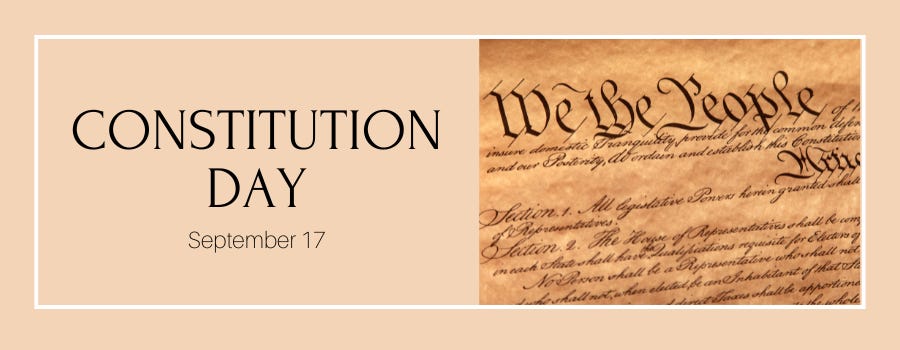
As we recognize the celebration of Constitution Day, it is worth remembering why our Founders established this framework of government in the first place. Outbursts of political violence in the 1780s, embodied by Shays’ Rebellion in 1786, convinced Americans that the structure of government created by the Articles of Confederation was insufficient to maintain order and liberty at once. The Constitution was designed to channel conflict into peaceful processes, allowing citizens to resolve disagreements through ordinary political practices at multiple levels, without resorting to force. Its principles—freedom of speech, federalism, separation of powers, rule of law, judicial independence, rights of the accused—are not abstract theories but practical safeguards against the descent into political violence. They are tools for transforming anger into argument, resentment into reason, and grievances into laws debated and decided by elected representatives.
The Constitution was meant to secure the promise of the Declaration of Independence: “that all men are created equal, that they are endowed by their Creator with certain unalienable Rights, that among these are Life, Liberty and the pursuit of Happiness.” These rights are not contingent on party membership, ideology, or popularity. They apply to every citizen equally.
That is why it is deeply un-American, not only to commit murder against someone on the basis of their ideas, but also to celebrate harm done to a political adversary, or to demand vengeance upon entire groups of ideological opponents engaged in ordinary, peaceful political argument in the wake of tragedy. Principles are not genuine if we apply them only to our political allies. They are tested—and proven real—when we apply them to those we oppose. To honor our traditions, we must defend free speech, due process, and equal protection under the law even when the person exercising those rights is a political rival. As Americans our constitutional principles call us to be civic friends across party or philosophical differences.
We have an opportunity now, as we mourn, to look towards the coming celebration of the 250th anniversary of the Declaration of Independence, and to recommit ourselves to these first principles. Our schools and universities must work to restore this understanding of the Constitution and the principles of the Declaration informing it. Civic education efforts alone won’t immediately solve our problems with growing political violence, but we need to renew these efforts immediately, and intensively, as part of the national response to this most recent tragedy of political violence.
As Yuval Levin argued in his book, American Covenant: How the Constitution Unified Our Nation―and Could Again (2024), the Constitution was designed not to seek unity in the sense of agreement, but rather to promote constructive disagreement. The framers understood that free people will disagree about nearly everything. The Constitution is designed to promote constructive spaces and institutions for argument, and the search for enough consensus to govern ourselves peacefully—from local to state to national politics.
The assassination of Charlie Kirk and other recent acts of political violence confront us with a sobering truth: the survival of our republic depends not only on the words of the Constitution but on our individual and collective commitments to live by its principles. We honor our constitutional order not when we demand retaliation, but when we refuse to let violence dictate our politics, and honor the shared humanity of those we disagree with. Whether common citizens, commentators, activists, or civic leaders, we must reject calls for collective blame or vindictive retribution, and instead recommit ourselves to the hard but essential work of persuasion, deliberation, and elections among civic friends. To do otherwise would betray the legacy of the Founders and the promise of the Declaration. At this moment, the truest way to honor the memory of Kirk and Constitution Day alike is to resolve that in America, political disputes must continue to be settled with words, not weapons.
We welcome you to share your thoughts on this piece in the comments below. Click here to view our comment section moderation policy.
The opinions expressed here do not necessarily reflect those of the Fair For All or its employees.
In keeping with our mission to promote a common culture of fairness, understanding, and humanity, we are committed to including a diversity of voices and encouraging compassionate and good-faith discourse.
We are actively seeking other perspectives on this topic and others. If you’d like to join the conversation, please send drafts to submissions@fairforall.org.

Excellent essay!