

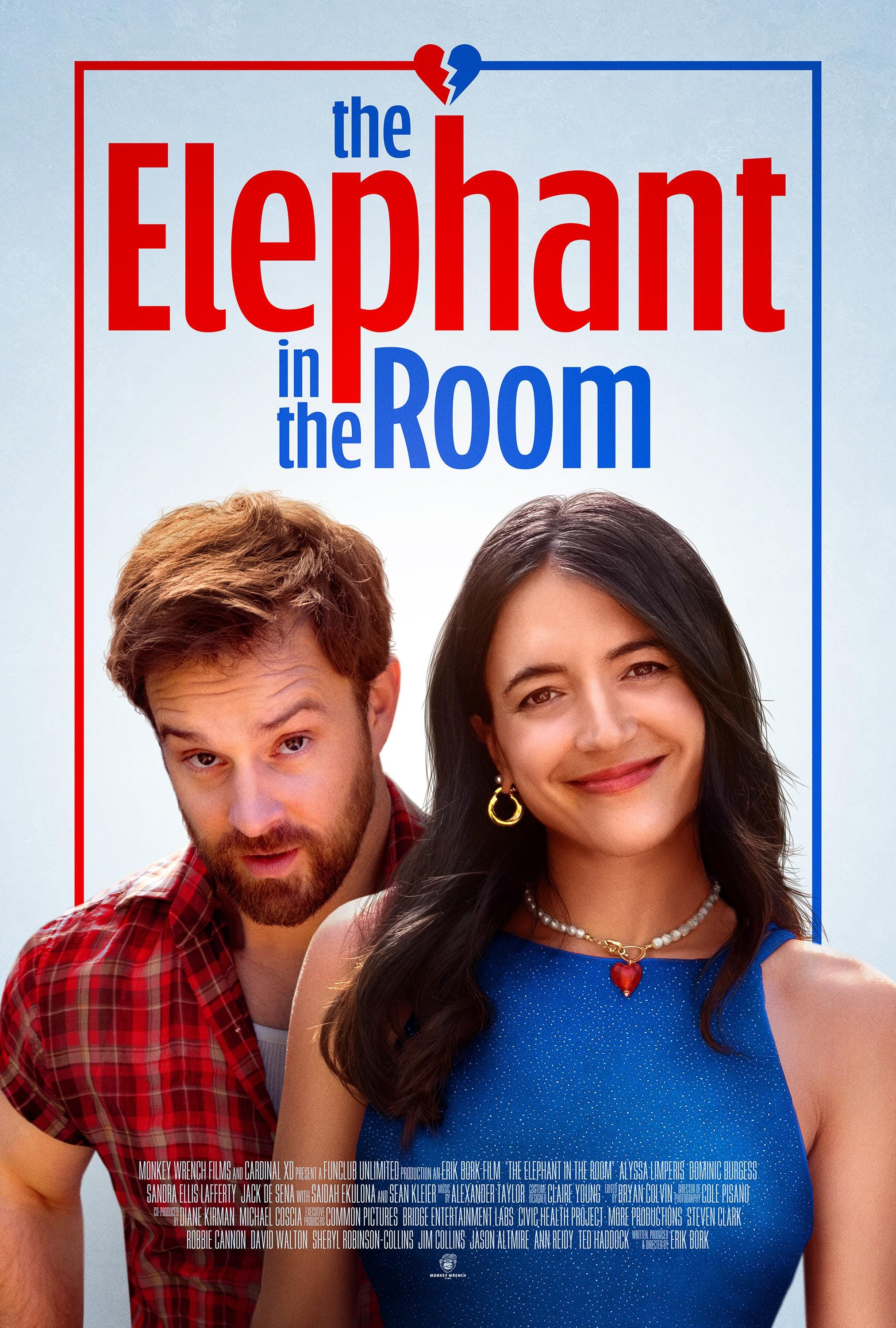
Can a new romcom about two people who try to date across party lines help to knit our great country back together?
That's the question posed by The Elephant In the Room (disclosure: Bridge Entertainment Labs, which is a client of mine, is an executive producer of the film), which was released to the public last week. The film stars a liberal social media manager (Leah, played by Alyssa Limperis) who falls for a cute, charming line cook named Vincent (played by Sean Kleier). But this is December 2020, and Vincent just voted for Donald Trump for president. Can Leah and Vincent's burgeoning romance survive their political differences?
It's a question a lot of us are asking ourselves. In a recent poll, 60 percent of Gen Z agreed that "It's important to date or marry someone who shares your political views."
That number is not a surprise. Some of it reflects a genuine belief that dating someone with shared values and political preferences is just easier. But some of it reflects a political prejudice that's becoming more and more acceptable in our culture. In the aftermath of Trump's 2024 victory, for instance, pundits on TV and social media encouraged liberals to cut ties with their conservative friends and family. Yale psychiatrist Amanda Calhoun went on MSNBC to advise viewers that reducing contact with their Trump-supporting friends and relatives “may be essential for your mental health.”
These kinds of messages have a real impact, because they change the permission structure of what we think is socially allowed and encouraged. When influential people tell us that we shouldn't build or maintain relationships with partisans from the other team, many of us listen.
More In Common, a nonpartisan think-tank dedicated to studying political polarization, released a report examining the "Predictors of interest in connecting across difference"—that is, what factors in our lives make us more or less likely to want to engage in relationships with folks across the aisle. They found that "the strongest predictor of interest is perceived community norms—that is, the belief that connecting across lines of difference is common and valued within one’s community."
That's why a movie like The Elephant In the Room is so important. Stories can shape our social norms. Will and Grace, the 1998-2006 series featuring two gay main characters, shaped how our country perceived gay and lesbian Americans. When we tell stories about characters who try to date across party lines, that matters. Leah and Vincent's relationship is messy, and the film doesn't shy away from the hard parts of their relationship (Leah, for instance, is extremely upset when Vincent wants to attend the January 6 protest). But the characters also push through, and that's important. When we see characters on the silver screen who are willing to build relationships with people across the aisle, it can make us more willing to do the same.
The other big way that the film changes our permission structure is that it decouples values from politics. I think a lot of us are told that other peoples' politics are a proxy for their values. A 2024 survey found that 45 percent of the electorate agrees at least somewhat that "The [Outparty] are not just wrong for politics, they're downright evil."
But The Elephant In the Room shows that this narrative isn't true. Leah wants to save the world, but she's also a little bit manipulative and sees Vincent as a project. Vincent, in turn, is far from the neo-Nazi that Leah expects: he's kind, generous, and one of his biggest values is taking care of his aging grandmother.
Over the course of 90 minutes, Leah and Vincent start to see each other's humanity across the gulf of their political differences. Maybe their example can encourage us to do the same.
The Elephant In the Room is now available to stream.
We welcome you to share your thoughts on this piece in the comments below. Click here to view our comment section moderation policy.
The opinions expressed here do not necessarily reflect those of the Fair For All or its employees.
In keeping with our mission to promote a common culture of fairness, understanding, and humanity, we are committed to including a diversity of voices and encouraging compassionate and good-faith discourse.
We are actively seeking other perspectives on this topic and others. If you’d like to join the conversation, please send drafts to submissions@fairforall.org.
Where can we see this and when?
How can a society function if people of different political views are not even willing to engage with each other? So sad.