

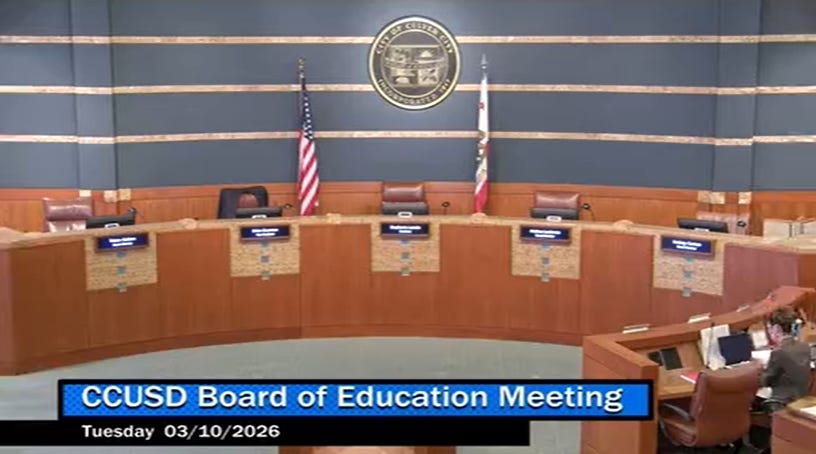
I regularly watch board meetings in Culver City Unified School District (CCUSD), where my daughter is enrolled, and occasionally attend in person. Since the pandemic the district has settled into a hybrid Zoom format, which has become a biweekly ritual for me.
Recently, public commenters on Zoom stopped appearing on camera, leaving me to hear only faceless voices. So, when I heard a somewhat exasperated but genuine parent begin their public comment with: “Please, for the love of God improve your communications…” it got my attention (48:00).
She then turned to the district’s finances and enrollment.
“I will vote no on any parcel tax,” she declared. “I will campaign no for any parcel tax, because until you guys get a handle on our student body… we need a more restrictive process to prove residency, and we need to right-size our district.”
CCUSD, like many California districts, has been losing students, and a recent district-funded study projects that this trend will continue. Payroll for teachers and administrators, however, has not shrunk to match this loss, and the board is asking voters to approve a parcel tax to close the gap.
As her time expired and the parent was finishing her comments, board member Triston Ezidore interjected: “Can we mute the hate speech, please?”
There was a brief pause.
“What hate speech?” the parent asked, sounding genuinely surprised.
But there was no answer. Her audio feed was abruptly cut, and the meeting quickly moved on (50:00).
Bear in mind the parent’s remarks were about fiscal policy, enrollment management, and district budgeting, which are standard topics at any school board meeting. Yet instead of engaging with the substance of her concerns, board member Ezidore’s remark recast them as a moral violation.
I’ve seen this play out before.
Before this incident, I served on several district committees, including the high school Site Council, the Local Control Accountability Plan committee, and the district’s Equity Advisory Council. In all of these forums, disagreement was often handled indirectly.
The Equity Advisory Council operated under a recurring “Norm Setting Agreement” that asked participants to “elevate marginalized voices” and “respect intersectionality”.
I raised a concern about this process at my first meeting and told the group I could not agree to those rules. My point was simple: experience can inform a discussion, but it should not determine who is right before the discussion begins.
No one engaged with my argument.
Instead, the facilitator read aloud a prepared anti-hate statement, the kind now recited before public comment at municipal meetings. The implication was clear enough. What I had said was not just wrong, but out of bounds.
Following that meeting, I sent an email to the facilitator and fellow committee members reiterating my earlier concerns about elevating voices based on identity rather than ideas. The response, both in the meeting and in the silence that followed, largely reaffirmed the existing framework.
The exchange at the board meeting felt so familiar because the mechanism was the same. You don’t have to refute an argument if you can simply relabel it. When a perspective is framed as harmful or hateful, it no longer needs to be addressed.
The parent’s comments were about trade-offs. The district faces a structural budget problem driven by declining enrollment and a cost structure that does not easily adjust. There are only a few options: raise more revenue, reduce costs, or some combination of both.
Reasonable people will disagree about which path to take, but that is the point of public comment. Yet in that moment, one side of that debate wasn’t treated as a position, but as a voice to be “muted.”
People take note when this happens. Speaking in front of a school board can be daunting — not just for the person speaking, but also for everyone else listening. That was certainly true for me. Whether they are on Zoom, physically in the room, or watching the event later, participants learn which arguments are safe to express and which ones carry a cost.
Some people will choose to keep speaking anyway. But many will not.
Over time, the range of acceptable viewpoints narrows not by formalized rule, but by signal. The meeting still looks “open.” The microphones are still there. But the boundaries have shifted, and that has consequences. You lose the parent who came to ask a budget question and decides it is not worth it next time. You lose the observer who has a similar concern but chooses to stay silent. The community loses the expectation that public officials will engage with criticism rather than deflect it. Once that expectation erodes, effective governance suffers, as well.
School boards are one of the few places where ordinary citizens can directly question decisions about taxes, staffing, and policy. When those questions can be dismissed rather than engaged, the community loses something essential — not decorum, but accountability.
We welcome you to share your thoughts on this piece in the comments below. Click here to view our comment section moderation policy.
The opinions expressed here do not necessarily reflect those of Fair For All or its employees.
In keeping with our mission to promote a common culture of fairness, understanding, and humanity, we are committed to including a diverse range of voices and to encouraging compassionate, good-faith discourse.
We are actively seeking perspectives on this topic and others. If you’d like to join the conversation, please send completed drafts to submissions@fairforall.org.

The only real purpose of all those mechanisms is to silence any opposition or criticism of the board and speaker. Bluntly, they're about maintaining power, not about improving civil discourse
This regressive movement wants power and has developed this anti-racism ideology, irrationality, and doublespeak so that its power will be unquestioned, not even subject to question. This movement is allying with others, the only requirement being irrationality and hostility to traditional individual freedoms.
That parent should sue the school board for its unconstitutional denial of his/her right to speak. The suit should demand the antiracist ideology be extirpated from the school system and school board. It is anti-American and anti-human.
We are very, very close to becoming another North Korea, governed by a hateful, malevolent, implacable, and all-powerful, regressive directorate. G-d help us.