

I think most of us are tired of ideologically ham-fisted movies and TV shows. We're tired of movies that treat us like five-year-olds who need a 10-minute monologue about the theme in order for us to get it, because we can't be trusted to use our brains to infer themes from the organic conflict and characters of a film. We're tired of shows that seem more interested in telling us who to vote for than in entertaining us or in helping us to see the world in all its breathtaking complexity. We're tired of movies where the villain is an orange-skinned despot named Dronald Drumpf.
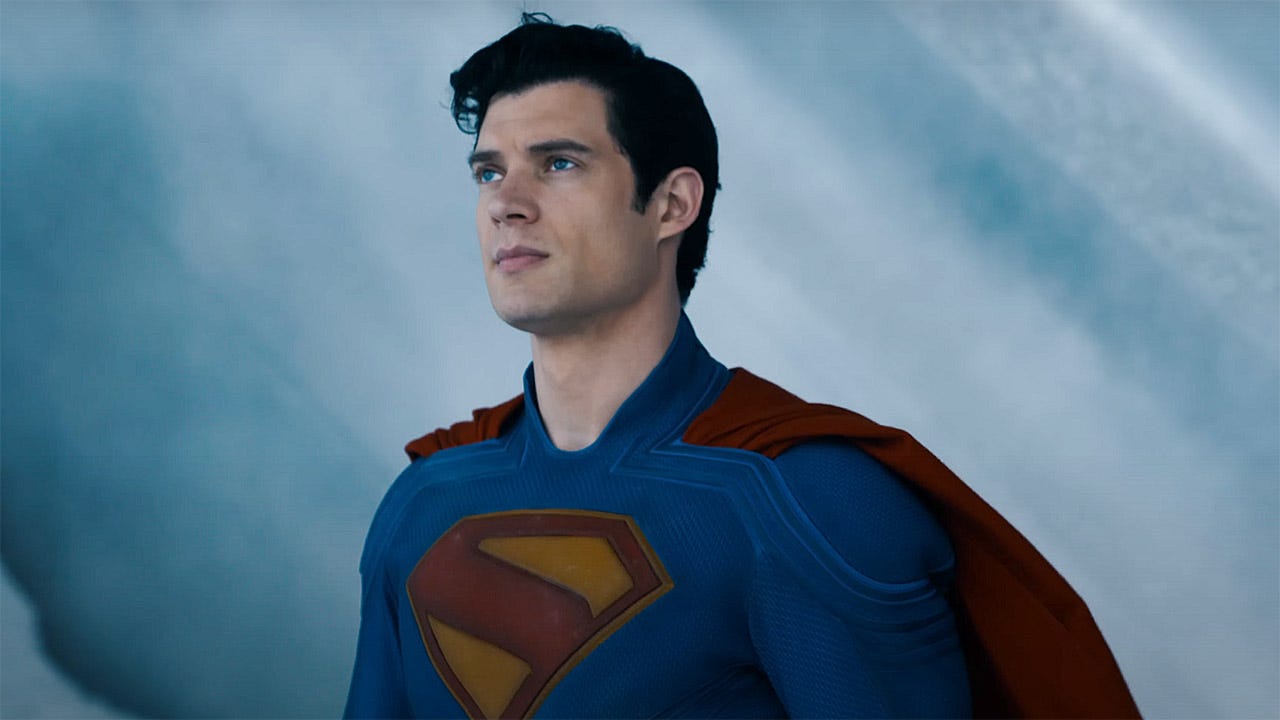
So when I heard that the new Superman movie had an ideological agenda—even if it was one with which I personally agreed, to try and unite the country—I was skeptical. Was the movie going to be flat and one-dimensional? Was all real conflict going to be smoothed over while the characters gave impassioned speeches about the importance of depolarization? Were Superman and Lex Luthor going to hold hands and sing Kumbaya in the final scene?
But to my relief, the movie was nothing of the sort.
Superman reminds me a lot of the ideals of Bridge Entertainment Labs (disclosure: Bridge Entertainment Labs is a client), a nonprofit focused on healing our toxic polarization by helping storytellers across America to tell less polarizing stories. For instance, they encourage storytellers to tell stories that embody "pluralism and heterodoxy" and which "feature authentic stories with complex and nuanced characters that defy expectations and stereotypes." The idea is that stories with simplistic antagonists whose motivations are self-evidently evil, for instance, simply reify our existing us-vs-them mindset by telling us that the antagonists in our own lives are self-evidently evil too. By contrast, when artists tell stories in which the antagonists have good reasons for their behavior (even if we still disagree with said actions), audiences might come away with a deeper curiosity for the good reasons behind the actions of our political opponents.
That's exactly what I saw in Superman. Lex Luthor isn't a cardboard villain with a one-dimensional motivation for power or money. Instead, he's complex. He's motivated by envy, but also by a deep love for humanity and a fear that aliens like Superman might prove to be humanity's undoing. That's a fair motivation when you're dealing with an unstoppable super-alien, especially when Luthor finds information suggesting that Superman was sent to earth by people with bad intentions. Luthor is still a terrifying and cunning antagonist who almost destroys the world, but his worst actions are driven, not by evil, but by a kind of motivated reasoning: he sees the bad that Superman might do, but is blind to the good that Superman actually does.
That makes Luthor not only more interesting as a villain, but also more relatable. Who of us hasn't engaged in motivated reasoning and ended up on the wrong side of an issue as a result? Unlike a cardboard villain just out for world domination, what pulled me into Luthor's story was how easily I could put myself in his shoes.
That same love of complexity and nuance shows up in how the movie grapples with its deepest themes. In an early scene, Louis Lane interviews Superman antagonistically, and her pointed questions help us to see how people in-universe who don't take Superman's good motivations as axiomatic might see him. There are thorny questions to grapple with if your hero is a demigod who flies around the world smashing tanks and threatening world leaders, and the story doesn't shy away from those questions. It's easy to see how an in-universe person could see Superman's actions and wonder if he might actually be the bad guy.
Ultimately, that complexity is what this story's about. As director James Gunn says, "I believe that most people in this country, despite their ideological beliefs, their politics, are doing their best to get by and be good people…This movie is about that." But one of the beauties of Superman is that, in contrast to some recent films and TV shows, the movie doesn't beat the audience over the head with that theme. Instead the theme emerges organically, from complex characters who grapple with thorny questions and sometimes end up on opposite sides of those questions.
In telling a deep and complex story, Gunn may well bring down the temperature in our overheated country. But perhaps even more importantly—for audiences who want a night of entertainment, for studio executives who want to finance a hit, for storytellers who want to create art that moves people—he's succeeded in making a better story than what would have emerged if he had just written Clark Kent as self-evidently virtuous and Luthor as obviously evil.
We welcome you to share your thoughts on this piece in the comments below. Click here to view our comment section moderation policy.
The opinions expressed here do not necessarily reflect those of the Foundation Against Intolerance & Racism or its employees.
In keeping with our mission to promote a common culture of fairness, understanding, and humanity, we are committed to including a diversity of voices and encouraging compassionate and good-faith discourse.
We are actively seeking other perspectives on this topic and others. If you’d like to join the conversation, please send drafts to submissions@fairforall.org.

Oh, I was hoping for comments already....I LOVE the comment section!! I love THE PEOPLE!!!
I will have to check back!! Thank you, Julian for a wonderful article!! I can't wait to see this movie! I truly hope this does what you say!! From what YOU say...I'll bet it does!! So much about this place in time that we're standing seems to be supernatural......We'll see....We can do all things through Christ who gives us strength!
"A new Superman film dares to treat its audience like adults." Please re-read that sentence. Then think about it.