

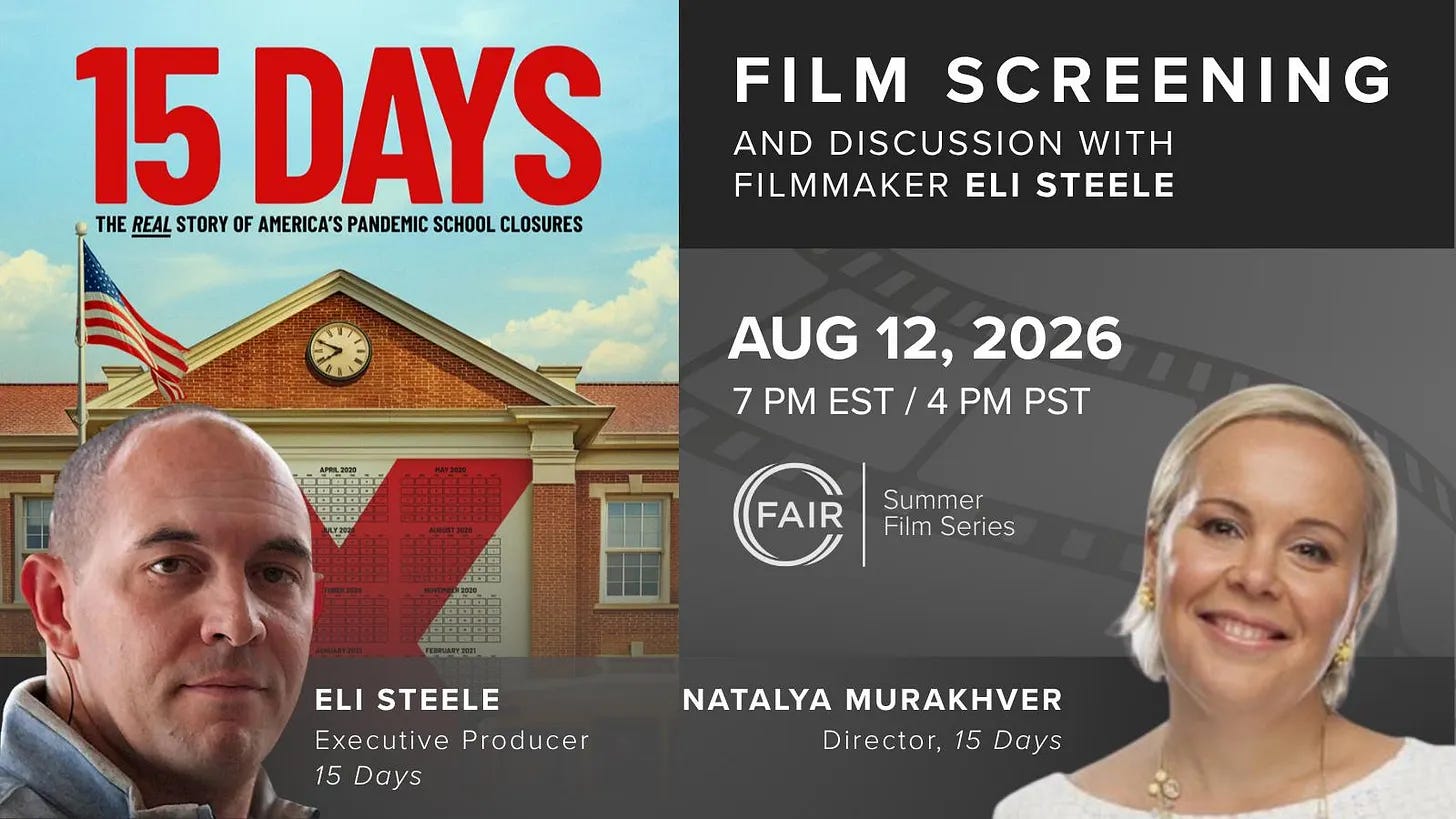
My name is Natalya Murakhver. In 2021, a year into the Covid-19 pandemic, I sued Mayor Bill de Blasio to reopen New York City’s public schools. Today, I run Restore Childhood, and recently directed my first film: 15 DAYS: The Real Story of America’s Pandemic School Closures.
In the process of creating 15 Days I interviewed nearly 60 people over three years to answer one question: Why did American schools stay closed longer than almost any other schools the world over?
I came into this fight as a parent, not a filmmaker. I went to the hearings, I organized other parents, and I filed the lawsuit. What I kept running into was a decision-making process with no regard for the people it affected most. Parents demanded to be heard during a time of great social, health and educational turbulence and were placated – being told to ‘trust the process’. In all of this, children had no seat at the table. Somewhere in that fight I understood that no one intended to preserve this history honestly, so I picked up a camera.
Eli Steele, a writer, filmmaker and FAIR board of Advisors member, mentored me from the moment I had the idea. He still does today as the film screens around the country in theaters and online. He watched the early cuts. He told me the cameras and lights to buy, the scenes to keep, cut, and rearrange. I could not have made this film without him, and closing out FAIR’s Eli Steele Film Series is a real honor.
Eli makes documentaries that follow the evidence past the point of discomfort. He directed What Killed Michael Brown?, which Amazon banned before public pressure forced it back onto the platform, where it rose to number one in documentaries. He directed How Jack Became Black, a film about the cost of sorting people by group identity, and, after October 7th, Killing America.
15 DAYS digs deeply into what happened to kids when our schools closed. Two doctors in the film, Jay Bhattacharya, now Director of the NIH and Scott Atlas, argued in the fall of 2020 that schools could open safely and that keeping them shut would harm children more than the virus could. What happened next is a civil-liberties story as much as a public-health one. Bhattacharya co-wrote the Great Barrington Declaration on October 4, 2020, with Martin Kulldorff of Harvard and Sunetra Gupta of Oxford. Four days later, NIH Director Francis Collins emailed Anthony Fauci calling for a “quick and devastating published takedown” of three scientists he labeled fringe. Reporters accused Bhattacharya of wanting to let the virus rip. Strangers sent him death threats. Social media platforms suppressed his account, which he only found out about later when internal files surfaced. Whatever you make of his conclusions, a system that answers dissent with suppression instead of debate fails everyone, and children lost a year of school (more in some places) to that failure.
Older students like Garrett “Bam” Morgan paid too. He played high school football in Queens at a level that draws college scouts. New York City shut down public school sports for over a year while private schools kept theirs open. No games, no scouts. No scouts, no scholarship. He repeated his senior year. He rebuilt his life, became his community college’s student body president, and is now headed to Howard University. He will still tell you plainly that he never got that lost year back.
Institutions stopped reasoning from evidence, treated disagreement as a threat to manage, and made life altering decisions for millions of children who had no voice in the matter.
That’s what 15 Days is about.
Join me online on Wednesday, August 12 as FAIR closes its Summer Film Series with a virtual screening of 15 DAYS, followed by a discussion with me, Eli Steele, and FAIR Executive Director Monica Harris.
15 DAYS is also streaming on Amazon Prime, Apple TV, Google Play, and the Restore Childhood Substack, where we publish regularly. More about the film at 15daysfilm.com.
We welcome you to share your thoughts on this piece in the comments below. Click here to view our comment section moderation policy.
The opinions expressed here do not necessarily reflect those of Fair For All or its employees.
In keeping with our mission to promote a common culture of fairness, understanding, and humanity, we are committed to including a diverse range of voices and to encouraging compassionate, good-faith discourse.
We are actively seeking perspectives on this topic and others. If you’d like to join the conversation, please send completed drafts to submissions@fairforall.org.
