

Dear Friends of FAIR,
I was a kid when America celebrated its bicentennial anniversary. I don’t remember much about what was happening in the country at the time, but I remember the feeling: parades, red-white-and-blue everything, collector’s items everywhere, and a sense that the whole country had agreed on what we were celebrating. It was simple. We had made it 200 years, America was doing well, and that seemed worth being proud of. Nobody felt compelled to qualify their pride or patriotism with an asterisk or explanation.
This year feels different, and I don’t think I’m the only one who feels it. We’re marking 250 years as a country still fighting a war, still sorting out how much division we can absorb before it becomes something worse, still trying to figure out what AI, social media, and a fast-changing economy are going to do to the way we live and work. A lot of people who love this country, who have given real parts of their lives to it, are feeling something more complicated than pride this year. Conflicted might be the better word. Even people deeply invested in America’s future are struggling to say, in one clean sentence, what this milestone means to them.
Our constitutional inheritance was never a finished project handed to us so we could admire it from a distance. It was built by people who often disagreed with each other, sometimes bitterly, and kept working anyway. They understood that America would only survive if each generation was willing to look honestly at where we stood and recommit to the work. Our country wasn’t built on consensus, but by people who realized the value of holding genuine disagreements and committed to staying at the table regardless. That’s the part of the founding story that tends to get lost or smoothed over during celebrations.
Our country is fifty years older than it was the last time we celebrated. If America were a person, it would be more experienced, but not always wiser for it. Being part of this moment requires us to step up and examine our history honestly — the parts we’re proud of and the parts we’re still wrestling with — without collapsing into either uncritical celebration or blanket cynicism. To honor America’s 250th anniversary, we need to do the hard work of showing up for the arguments like our Founders did instead of walking away from them. It means extending patience to neighbors who see the country differently than we do. That’s a lot harder than showing up for a parade or watching fireworks explode in the sky, but it’s a more fitting tribute to the grand experiment our founders built.
So what does this look like in practice? Here’s one small, concrete place to start: go back to the sources. Not a summary of America’s history, but the actual record of how our country has evolved and understood itself over time. Because history examined through primary resources is often more complicated and more interesting than the version we read secondhand through the lenses of other people.
Our own Many Stories, One Nation curriculum was built on a similar premise: that understanding this country and what it represents means being able to hold multiple, sometimes competing, true stories about it at the same time, rather than flattening our history into a single narrative in either direction.
Our friends at FAIR in Libraries and the Association of Library Professionals just released three reading lists (elementary, middle & high school, and adult) for America’s 250th, built by librarians who care about the same free and open discourse our founders cherished. These lists are a good way to spend part of your holiday weekend, and worth passing along to a librarian in your life who isn’t yet an ALP member.
If you’re not already a member of these communities, this is a good week to change that: join FAIR in Libraries or ALP. Their membership drive closes July 11th, and it’s a small, direct way to support the people doing the quiet work of keeping libraries places for open inquiry rather than ideological battlegrounds.
None of this resolves the tensions our nation is grappling with, and it’s not supposed to. But learning our own history honestly and supporting the people and institutions that help others do the same feels like a fitting way to meet a complicated anniversary. This year, honor America with more than a parade. Honor the actual work this anniversary celebrates.
We don’t get another 250th. Let’s do this one right.
Join us.
With gratitude,
Monica Harris
Executive Director, FAIR
Subscribe now to receive FAIR News weekly in your Inbox

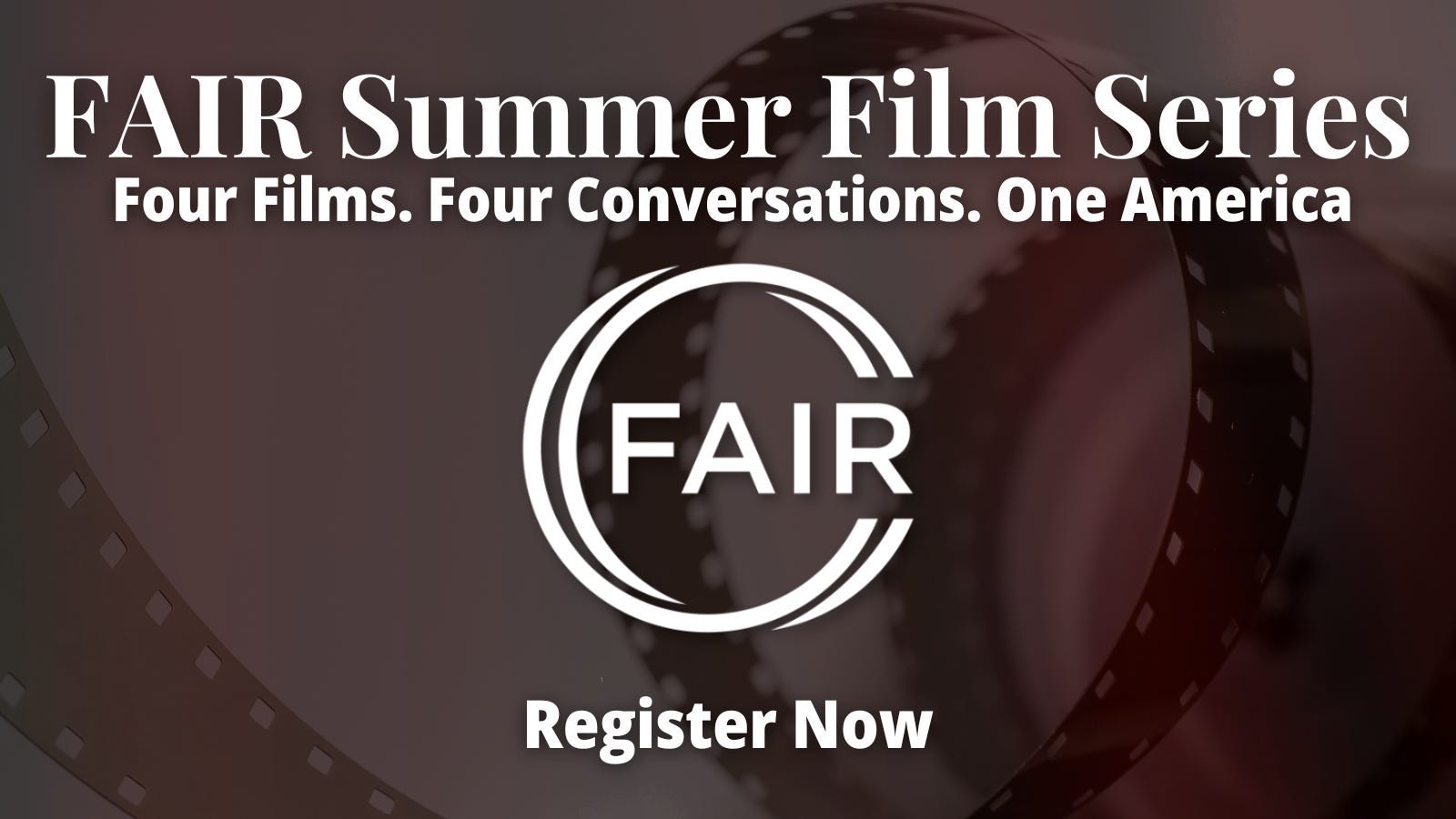
As America approaches its 250th anniversary, the nation is still wrestling with some of its oldest questions: Who belongs? What does equality require? How should we understand our differences?
This summer, FAIR’s Film Series will explore these questions through four compelling documentaries produced by Eli Steele and discussions with filmmakers, scholars, and thought leaders.
Join us for this can’t-miss lineup:
🎬 How Jack Became Black — July 1
🎬 What Killed Michael Brown? — July 15
🎬 Killing America — July 29
🎬 15 Days — August 12
FAIR in Conversation is Back!
FAIR in Conversation has relaunched with a new monthly format built for this moment. We’re leaning away from books and into the issues themselves: the debates, decisions, and developments that are defining what fairness, free speech, and equal dignity mean in America, and beyond, right now.
Each session will center on a pressing topic of the day, drawing on a curated mix of articles, book summaries, short essays, podcasts, films, and other multimedia resources to ground the conversation before opening the floor for discussion.
Sessions will be virtual, open to all FAIR members, and designed to be as accessible as they are substantive. You don’t need to have read anything in advance. Just bring your curiosity, your willingness to listen, and your commitment to engage in good faith.
These are exactly the conversations America needs now, and we are committed to modeling them. Sessions will run monthly through September 23rd. We hope you’ll join us!

Note to readers: We have paused the FAIR News podcast. If you prefer listening, rather than reading these newsletters, an audio version is available directly on the Substack app. Thank you for tuning in!
No matter how hard they try they can’t prove America is anything but Good and Great:
https://fraenkelfred.substack.com/p/youre-not-250-years-old-every-day?r=3oe3t&utm_medium=ios