


Dear FAIR Community,
This Wednesday marks three years since October 7, 2023, when Hamas terrorists brutally murdered 1,200 Israelis and took more than 250 hostages. For many of you, that day was never distant news. It was a phone call from a relative or friend you will never forget, a name you recognized, and a grief that has not eased with time.
We take this moment to honor the lives taken, the families still mourning, and everyone who carries that day with them. Zichronam livracha. May their memories be a blessing.
In the months after October 7, antisemitism in the United States rose to levels not seen in generations — and by many measures, the climate has worsened. A June AP-NORC poll found that only one in three Jewish Americans feels safe in this country, and 40% are now less likely to wear anything that identifies them as Jewish. The ADL’s 2025 audit recorded 6,274 incidents of antisemitism, which were fewer than the year before but included a record number of physical assaults and three killings.
Each of these numbers represents a person: a student who stopped wearing a Star of David to school, a parent wondering whether to mention an antisemitic slur to a principal, a congregation that now includes armed security in its budget. No community in America should have to live this way, and no one who believes in equal dignity should accept this climate as normal.
Much of today’s antisemitism arises from a simple but corrosive error: treating Jewish Americans as stand-ins for the government of Israel. The ADL found that almost half of all antisemitic incidents in 2025 were related to Israel or Zionism. This conflation has become so prevalent that the International Holocaust Remembrance Alliance (IHRA)’s working definition of antisemitism, adopted by many state and local governments as well as school districts, names it explicitly: holding Jews collectively responsible for the actions of the State of Israel.
The IHRA also states that “criticism of Israel similar to that leveled against any other country cannot be regarded as antisemitic.” FAIR believes this distinction matters. The IHRA definition is a tool for identifying harassment and discrimination, not for policing political opinion or freedom of expression. Students and citizens remain free to criticize any government, including Israel’s. What they may not do is target, exclude, or harass a Jewish person because of that government’s actions.
Jewish Americans hold a wide range of views on Israel and its government, just as Americans of every background hold a wide range of views on every government, including their own. Some feel a deep and passionate connection to Israel; others are critical of it; many hold views that are more complicated and nuanced. Yet none of these views is a condition for dignity, safety, or belonging.
No one should have to declare a political position before being welcomed into a classroom, a workplace, or a community. No one should be blamed for the actions of a government they did not elect. A Jewish person should never be pressured to denounce Israel to earn acceptance, nor should they be presumed to speak for it.
FAIR’s answer to hatred has always been the same: see every person as an individual, not as a label or category. This principle asks something of each of us.
Speak up early. Antisemitism rarely begins with violence. It starts with a joke that goes unchallenged, a slur scrawled on a desk, a student excluded from a group project. Naming these moments clearly, before they escalate, is one of the most protective things we can do.
Keep talking across differences. Our membership includes people with very different views on the Middle East. We can disagree vehemently about domestic and foreign policy and still agree that no one should feel unsafe in a classroom, a workplace, or their community because they are Jewish.
When Your Child’s School Falls Short. Schools have a legal duty to protect every student from a hostile learning environment. When a school applies its anti-harassment policies to some students and not others, parents have every right to ask why. If your child’s school is not taking antisemitism seriously, you don’t have to start from a blank page. FAIR has prepared a template letter for addressing antisemitism and a hostile environment in schools. You can adapt it to your situation and send it to your school or district.
We also recommend finding out whether your school district, city, or state has adopted the IHRA definition of antisemitism. If it has formally adopted the IHRA definition, cite that in your letter. A district or municipality that has taken this step has told its community how it recognizes antisemitism, and parents are entitled to ask it to apply that standard and take action.
Federal law also protects students. Under Title VI of the Civil Rights Act, schools that receive federal funds must respond to harassment based on shared ancestry that creates a hostile environment. A clear, measured letter that documents what happened, cites the relevant policy, and asks specific questions often gets a faster and more serious response than a phone call.
Every day, FAIR works to make sure institutions treat all Americans as individuals deserving of equal dignity and respect. We equip parents with tools like the antisemitism template letter, advocate for institutions to apply policies consistently, and develop curricula that teach students to see one another as fellow citizens instead of representatives of a group.
If FAIR’s mission matters to you, please consider making a gift today. Every contribution helps us stand with families confronting antisemitism in schools and beyond.
Three years later, we remember and commit, once again, to a country where no one has to hide who they are to be safe.
With gratitude,
Monica Harris
Executive Director, FAIR
Subscribe now to receive FAIR News weekly in your Inbox.


Educators Alliance
FAIR is continuing the Educators Alliance for the 2026-2027 school year to equip PK–12 educators with the knowledge, strategies, and community support they need to foster schools that are more enriching and free from bias for students and educators.
We are at a turning point for education—and with the relaunch of FAIR’s Educators Alliance, we have an opportunity to step beyond polarization and create classrooms rooted in curiosity, dignity, and respect.
Each monthly gathering will open with updates and presentations from FAIR staff, fellows, Chapter Leaders, and occasional guest speakers. Together, we’ll explore strategies for supporting educators, communities, and local chapters—and for advancing positive change at the local, regional, and national levels. Following presentations, participants will have space for open forum discussions to connect, seek advice, and coordinate on pressing issues in their schools. Breakout rooms will be divided into PK-6 and 7-12 grade levels with experienced teachers facilitating those conversations.
Educators will also be invited to contribute to a new FAIR in Education newsletter, showcasing stories, strategies, and resources from across the FAIR network.
Whether you are a teacher, paraprofessional, or administrator, join us as we continue the FAIR Educators Alliance and shape the future of education together.
There are 6 meetings left to sign up for down below.
Next Session: Nov 5th, 2026 07:00 PM Eastern Time (US and Canada)
Every month on the First Thu, until Apr 1, 2027, 1 hr sessions, 7 occurrences
Note: Despite Zoom’s notice, FAIR maintains strict confidentiality of contact information provided.
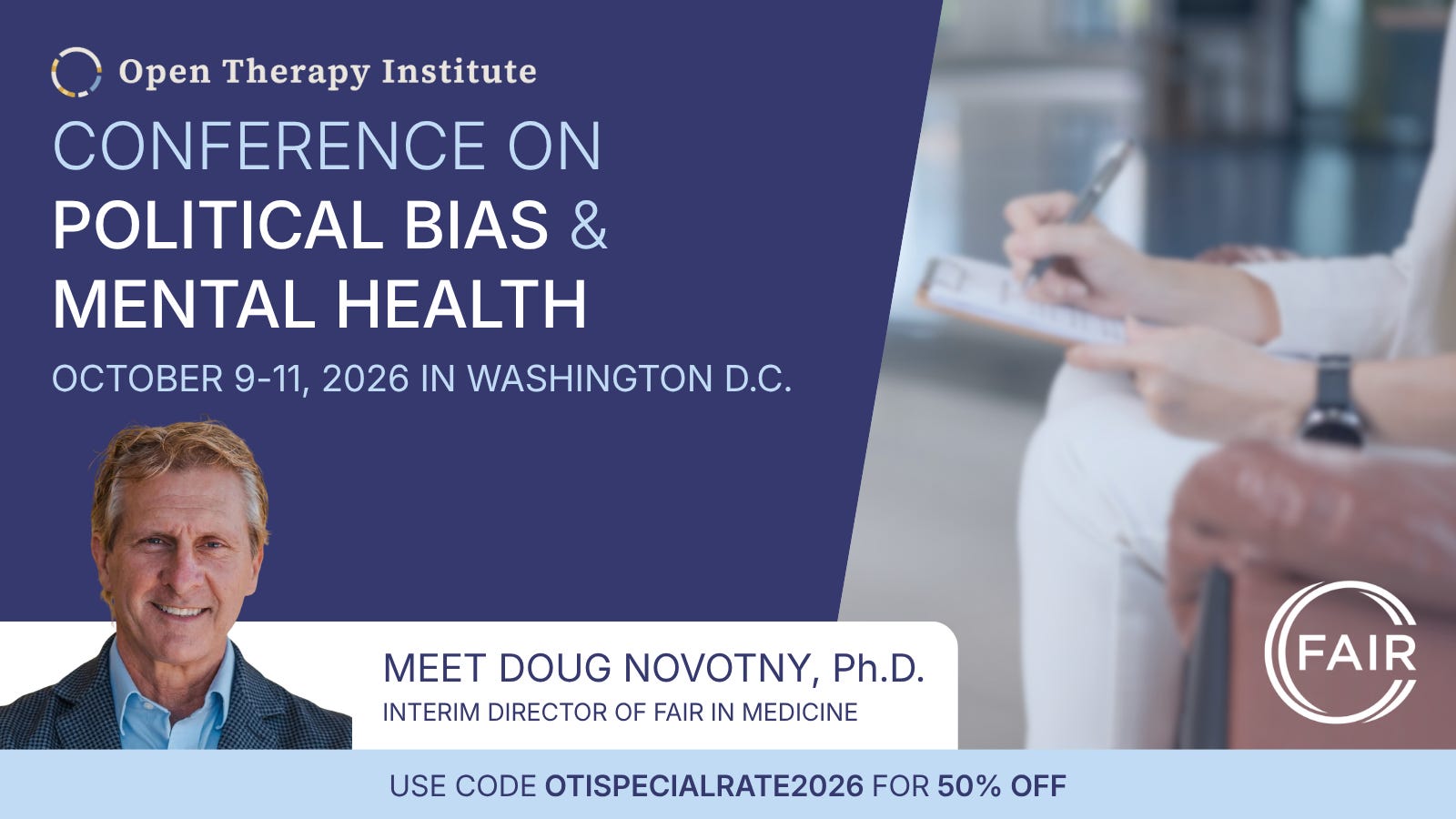
OTI Conference on Political Bias and Mental Health
Earlier this year FAIR announced its collaboration with the Open Therapy Institute read here.
FAIR members are invited to join the Open Therapy Institute‘s Conference on Political Bias and Mental Health, October 9–11, in Washington, DC.
The program features a live podcast recording with Rob Henderson and Erica Komisar, a panel with Sally Satel, and more. 9.25 CE credits available.
Use code OTISPECIALRATE2026 for 50% off. Register here.
We hope to see you in DC!
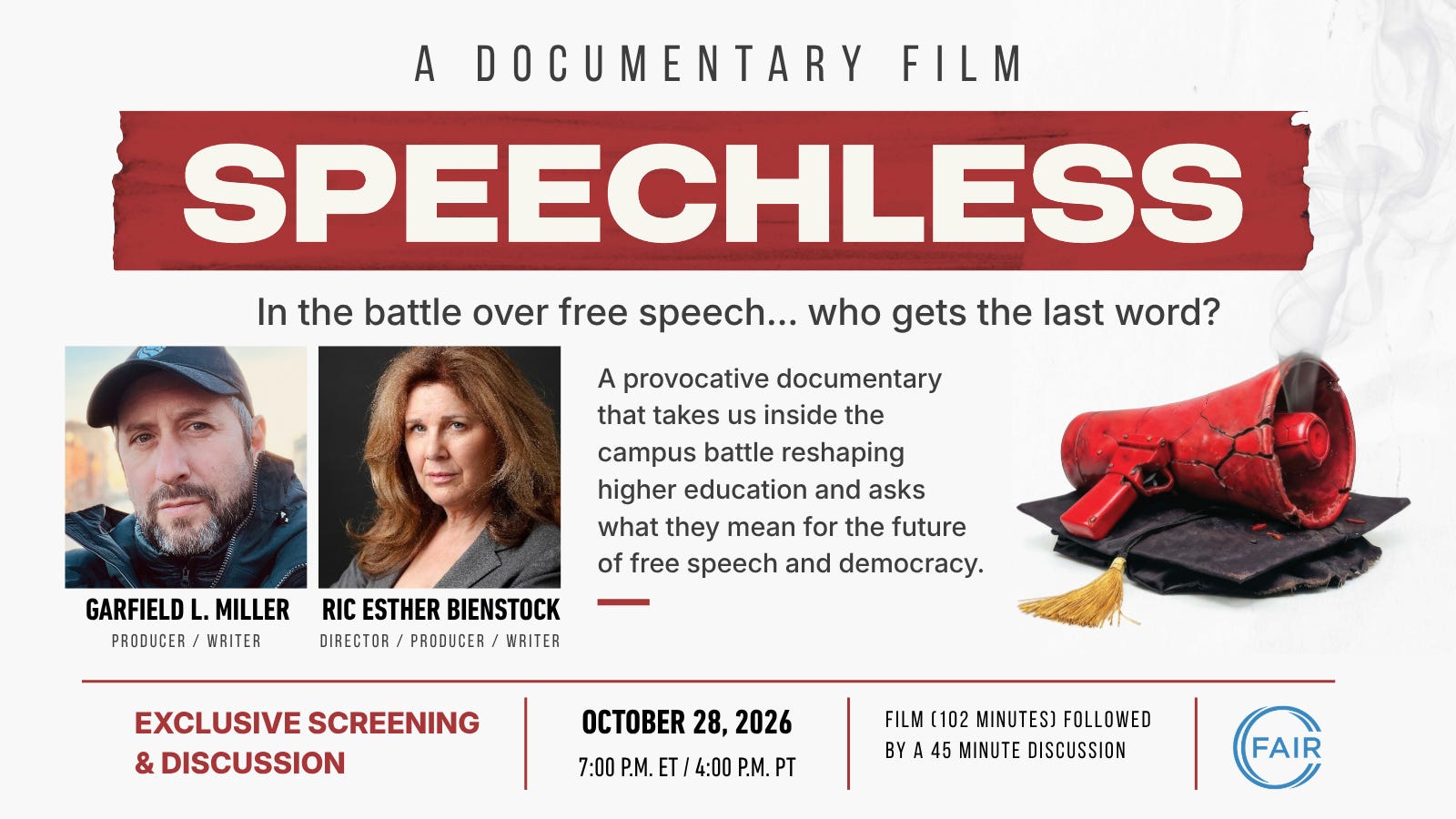
Speechless Film Screening
Tickets Now on Sale - See Below
Join FAIR for an exclusive screening of Speechless, a provocative documentary exploring the battle over free speech on college campuses and what it means for the future of higher education and democracy.
The film—which is now available to a U.S. audience for the first time—is a gripping investigation into the breakdown of open inquiry in the very institutions meant to protect it, and what happens to a democracy when it loses faith in free speech, honest disagreement, and the hard work of conversation.
The post-film discussion will include several renowned panelists, offering a range of perspectives on the issues explored in the film.
The 102-minute film will be followed by a 45-minute discussion.
October 28 at 7:00 p.m. ET / 4:00 p.m. PT.

Note to readers: We have paused the FAIR News podcast. If you prefer listening, rather than reading these newsletters, an audio version is available directly on the Substack app. Thank you for tuning in!
To say "half of these incidents were related to Zionism or Israel" is highly misleading. It implies that were it it not for the actions of the Israeli government in Gaza these incidents would not have occurred. But the insanity of Jew hatred was released within 24 hours of October 7 before Israel had responded in any way whatsoever. "Related to Israel or Zionism" should be restated to correctly report that the perpetrators "claimed" that this was the reason for their actions. The reasons for their actions should be held completely distinct from those who engage in rational political protest of the actions of the Israeli government. The reasons for violent, humiliating, intimidating, or otherwise hateful actions against Jews is Jew hatred. "Antisemitism" is too bland a word.
IHRA includes: “Accusing Jewish citizens of being more loyal to Israel, or to the alleged priorities of Jews worldwide, than to the interests of their own nations.”
If this alone can define antisemitism, then I am a raging antisemite for I firmly believe that more than a few of our oligarchs are more loyal to Israel than the U.S. Some even hold dual citizenships thus begging the question.
I would strongly advise the IHRA to delete this particular statement.