


Dear Friends of FAIR,
I am pleased to announce the launch of FAIR’s California Chapter, spearheaded by Bay Area Chapter leader Sunil Wijeyesekera.
California writes much of the country’s education and civil rights policy before any other state does. Legislation that begins in Sacramento often reappears in Denver, Minneapolis and Springfield within a session or two. This makes FAIR’s presence in California critical to our ongoing efforts to promote a common culture of fairness and equality nationwide.
FAIR is not new to California. We’ve had city-based Chapters in the Bay Area and Los Angeles, and they have done good work in their communities. But a Chapter rooted in metropolitan areas can only do so much for members in Fresno, Bakersfield, or Redding. Because many of the challenges our California members face are initiated at the state level, our response should be organized at that level too. FAIR California gives members across the state one place to pool information, share resources, and act together.
Many of you have followed FAIR’s petition opposing the University of California’s proposed admissions mandate, which would have made a high school liberated Ethnic Studies course a prerequisite for entry into the UC system. FAIR joined other organizations in challenging this requirement, and the proposal was stopped.
The UC mandate was, in fact, worse than AB 101, California’s statewide Ethnic Studies requirement, because it would have superseded local control. Districts that had developed their own thoughtful course content would have had to conform to UC’s content standards or watch their graduates lose ground in admissions. Had the mandate passed, FAIR’s Many Stories, One Nation curriculum would have had no realistic path in California.
FAIR’s California Chapter was born out of an event at the Commonwealth Club in San Francisco, attended by Sunil and other Chapter members. It was there that they met Richard Sander, the UCLA professor who proposed a committee to counter the mandate. FAIR member George Maurer wrote the petition, and two other FAIR members served on the committee that carried it forward. This is precisely why FAIR’s Chapters matter. We put ourselves in the rooms where decisions are made.
Since FAIR’s California Chapter launched last month, the inquiries have not stopped. A radio host in Paso Robles has invited FAIR to discuss Ethnic Studies and what parents should look for in a curriculum. This presents a valuable opportunity to introduce Many Stories, One Nation to listeners on the Central Coast, a part of the state well outside the orbit of FAIR’s Los Angeles and Bay Area Chapters. The California Family Council has invited FAIR to join the statewide parental rights coalition it chairs. We’ve also received outreach from a local branch of Heterodox Academy, a prosecutor concerned about the California Racial Justice Act, a journalist reporting on community-building efforts in Marin County, and the International Foundation for Therapeutic and Counseling Choice.
All of this has happened since the beginning of August, and it highlights the power of our Chapter members to put FAIR on the map for groups that would otherwise have no reason to know we exist.
Our new California Chapter also gives us standing. The state’s legislature frequently introduces bills that run counter to FAIR’s principles and constitutional law. While Sunil has testified against several of them as a private citizen, it will be far more impactful if he and other FAIR members can state: “I represent FAIR, a civil rights organization with approximately 3,500 members in California with members from every corner of the state.”
The California Chapter’s first priority will be its Substack, modeled on FAIR Colorado’s, which has been one of our best examples of building a local presence. The opening articles will cover California legislation, Ethnic Studies, and state-specific parental opt-out templates. The goal is to publish one article per week, and 10 members have already volunteered to write, edit, or review. A monthly chapter Zoom will run alongside the Substack.
The Chapter has added 15 new members and a number of followers in its first weeks, along with its first paid subscribers. If you live in California, we invite you to subscribe to the California Chapter Substack, join the monthly call with members, and consider coming to Sacramento with other FAIR members in the next session. If you’re interested in writing, Sunil would love to hear from you. And if you live elsewhere, you might want to follow along, anyway — because whatever California does, your state may be doing next.
With gratitude,
Monica Harris
Executive Director, FAIR
Subscribe now to receive FAIR News weekly in your Inbox

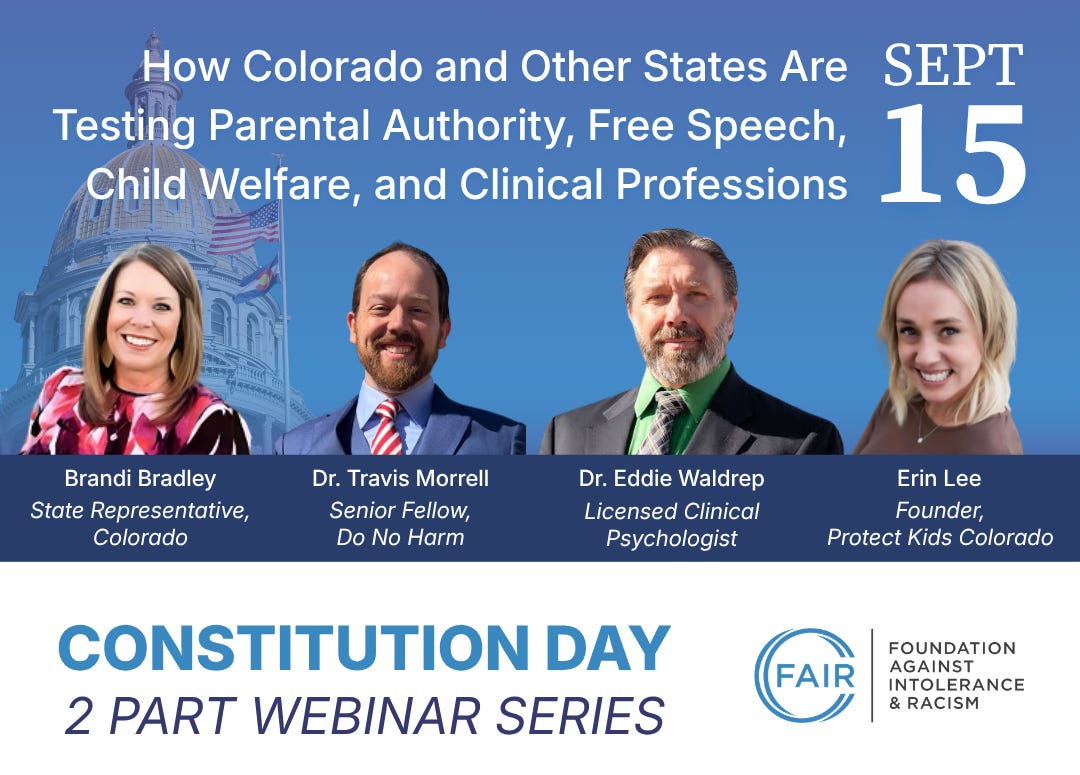
How Colorado and Other States Are Testing Parental Authority, Free Speech, Child Welfare, and Clinical Professions
This will be the first in a two part series intended to highlight new laws that breach our Constitutional rights. Colorado has passed a series of laws that many parents, clinicians, and citizens believe undermine parental authority, chill free speech, place children at risk, and degrade the mental health and medical professions. In this first webinar of the Constitutional Rights Series, four leaders on the front lines will examine how these policies are playing out in real time—and what is at stake for families and free expression.
Featured speakers:
State Representative Brandi Bradley will discuss the steady erosion of parental rights in Colorado and the legislation she has championed to restore them.
Dr. Travis Morrell, Senior Fellow at Do No Harm, sees first-hand how bad medicine morphs into laws that impinge on civil rights.
Dr. Eddie Waldrep, clinical psychologist, will address how therapists are increasingly pressured into self-censorship and why the practice of therapy itself is at risk.
Erin Lee, co-founder of Protect Kids Colorado, will outline three ballot initiatives appearing before Colorado voters this November that offer a direct opportunity to strengthen protections for children’s well-being.
Join us for a clear-eyed look at the legislative landscape and the concrete paths still available to defend the rights of all Coloradans and Americans as we use one state as a case study of what to do when the state and federal laws conflict with each other.
Date: September 15, 2026
Time: 7:00 EST
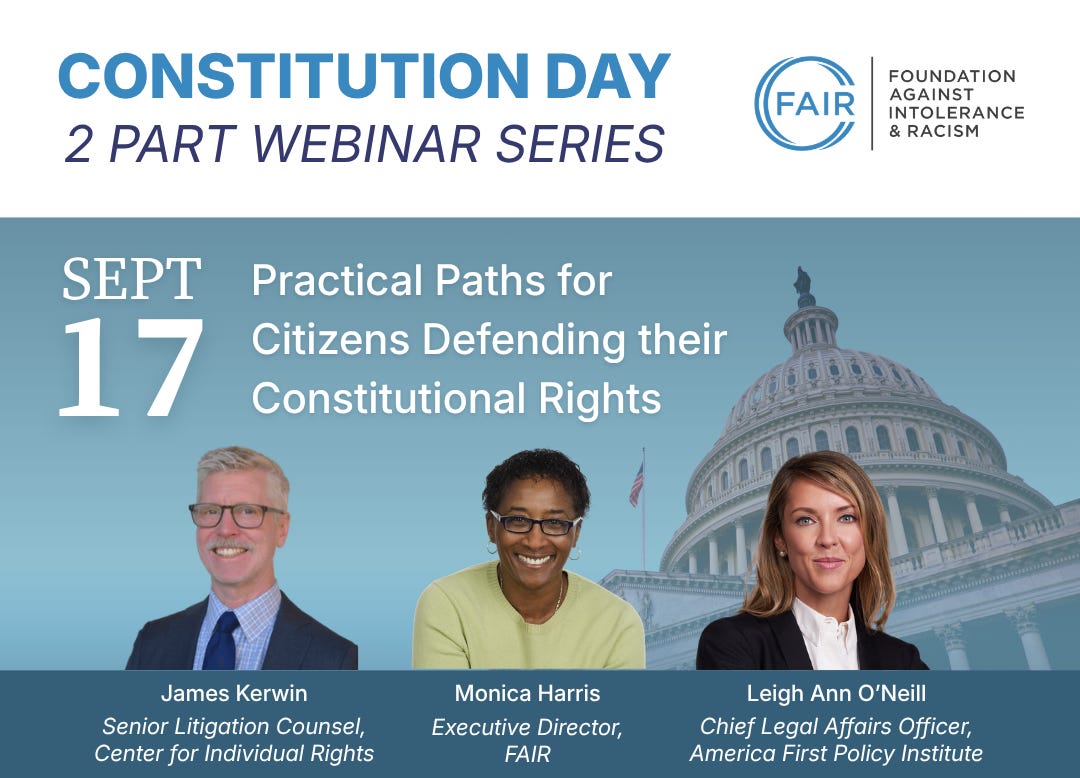
Practical Paths for Citizens Defending their Constitutional Rights
When state statutes clash with the U.S. Constitution and federal law, ordinary citizens are left asking a practical question: What can we actually do? This second webinar in the Constitutional Rights Series moves from diagnosis to action, examining both the legal roots of the problem and the lawful tools available to protect individual rights.
Featured speakers:
James Kerwin of the Center for Individual Rights will explain how Colorado’s Anti-Discrimination Act has become the legal foundation for recent laws that elevate group identity over individual rights and free speech.
Leigh Ann O’Neill of America First Policy Institute will walk through concrete, practical steps citizens can take to safeguard their constitutional protections when state policy conflicts with higher law.
Monica Harris
This session is designed for parents, professionals, and engaged Coloradans and all Americans who want clarity on the legal terrain and realistic next steps for defending their rights.
Date: September 17, 2026
Time: 7:00 EST

FAIR in Conversation is Back!
Is Woke Dead… or Just on Pause?
Have we actually turned the corner and are now walking away from Woke policies? What about Critical Race Theory – is it already so institutionalized that we don’t recognize it?
DEI offices are closing. Corporations seem to be abandoning once-mandated initiatives. Universities are retreating from some of their most controversial policies.
It’s hard to believe that a sweeping political movement built on strong, activist ideas would simply vanish overnight, and that Woke-ism, CRT and DEI have suddenly lost their popularity and influence. So, is it true that Woke-ism is over? Or is it possible that the Woke agenda has become less visible while quietly building strength and devising new tactics to reshape our institutions and culture?
This month’s FAIR In Conversation will look beyond headlines and political talking points to examine what has actually changed, and what hasn’t.
Join us for a thoughtful, evidence-based discussion as we ask the questions many are wondering, but few have carefully examined.
Sessions will run monthly through September 23rd. We hope you’ll join us!

Note to readers: We have paused the FAIR News podcast. If you prefer listening, rather than reading these newsletters, an audio version is available directly on the Substack app. Thank you for tuning in!
If you wish to contact FAIR California, send an email to california@fairforall.org.