

Dear Friends of FAIR,
Today, millions of Americans will observe Juneteenth — a day of remembrance, gratitude, and moral clarity.
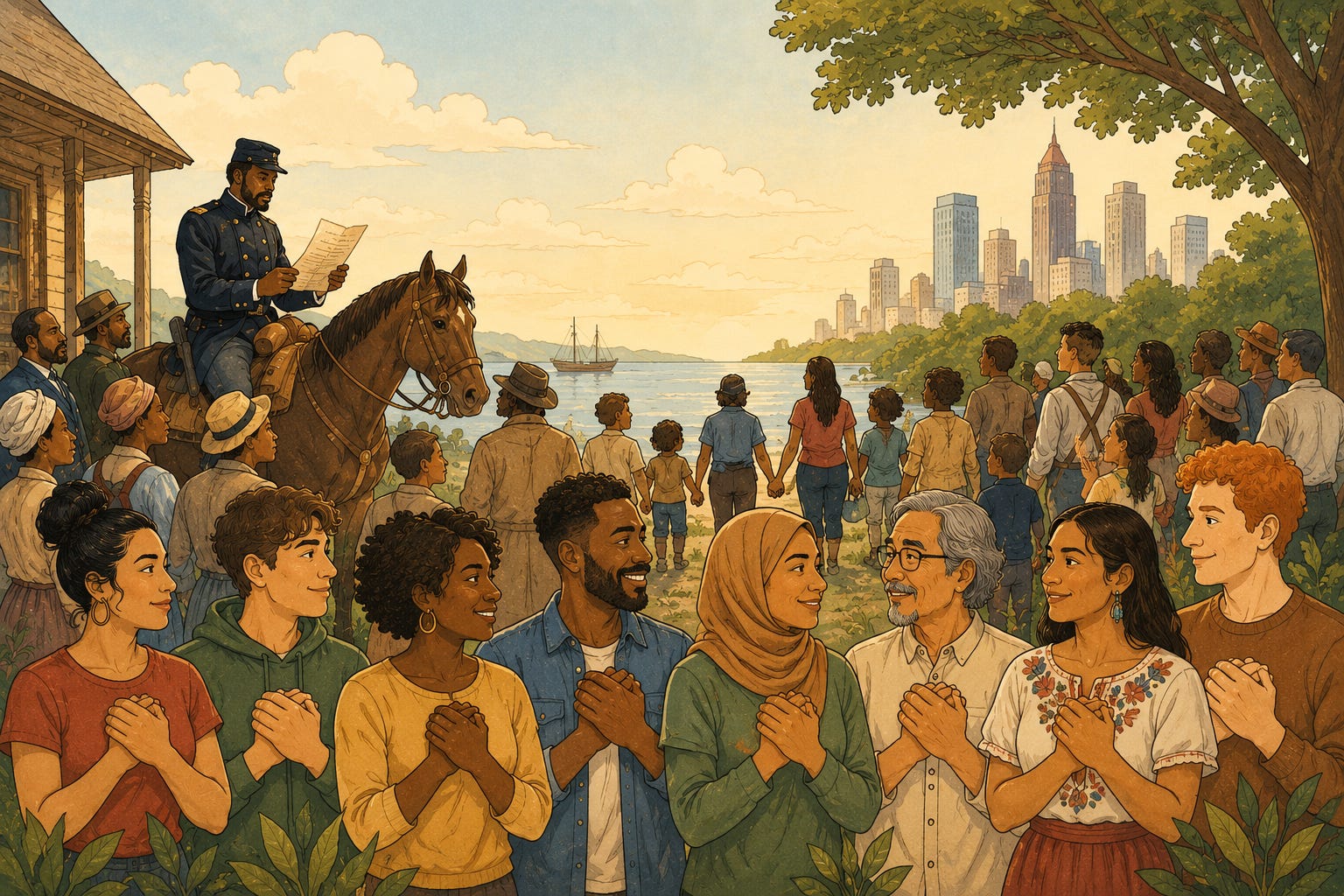
On January 1, 1863, President Abraham Lincoln issued his final Emancipation Proclamation declaring that “all persons held as slaves” within rebellious states “are, and henceforward shall be free.” But that proclamation could not be enforced in places under Confederate control. The roughly 250,000 enslaved people in Texas, the westernmost state of the Confederacy, remained in bondage after Lincoln’s Proclamation.
It wasn’t until June 19, 1865 — two and a half years later — that General Granger arrived in Galveston to publicly deliver General Order No. 3, announcing that enslaved men, women, and children in that state were free. The order began simply: “The people of Texas are informed that, in accordance with a proclamation from the Executive of the United States, all slaves are free.” Order No. 3 also included language that seemed extraordinary at the time: freedom involved “an absolute equality of personal rights and rights of property between former masters and slaves.”
The moment that Order No. 3 reached enslaved Texans marked the final stroke in a long and bitter struggle for freedom. Hundreds of thousands of men, women, and children who had been waiting years for freedom finally learned they were free. The following year, citizens gathered to celebrate in their finest clothes, with prayer, music, food, and deep thanksgiving.
That was the first Juneteenth celebration.
Juneteenth isn’t merely a holiday about delayed news. It is a holiday about the long and bloody effort to bring American law into alignment with American principle: that all men are created equal.
Here’s why that matters: Juneteenth marks the moment when American law finally aligned with American principle. The nation had declared its independence in 1776 on a self-evident truth: “all men are created equal,” yet slavery persisted for nearly 90 years. The contradiction was glaring and unavoidable.
Throughout history, many cultures and governments accepted slavery as natural and even customary. But America could not. The moment our nation declared universal human equality to be the foundation of its legitimacy, slavery became an unbearable moral problem. Good people living within a nation founded on good principles cannot indefinitely tolerate such a contradiction.
This inconsistency demanded resolution, but that resolution came at catastrophic cost: a civil war that claimed more than 600,000 lives, a constitutional amendment, and the complete reconstruction of American law and society. In less than a century after its founding, Americans finally ended a practice that had existed for thousands of years across cultures and continents.
The story of American abolition teaches something vital: When a nation’s founding principles are rooted in genuine respect for human dignity and equal protection, its work becomes the work of ensuring these principles are adhered to in practice.
That is the bedrock of FAIR’s mission.
We believe that a pluralistic democracy built on equal protection and free expression requires constant, deliberate work. It requires that each of us practice civil discourse, even when we are in disagreement. It requires that we defend the constitutional rights that protect minority groups and dissenting voices from majoritarian overreach. It requires that we educate citizens so they can better understand one another and grapple seriously with difficult history.
It requires the work that Juneteenth represents: aligning law, practice, and culture with our Founders’ commitment that all people deserve equal dignity and equal rights.
This commitment was not fully realized on June 19, 1865, and it is still not fully realized today. The arc of justice does not bend toward itself; rather, it demands that people who see the contradiction between principle and practice refuse to accept it and work tirelessly to resolve it.
Today, we honor those who fought and sacrificed to bring law into alignment with principle — and we invite you to ask: What does it look like to continue that work in your own community?
We all have a unique role to play in this mission. You can answer the call today by:
Engaging Your Community: Join the conversation by attending an upcoming webinar, educational program, or local discussion.
Building Local Connections: Connect with a FAIR Chapter near you or spark something new by starting a chapter to host events, conversations, and outreach in your area.
Bringing History to Light: Help us introduce FAIR’s new Many Stories, One Nation curriculum to schools and civic leadership in your community.
Fueling the Movement: Every program, resource, and classroom tool we offer is made possible entirely by the generosity of people like you. Consider making a donation to sustain this work.
This is FAIR’s calling, and it’s a calling that Juneteenth reminds us all to answer.
With gratitude,
Monica Harris
Executive Director, FAIR

The Canadian Free Speech Crisis with Lisa Bildy
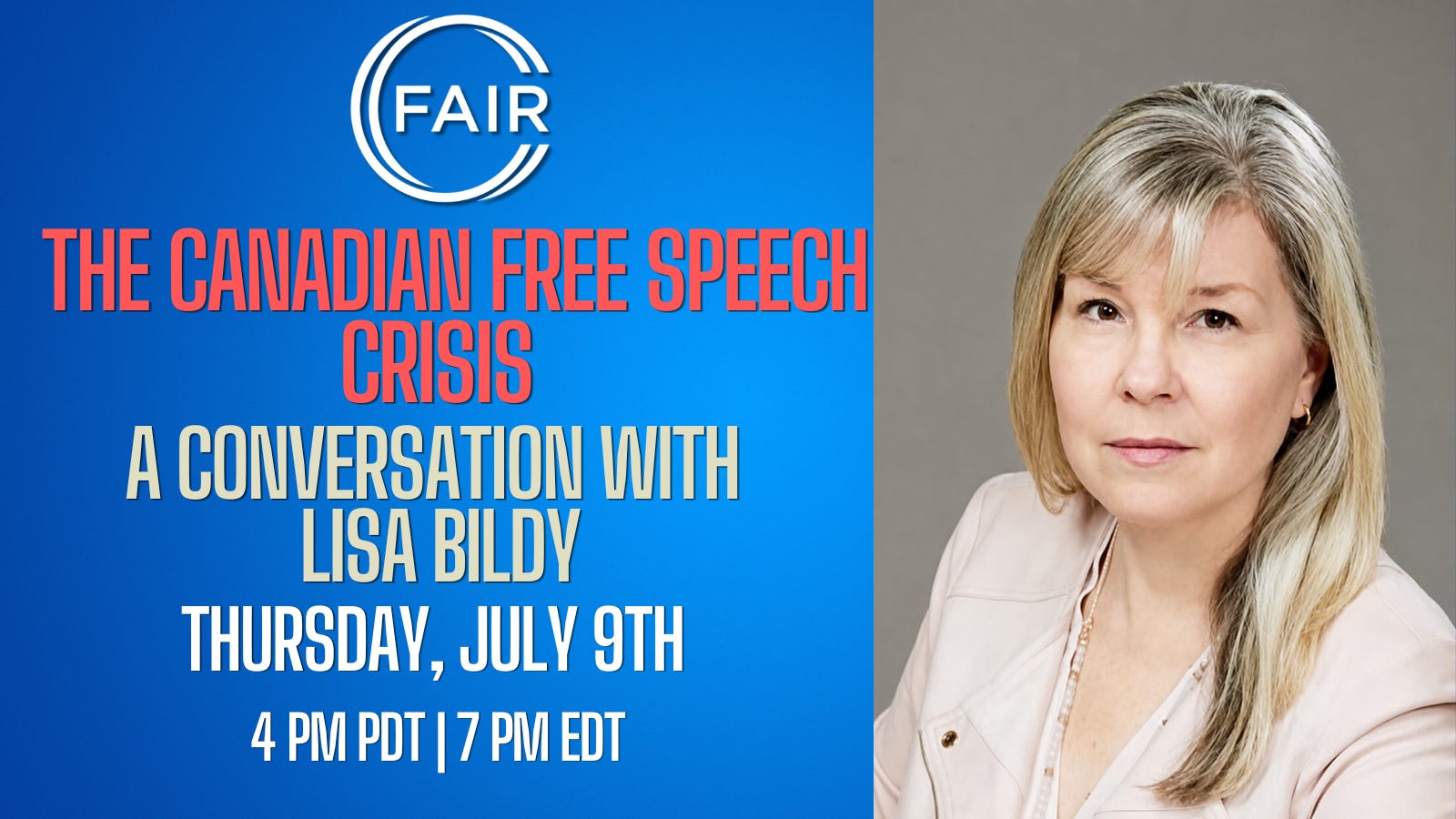
Canada shares our values, our language, and our legal traditions — yet free speech there is under pressure in ways that would have been unimaginable a decade ago. FAIR Advisor Lisa Bildy of the Free Speech Union of Canada will walk us through the landscape: who’s being silenced, who’s pushing back, and the cultural pressures that are reshaping expression north of the border. Join us for a candid look at what’s happening in Canada and why it matters for all of us.
FAIR in Conversation is Back!
FAIR in Conversation has relaunched with a new monthly format built for this moment. We’re leaning away from books and into the issues themselves: the debates, decisions, and developments that are defining what fairness, free speech, and equal dignity mean in America, and beyond, right now.
Each session will center on a pressing topic of the day, drawing on a curated mix of articles, book summaries, short essays, podcasts, films, and other multimedia resources to ground the conversation before opening the floor for discussion.
Sessions will be virtual, open to all FAIR members, and designed to be as accessible as they are substantive. You don’t need to have read anything in advance. Just bring your curiosity, your willingness to listen, and your commitment to engage in good faith.
These are exactly the conversations America needs now, and we are committed to modeling them. Sessions will run monthly through September 23rd. We hope you’ll join us!

FAIR Educators Alliance 2025-2026
Join the FAIR Educators Alliance for the 2025–2026 school year to equip PK–12 educators with the knowledge, strategies, and community support they need to foster schools that are more enriching and free from bias for students and educators.
Each monthly gathering will open with updates and presentations from FAIR staff, fellows, Chapter Leaders, and occasional guest speakers. Together, we’ll explore strategies to support educators, communities, and local chapters—and to advance positive change at the local, regional, and national levels.
Following the presentations, participants will have space for open-forum discussions to connect, seek advice, and coordinate on pressing issues in their schools. Breakout rooms will be divided into PK-6 and 7-12 grade levels with experienced teachers facilitating those conversations.
Meetings: First Thursday of each month at 7 PM ET via Zoom Duration: 1 hour

Note to readers: We have paused the FAIR News podcast. If you prefer listening, rather than reading these newsletters, an audio version is available directly on the Substack app. Thank you for tuning in!
Human rights have regressed. Objectively. What were once protected categories for biological women have now been taken away. Instead, we have honor-based protections. What do I mean by that? At one time, women had spaces just for them because they are biological women They were spaces that kept women safe, gave them privacy and gave them opportunities. A new category, "trans women," has been created, but there isn't a new space for their rights. Instead, their rights are infringing on and removing the rights of biological women in the spaces meant for them under the Universal Declaration of Human Rights. Relying on people to behave nicely in the new spaces ... We don't use honor based rights for Banking or Aviation. We have solid rules because rules work. honor based systems do not. And would lead to bankruptcy and deaths. In the case of banks and aviation.
Taking woman's biological rights and protections and gifting them to biological men...The move goes against the Universal Declaration of Human Rights that says you can't take rights from one category and gift it to another. The true move here would have been to create separate spaces for trans women. Where they are protected, keeping biological woman spaces for biological women...
So yes, Juneteenth reminds us that freedom, equal protection, and civic responsibility require ongoing community effort. But what about recognizing the rights that are being lost right before our eyes?
I appreciate the call to honor our country's "Founding Principles" as a far more effective one than to simply admire its "Founding Fathers." After all, they were flawed humans, like all of us. Their brilliant articulation of those principles, and the awareness that they would always be just out of reach, inspired the phrase "towards a more perfect union." THAT is much more aspirationally animating than simply putting men on pedestals and then fruitlessly and forever defending that placement.