

Dear Friends of FAIR,
Accreditation is the most powerful lever in American higher education that almost no one outside of it can name. This month FAIR moved to pull it.
On September 21, FAIR filed a formal comment with the U.S. Department of Education on its proposed overhaul of the rules governing accreditation. Two days later, the National Advisory Committee on Institutional Quality and Integrity, the federal advisory committee that reviews accreditors, met to consider whether the American Bar Association should keep its authority to accredit the nation’s law schools. FAIR requested time to address the committee and was not among those selected to speak.
Accreditors are private organizations that hold significant public power. A school that loses its accreditation also loses access to federal student aid, which totals more than $100 billion a year. For law schools, the stakes are even higher: nearly every state requires a degree from an ABA-approved school before a graduate may sit for the bar exam. That makes accreditors gatekeepers in the most literal sense, and when a gatekeeper requires institutions to adopt a particular set of beliefs, a function meant to assure educational quality quietly becomes a licensing power over the ideas practitioners must adopt.
It’s worth tracking how this process works, because the power of accreditation is easy to overlook.
First, a requirement is written into an accreditation standard. Schools then rewrite their policies to comply because the alternative is losing their students’ access to financial aid. Those policies in turn shape a school’s hiring, promotion, and curriculum. Eventually students may be compelled to take an ideologically driven course in order to graduate — a requirement set by a governing body they have likely never heard of and to which they have no ability to appeal.
FAIR and its members have seen this process play out again and again, and we seized an opportunity to correct it.
FAIR’s comment letter supports two of the Department’s proposed rules: the first would require accreditors to make decisions that are neutral with respect to viewpoint and ideology, and the second would require them to consider whether the schools they accredit protect academic freedom and intellectual diversity. We also asked the Department to limit its own rule. A requirement that institutions maintain and apply a policy is legitimate. A rule read to require any particular distribution of viewpoints among faculty would be a mandate of exactly the kind this rulemaking is meant to end, pointed in a different direction. FAIR opposes ideological mandates, not merely the ones we happen to disagree with, and we asked the Department to put that limitation in the text of the rule rather than leaving it in the preamble.
Earlier this month, the ABA’s accrediting council repealed Standard 206, which had required law schools to demonstrate “concrete action” toward diversity. While FAIR welcomes this change, we note that council members stated that their vote was aimed at protecting the council’s standing as the nation’s primary law school accreditor. Our concern is that what a council repeals in order to keep its monopoly can be restored once the monopoly is secure.
Had we been given an opportunity to speak before the committee this week, FAIR would have asked it to accept the staff recommendation and deny renewal, or at minimum decline to extend the council’s waiver of the independence requirement. More importantly, we would have urged the Department to recognize additional accreditors of law schools so that schools are not limited to a single accreditor, and students can choose among law schools that genuinely differ. We intend to keep pressing both points.
None of this stops at law schools. The rules FAIR commented on would apply to every recognized accreditor in the country, and the American Psychological Association’s Commission on Accreditation appeared before the same committee this week seeking renewal of its own recognition. Last year, that commission paused, but did not repeal, the diversity requirement in its own standards. Several FAIR members submitted their own comments urging a stricter review of the commission’s recognition.
Federal recognition is a privilege, not a right, and the government should not lend that privilege to a private body doing indirectly what the First Amendment forbids the government to do directly. Viewpoint diversity in all professions begins with structural diversity in those who accredit them.
We will report back on what comes of this. In the meantime, if you are a student, a faculty member, or a clinician who has been required to affirm something you did not believe in order to graduate, to be hired, or to keep your license, we want to hear from you.
But this isn’t work we can do alone. It only happens because people like you make it possible.
Your gift today helps FAIR stay in rooms like this one, where decisions that shape American education are made quietly and with almost no one watching. No matter the size, your donation helps us keep showing up.
Thank you for standing behind this important work!
With gratitude,
Monica Harris
Executive Director, FAIR
Subscribe now to receive FAIR News weekly in your Inbox.

Educators Alliance
FAIR is continuing the Educators Alliance for the 2026-2027 school year to equip PK–12 educators with the knowledge, strategies, and community support they need to foster schools that are more enriching and free from bias for students and educators.
We are at a turning point for education—and with the relaunch of FAIR’s Educators Alliance, we have an opportunity to step beyond polarization and create classrooms rooted in curiosity, dignity, and respect.
Each monthly gathering will open with updates and presentations from FAIR staff, fellows, Chapter Leaders, and occasional guest speakers. Together, we’ll explore strategies for supporting educators, communities, and local chapters—and for advancing positive change at the local, regional, and national levels. Following presentations, participants will have space for open forum discussions to connect, seek advice, and coordinate on pressing issues in their schools. Breakout rooms will be divided into PK-6 and 7-12 grade levels with experienced teachers facilitating those conversations.
Educators will also be invited to contribute to a new FAIR in Education newsletter, showcasing stories, strategies, and resources from across the FAIR network.
Whether you are a teacher, paraprofessional, or administrator, join us as we continue the FAIR Educators Alliance and shape the future of education together.
There are 7 meetings to sign up for down below. Scroll up and down below to see all of the sessions!
Oct 1, 2026 07:00 PM Eastern Time (US and Canada)
Every month on the First Thu, until Apr 1, 2027, 1 hr sessions, 7 occurrences
Note: Despite Zoom’s notice down below, FAIR maintains strict confidentiality of contact information provided.
OTI Conference on Political Bias and Mental Health
Earlier this year FAIR announced its collaboration with the Open Therapy Institute read here.
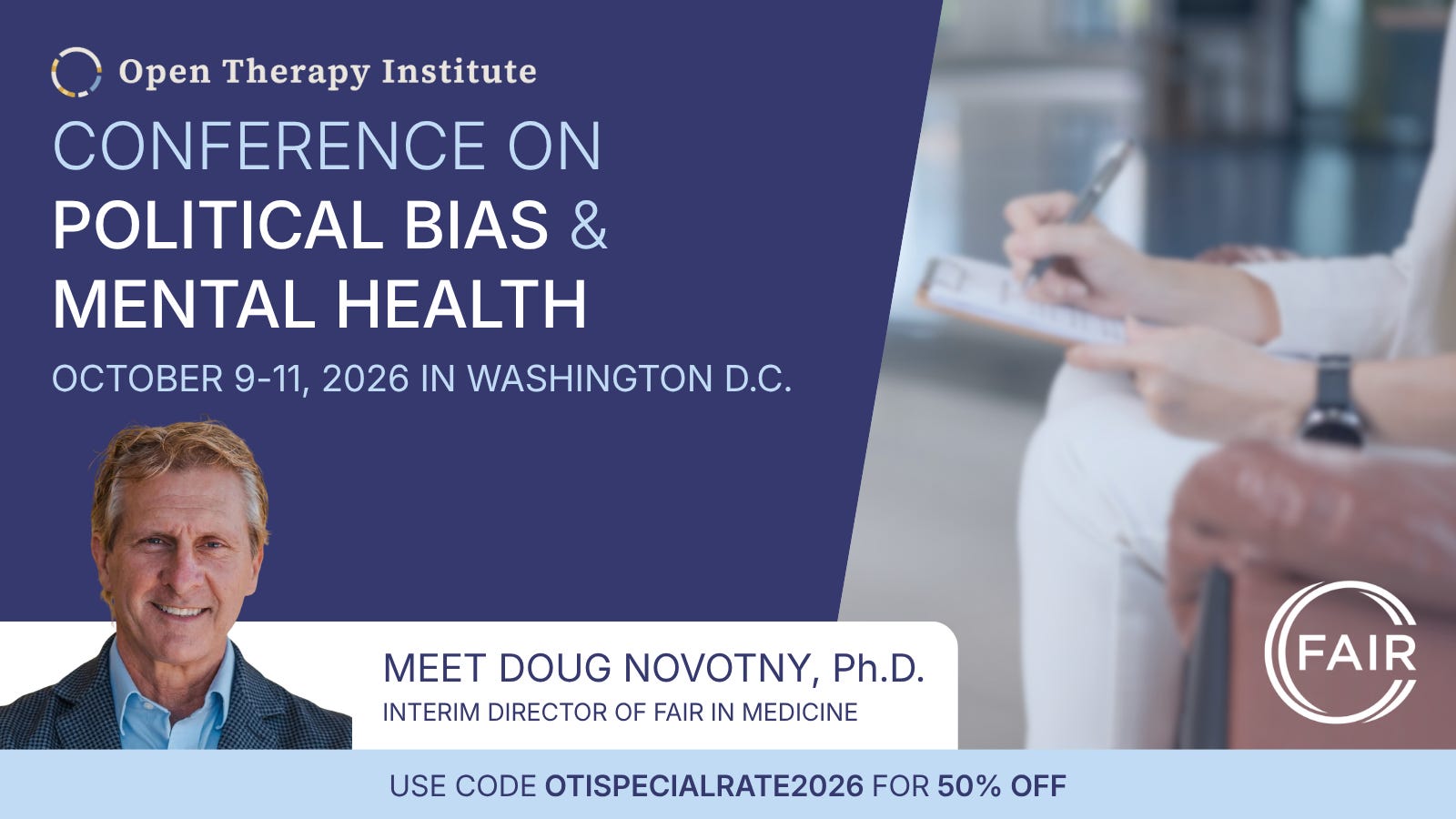
FAIR members are invited to join the Open Therapy Institute‘s Conference on Political Bias and Mental Health, October 9–11, in Washington, DC.
The program features a live podcast recording with Rob Henderson and Erica Komisar, a panel with Sally Satel, and more. 9.25 CE credits available.
Use code OTISPECIALRATE2026 for 50% off. Register here.
We hope to see you in DC!

Note to readers: We have paused the FAIR News podcast. If you prefer listening, rather than reading these newsletters, an audio version is available directly on the Substack app. Thank you for tuning in!
The link to the 7 sessions of the Educator's Alliance is missing?