


Dear Friends of FAIR,
FAIR has submitted a comprehensive comment letter to the Federal Communications Commission (FCC) supporting its investigation into The Walt Disney Company for potential unlawful employment discrimination practices related to diversity, equity, and inclusion (DEI) programs.
In March, the FCC opened a public docket following evidence that Disney has systematically prioritized demographic characteristics over individual merit in hiring, promotion, and content decisions. FAIR argues that Disney’s practices violate both federal civil rights law and the FCC’s public interest standards for broadcast licensees.
FAIR’s letter addresses two interconnected problems. First, Disney’s explicit racial and gender targeting in recruitment, measurable demographic quotas in hiring and promotion, and performance evaluations tied to “diversity metrics” constitute unlawful employment discrimination. The Supreme Court’s recent decision in Students for Fair Admissions v. Harvard made clear that using race as a factor in decision-making, even with good intentions, violates equal protection principles.
The individuals harmed are clear: those denied opportunities because they don’t fit demographic targets, and those hired partly on the basis of race or sex rather than qualifications. But the harm extends beyond individual employees. When advancement is conditioned partly on demographic representation, the workplace message is inescapable: merit is secondary to identity.
Second, and equally important, Disney’s DEI infrastructure threatens editorial independence. The FCC has long recognized that broadcast licenses carry a “public trustee” obligation. Licensees must serve the public interest, which includes ensuring that a broad spectrum of viewpoints is represented in news, entertainment, and children’s programming.
When hiring, promotion, and content decisions are filtered through DEI metrics, an ideological test replaces editorial judgment. Producers, writers, and on-air talent are selected not solely based on talent and vision, but in part on demographic alignment and ideological conformity with the company’s stated commitments. The result is narrower, not broader, viewpoint diversity, particularly around issues of identity, equity, and race.
FAIR’s filing argues that this isn’t simply an internal corporate matter. Disney holds broadcast licenses for ABC and affiliated stations granted by the FCC in trust for the public. Those licenses require compliance with federal civil rights law and service in the public interest.
If the FCC investigation finds violations, the consequences can and should extend beyond Disney. FAIR’s filing calls on the FCC to use this investigation as a clear signal to all broadcasters that employment discrimination and ideological conformity, even when framed as diversity and inclusion, will be subject to enforcement action.
When large corporations condition employment on demographic conformity and use that conformity to shape what millions of Americans see and hear, they narrow the marketplace of ideas and institutionalize orthodoxy while claiming to advance inclusion.
FAIR has always believed that civil rights law protects everyone — not as a function of demographic category, but as a matter of principle. That principle is now being tested in the FCC docket. The Commission’s response will signal whether equal protection means what it says, and whether viewpoint diversity is something the FCC actually intends to protect.
Holding major institutions accountable to equal protection law requires resources — legal expertise, strategic filing, sustained pressure. If you share FAIR’s commitment to equal protection for all, please consider making a gift today to help us sustain this fight.
With gratitude,
Monica Harris
Executive Director, FAIR
Subscribe now to receive FAIR News weekly in your Inbox

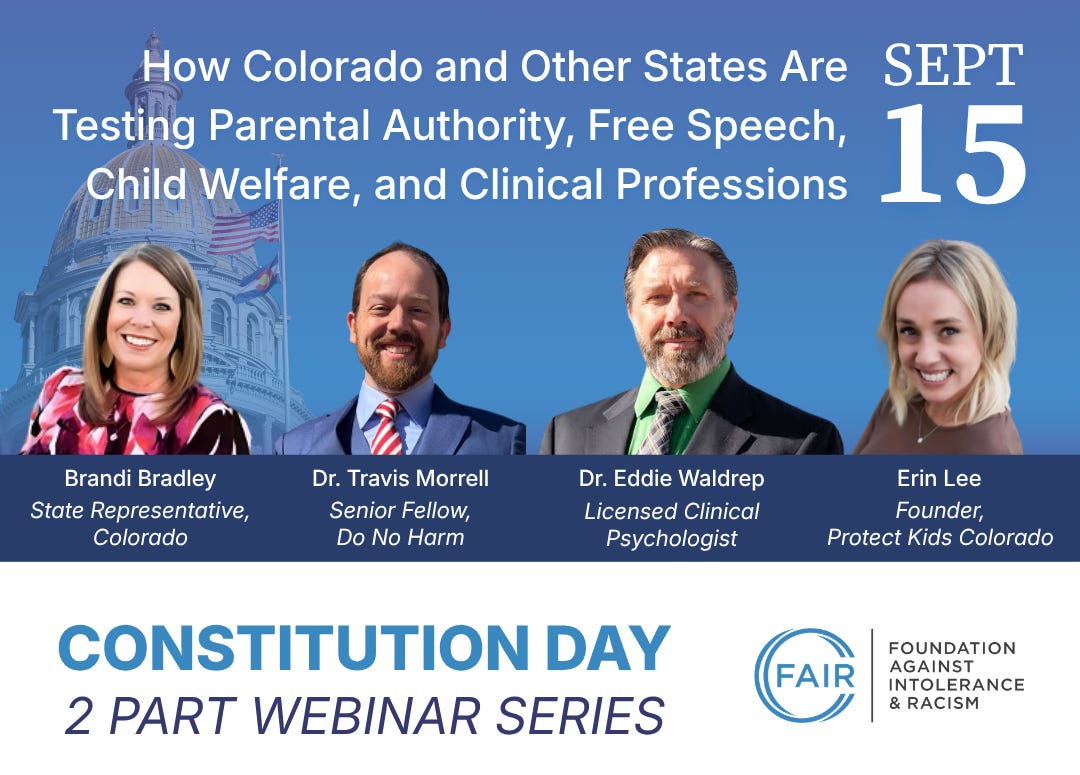
How Colorado and Other States Are Testing Parental Authority, Free Speech, Child Welfare, and Clinical Professions
This will be the first in a two part series intended to highlight new laws that breach our Constitutional rights. Colorado has passed a series of laws that many parents, clinicians, and citizens believe undermine parental authority, chill free speech, place children at risk, and degrade the mental health and medical professions. In this first webinar of the Constitutional Rights Series, four leaders on the front lines will examine how these policies are playing out in real time—and what is at stake for families and free expression.
Featured speakers:
State Representative Brandi Bradley will discuss the steady erosion of parental rights in Colorado and the legislation she has championed to restore them.
Dr. Travis Morrell, Senior Fellow at Do No Harm, sees first-hand how bad medicine morphs into laws that impinge on civil rights.
Dr. Eddie Waldrep, clinical psychologist, will address how therapists are increasingly pressured into self-censorship and why the practice of therapy itself is at risk.
Erin Lee, co-founder of Protect Kids Colorado, will outline three ballot initiatives appearing before Colorado voters this November that offer a direct opportunity to strengthen protections for children’s well-being.
Join us for a clear-eyed look at the legislative landscape and the concrete paths still available to defend the rights of all Coloradans and Americans as we use one state as a case study of what to do when the state and federal laws conflict with each other.
Date: September 15, 2026
Time: 7:00 EST
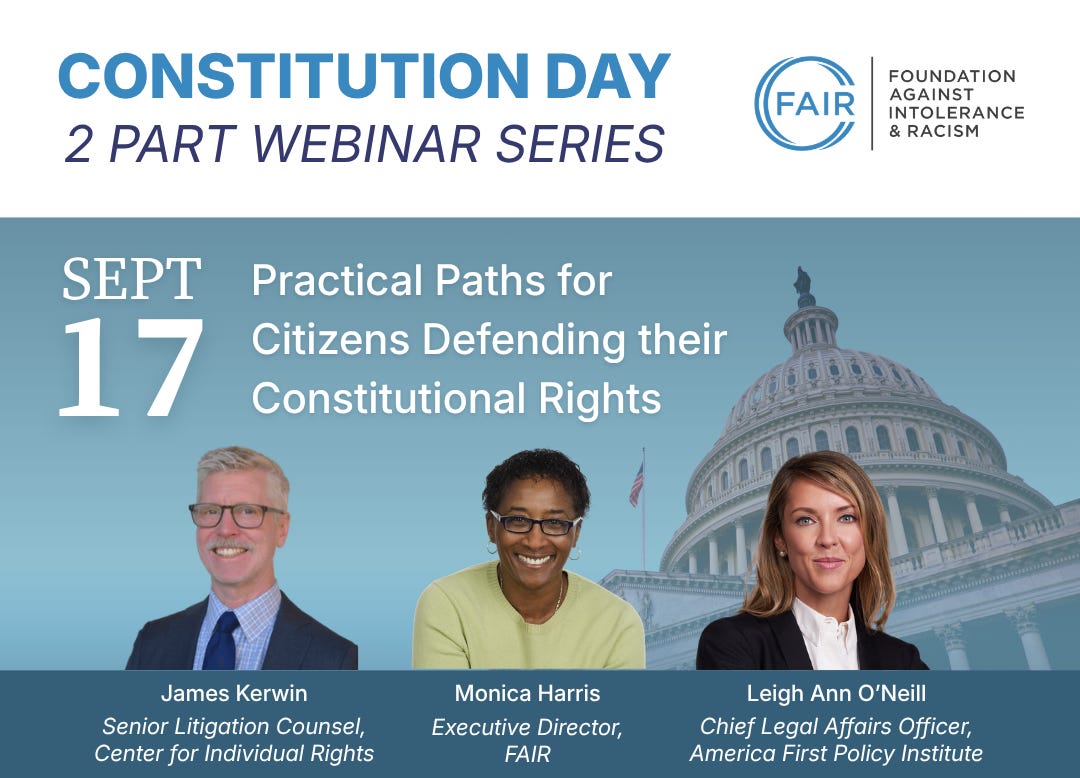
Practical Paths for Citizens Defending their Constitutional Rights
When state statutes clash with the U.S. Constitution and federal law, ordinary citizens are left asking a practical question: What can we actually do? This second webinar in the Constitutional Rights Series moves from diagnosis to action, examining both the legal roots of the problem and the lawful tools available to protect individual rights.
Featured speakers:
James Kerwin of the Center for Individual Rights will explain how Colorado’s Anti-Discrimination Act has become the legal foundation for recent laws that elevate group identity over individual rights and free speech.
Leigh Ann O’Neill of America First Policy Institute will walk through concrete, practical steps citizens can take to safeguard their constitutional protections when state policy conflicts with higher law.
Monica Harris
This session is designed for parents, professionals, and engaged Coloradans and all Americans who want clarity on the legal terrain and realistic next steps for defending their rights.
Date: September 17, 2026
Time: 7:00 EST
FAIR in Conversation is Back!
Is Woke Dead… or Just on Pause?
Have we actually turned the corner and are now walking away from Woke policies? What about Critical Race Theory – is it already so institutionalized that we don’t recognize it?
DEI offices are closing. Corporations seem to be abandoning once-mandated initiatives. Universities are retreating from some of their most controversial policies.
It’s hard to believe that a sweeping political movement built on strong, activist ideas would simply vanish overnight, and that Woke-ism, CRT and DEI have suddenly lost their popularity and influence. So, is it true that Woke-ism is over? Or is it possible that the Woke agenda has become less visible while quietly building strength and devising new tactics to reshape our institutions and culture?
This month’s FAIR In Conversation will look beyond headlines and political talking points to examine what has actually changed, and what hasn’t.
Join us for a thoughtful, evidence-based discussion as we ask the questions many are wondering, but few have carefully examined.
Sessions will run monthly through September 23rd. We hope you’ll join us!

Note to readers: We have paused the FAIR News podcast. If you prefer listening, rather than reading these newsletters, an audio version is available directly on the Substack app. Thank you for tuning in!
Would it make a difference if the same hiring decisions were made for marketing reasons? Trying to reach a particular market may require or prosper best through hiring members of that market. I can see Disney legitimately using that defense.
yes. but DEI isn't always the devil because it seems it is blamed for a lot... as it itself blames a lot. Where's the facts? DEI makes bold claims. are the critics addressing or grifting?
and the FCC... well. they've been shutting people up as well. as per trump and project 2025's anti free speech designs.