

Dear Friends of FAIR,
Every August, parents around the country wrestle with the same question: “I read something in my child’s handbook that doesn’t seem right. What am I supposed to do about it?”
Parents have the instinct that something doesn’t feel right, but they often lack the language that helps them articulate their concerns or the confidence that expressing them is worth the trouble.
FAIR has the language, and it’s yours to use.
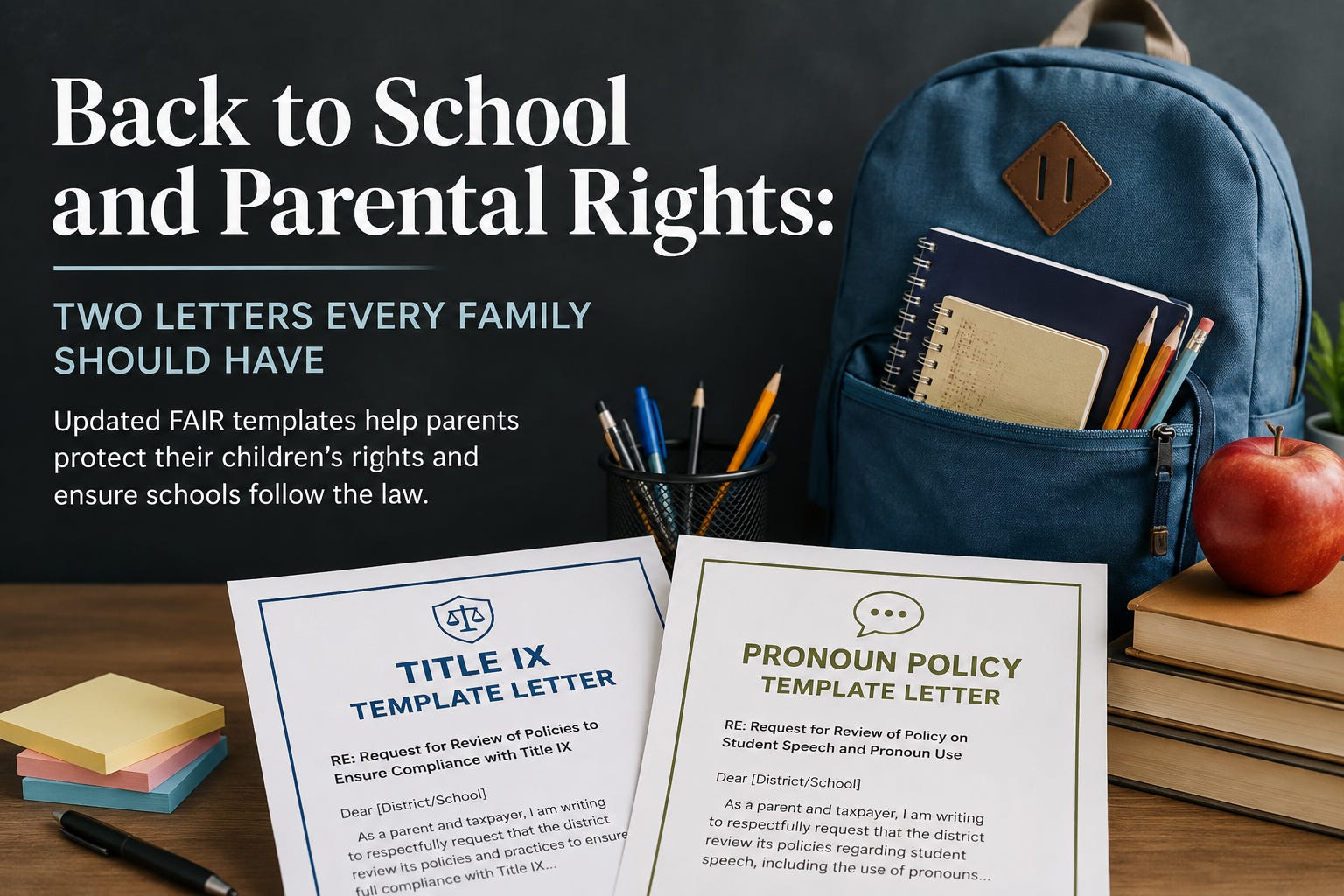
As families gear up for the 2026–27 school year, we’ve updated two of our most-requested templates. Both are grounded in current federal law, and both are written to be sent by an ordinary parent, not a lawyer.
The legal landscape has changed, yet many districts have not kept pace.
In 2024, the Department of Education issued a Title IX Final Rule expanding the statute beyond sex to include gender identity. On January 9, 2025, a federal court vacated that rule in State of Tennessee v. Cardona. As a result, no rule expanding Title IX to gender identity is legally enforceable anywhere in the country today. The Department’s Office for Civil Rights has been explicit that Title IX’s requirements control, regardless of state law or athletic association rules.
The Department has also demonstrated that it will enforce the restored framework directly. Its case against Jefferson County Public Schools, Colorado’s second-largest district, escalated from a finding of violation to a formal warning to enforcement action. In July, the district sued the Department rather than revise its policies.
Our template asks districts to proactively review their policies on restrooms, locker rooms, overnight accommodations, and athletics. Districts with the foresight to adjust their policies now can maintain control over how and when they communicate with families. Districts that wait for a complaint risk facing a ten-day compliance order and public backlash in the middle of a crisis.
You can download the template here.
On November 6, 2025, the full Sixth Circuit, sitting en banc, ruled in Defending Education v. Olentangy Local School District that a public school district could not discipline students for declining to use a classmate’s preferred pronouns. The court held the policy amounted to viewpoint discrimination and compelled speech under the First Amendment, finding no evidence the speech would materially disrupt the classroom.
The ruling follows a line running back to West Virginia State Board of Education v. Barnette, where in 1943 the Supreme Court held that schoolchildren could not be forced to salute the flag. As Justice Jackson wrote: “If there is any fixed star in our constitutional constellation, it is that no official, high or petty, can prescribe what shall be orthodox.”
Our letter, available for download here, guides a district through the Olentangy ruling and asks it to review any policy that compels pronoun use, whether directly or through the threat of discipline under an anti-harassment rule.
These templates are fully editable and allow you to:
Raise a specific concern in writing, with the case law already cited for you
Ask your district to act on its own schedule, rather than under federal pressure
Create a written record in case you ever need one
All you need to do is add your district’s name, list the policies that concern you, sign the letter, and cc the school board.
To be clear, these templates do not ask schools to be unkind to any student, nor do they demand that any child be excluded, ignored, or made to feel unsafe. Every student deserves dignity, and a school that cannot extend that to all of its students has failed at something more fundamental than policy.
These letters present a straightforward request that should be uncontroversial: public schools must follow federal law and ensure that no student is compelled to affirm a belief they do not hold. Those twin commitments protect every child in the building, including the children whom a given policy was intended to help.
In our experience, a calm, well-sourced letter from a parent who has done their own research is one of the most effective tools a family has.
Maintaining these legal resources requires time and effort. Every FAIR template is researched, drafted, and reviewed before it’s published, then revised each time a court moves the ground underneath it. We provide them because we believe a parent’s ability to advocate for their child should never depend on whether they can afford an attorney, and the families who most need these letters are rarely the families who can hire one.
If these templates are useful to you, please consider making a donation today to help us keep these resources freely available to every family who needs them.
Thank you for standing with us.
With gratitude,
Monica Harris
Executive Director, FAIR
Subscribe now to receive FAIR News weekly in your Inbox

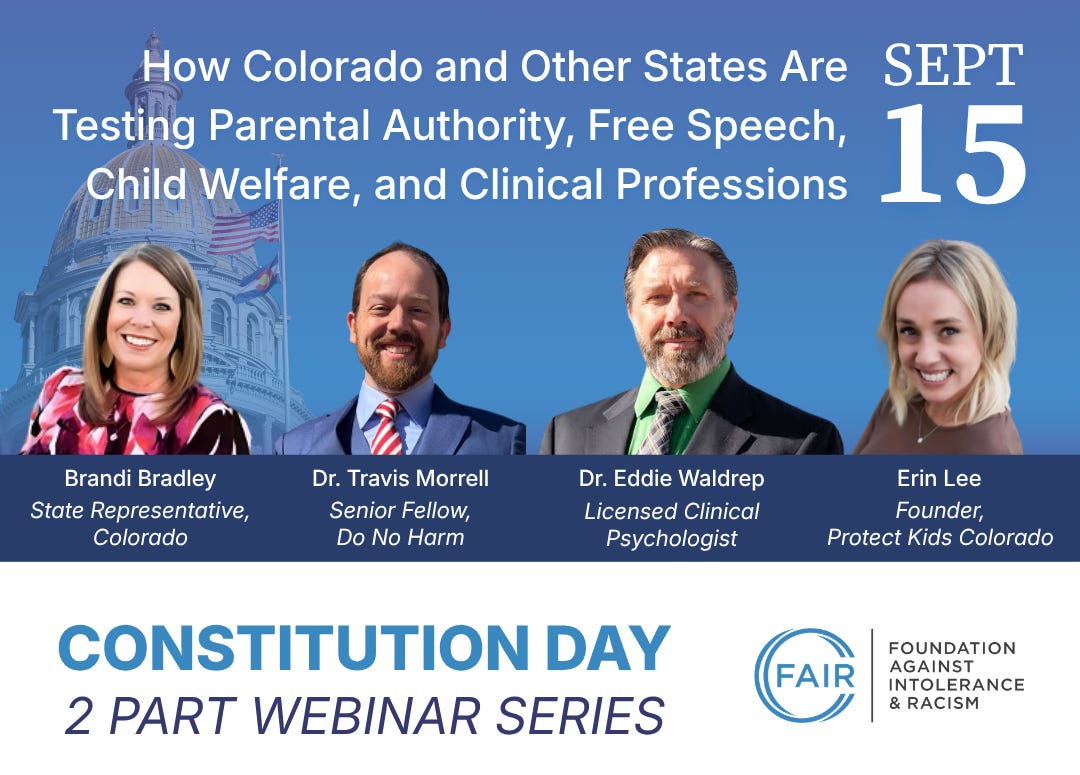
How Colorado and Other States Are Testing Parental Authority, Free Speech, Child Welfare, and Clinical Professions
This will be the first in a two part series intended to highlight new laws that breach our Constitutional rights. Colorado has passed a series of laws that many parents, clinicians, and citizens believe undermine parental authority, chill free speech, place children at risk, and degrade the mental health and medical professions. In this first webinar of the Constitutional Rights Series, four leaders on the front lines will examine how these policies are playing out in real time—and what is at stake for families and free expression.
Featured speakers:
State Representative Brandi Bradley will discuss the steady erosion of parental rights in Colorado and the legislation she has championed to restore them.
Dr. Travis Morrell, Senior Fellow at Do No Harm, sees first-hand how bad medicine morphs into laws that impinge on civil rights.
Dr. Eddie Waldrep, clinical psychologist, will address how therapists are increasingly pressured into self-censorship and why the practice of therapy itself is at risk.
Erin Lee, co-founder of Protect Kids Colorado, will outline three ballot initiatives appearing before Colorado voters this November that offer a direct opportunity to strengthen protections for children’s well-being.
Join us for a clear-eyed look at the legislative landscape and the concrete paths still available to defend the rights of all Coloradans and Americans as we use one state as a case study of what to do when the state and federal laws conflict with each other.
Date: September 15, 2026
Time: 7:00 EST
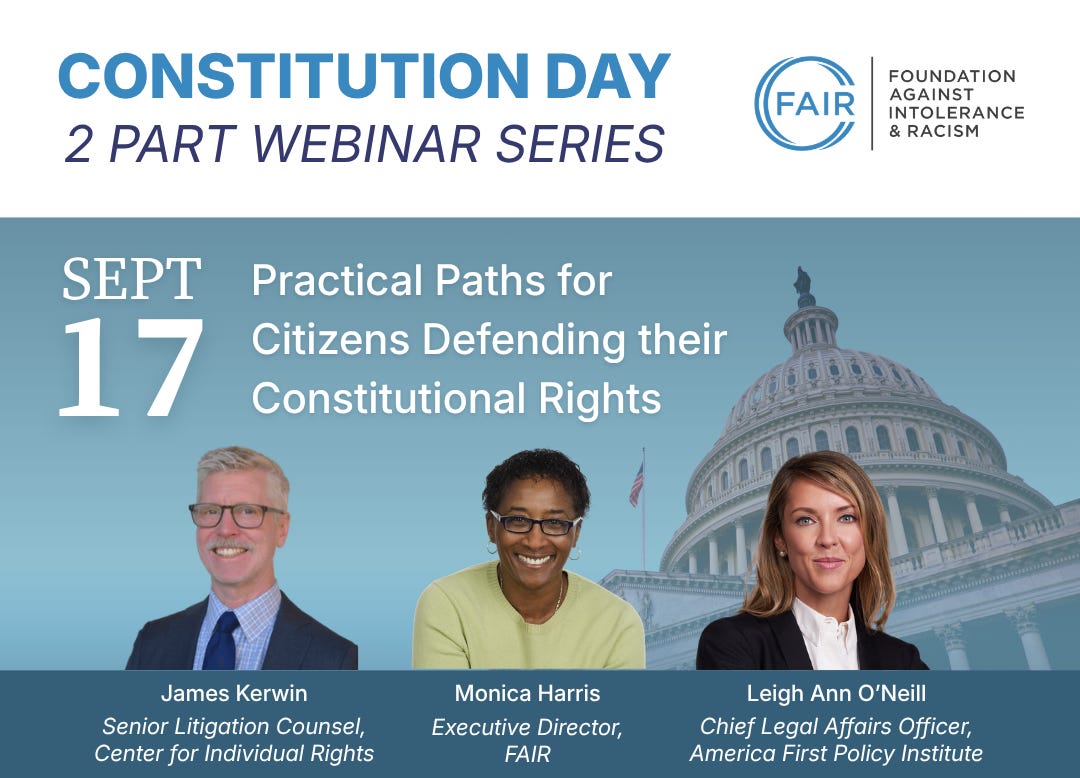
Practical Paths for Citizens Defending their Constitutional Rights
When state statutes clash with the U.S. Constitution and federal law, ordinary citizens are left asking a practical question: What can we actually do? This second webinar in the Constitutional Rights Series moves from diagnosis to action, examining both the legal roots of the problem and the lawful tools available to protect individual rights.
Featured speakers:
James Kerwin of the Center for Individual Rights will explain how Colorado’s Anti-Discrimination Act has become the legal foundation for recent laws that elevate group identity over individual rights and free speech.
Leigh Ann O’Neill of America First Policy Institute will walk through concrete, practical steps citizens can take to safeguard their constitutional protections when state policy conflicts with higher law.
Monica Harris
This session is designed for parents, professionals, and engaged Coloradans and all Americans who want clarity on the legal terrain and realistic next steps for defending their rights.
Date: September 17, 2026
Time: 7:00 EST
FAIR in Conversation is Back!
What is the difference between the isms? Socialism, Capitalism, Fascism, Communism…
The United States was founded on a constitutional system that places individual liberty, limited government, and the rule of law at its center. Yet throughout history, competing political philosophies, including socialism and communism, have offered very different answers to fundamental questions about the relationship between the individual, the state, property, equality, and freedom.
How different are these competing visions? Can they coexist within America’s constitutional framework? And what do we actually mean when we use labels like communism, socialism, capitalism, fascism, and democracy?
Whether you believe communism represents a growing influence in American life, think the concern is overstated, or simply want a deeper understanding of the issues, this conversation is designed to encourage thoughtful discussion rather than partisan talking points.
Sessions will be virtual, open to all FAIR members, and designed to be as accessible as they are substantive. You don’t need to have read anything in advance. Just bring your curiosity, your willingness to listen, and your commitment to engage in good faith.
. Sessions will run monthly through September 23rd. We hope you’ll join us!

Note to readers: We have paused the FAIR News podcast. If you prefer listening, rather than reading these newsletters, an audio version is available directly on the Substack app. Thank you for tuning in!